Amsterdam Jewish neighborhood Site Home - What's New? -Feedback - About Jack- Travel/Art Links

Amsterdam
|
Amsterdam Jewish neighborhood Site Home - What's New? -Feedback - About Jack- Travel/Art Links |
|
|
|
Amsterdam |
|
Amsterdam-Portuguese synagogue- Jewish Museum |
|||||||||
|
Jewish area-Jewish history-Nieuwmarkt
Jewish area-Zuiderkerk-Diamond history
Jewish area- Rembrandt
Jewish
Portuguese
|
|||||||||
On Mr. Vissersplein, in the centre of the square, is the splendid Portugees Israelitische Synagoge (Portuguese synagogue). Built in 1675, it survived WWII and was then restored in the 1950’s. Its interior, with a lofty barrel-vaulted roof, was intended by its architect, Elias Bouman, to echo that of the Tempe of Solomon. The huge space is lit by scores of arched windows and original 17th century brass chandeliers. Nothing has changed since centuries. Notice the monumental “hechal” (nook where the Torah is stored), An exemplary of “Saint History” by Manassé ben Israel, illustrated by Rembrandt who was his friend.
But did you
know that anecdote why it is called Portuguese synagogue? In 1492 Jews had to
flee inquisition from Spain. They thought they would be secure in Portugal, but,
bad luck, they were compelled to convert. Hundred years later, some of their
descendants, wanting to live as Jews, looked for shelter in Amsterdam, known for
its tolerance. Bad luck again!! The Netherlands were at war with Spain! So the
Jews preferred to say they were from Portuguese origin. Got the picture?
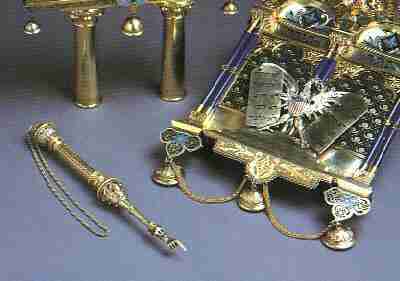
Within, religious objects
and artworks include the marvellous marble ark of the Great Synagogue, elaborate
silverware, gorgeously embroidered prayer shawls. All is very bright thanks to
large glass-cases. Upstairs, an exhibition outlines the role played by the
Jewish community in the development of Amsterdam’s trade and industry. A
grimmer note is struck by the exhibition downstairs, showing false
identification papers and ration cards used in the struggle to evade capture by
the nazis. |
|||||||||
 Sephardim got not along so good, hence they demanded separate places of
worship). Less fortunate than the Portuguese synagogue, they were burnt and
looted by the German philanthropists.
Sephardim got not along so good, hence they demanded separate places of
worship). Less fortunate than the Portuguese synagogue, they were burnt and
looted by the German philanthropists.