|
Toulon
introduction
Toulon, more
in detail
|
From Hyeres to TOULON, take the D 559, passing LE
PRADET, a typical and charming coastal village. Countless savage creeks alternating with fine sand beaches and a typical southern small port.
But TOULON is our destination. 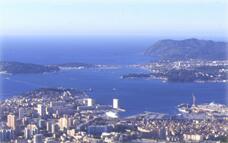
Arriving in this city, wit mostly high rising immigrant flats, we could wonder if there is much difference of what the first impression is when you arrive in Marseille. TOULON (167,000 citizens), resembles Marseille, with its struggle against unemployment, workless north Africans, crime and drug trade, and a city planning after the war that can be named by its name: criminal.
 |
|
Old Toulon |
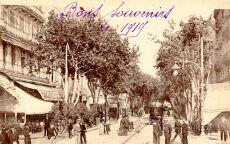
It is interesting to see how city council tries to repair the mistakes of its predecessors, by giving the old centre of Toulon a bit of its ancient character. Fetid little alleyways and chaotic urban sprawl offer little enticement but visit without a guide is to recommend in his attractive old core, the main reason being you will see almost no tourists, since they all bypass it.
As a car driver, be prepared for hell! Roads are joining in the city without any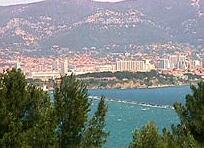 logic and the current traffic is a constant jam. Clustered around a deep natural harbour and enclosed by the 500 m high and grey Mont Faron, a mountain with a museum dedicated to the allied landings in August 1944. logic and the current traffic is a constant jam. Clustered around a deep natural harbour and enclosed by the 500 m high and grey Mont Faron, a mountain with a museum dedicated to the allied landings in August 1944.
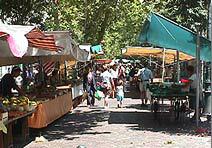 Toulon is France's leading naval base and has its own share of grand buildings, chic boutiques, lively fish markets and a sense of cosmopolitan energy matched only by Marseille.
A strange thing is that the Greek never appeared in Toulon's history. The history starts only in the 15th century when Louis II from Anjou chooses the place in 1404 as a base for his expeditions against the kingdom of Naples. Under Henri IV it became a big naval military port, continued by Richelieu. Vauban designed later what Toulon is today as a fortified port. It had a also a bad reputation since this was the departure harbour of all the condemned criminals (?) sent to the French Antilles (like Jean Valjean from Les Miserables).
WWII is the sad end of the French fleet when Hitler invaded in November 1942 the zone libre (south of France) as a response to the attacks of the allies in North Africa, the French themselves sinks the French fleet in Toulon.
The large and long boulevard de Strasbourg starting at the place de la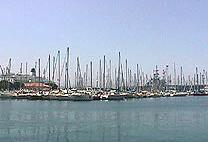 Liberté, a large square with fountain and statue of liberty, separates the modern northern part and the southern, older part with the harbour. South of the place Victor Hugo, lies the seamier side of the city, a warren of narrow streets leading to the old port (darse vieille) has quite a insalubrious bars that rub shoulders with dingy restaurants that dispense the Toulon version of bouillabaisse (made with potatoes) and north African specialities. At the avenue de la Republique where the modern city hall is built amid old houses, it is agreeable to stroll to the old harbour. Liberté, a large square with fountain and statue of liberty, separates the modern northern part and the southern, older part with the harbour. South of the place Victor Hugo, lies the seamier side of the city, a warren of narrow streets leading to the old port (darse vieille) has quite a insalubrious bars that rub shoulders with dingy restaurants that dispense the Toulon version of bouillabaisse (made with potatoes) and north African specialities. At the avenue de la Republique where the modern city hall is built amid old houses, it is agreeable to stroll to the old harbour.
More about the harbour and more about Toulon in next article.
Bibliography
John Pemble, "the Mediterranean Passion, Victorians and Edwardians in the South", (Oxford University Press 1988), Mary Blume, "Cote d'Azur. Inventing the French Riviera" (Thames and Hudson, London 1982), The Twenties, From Notebooks and Diaries of the Period, by Edmund Wilson (Cannes 1921),"Les Sciences et Arts chez les Religieux de Toulon et de Marseille, by Froeschlé, Michel( Revue d'Histoire de l'Englise de France),"The devils of Toulon : demonic possession and religious politics in eighteenth-century Provence",
by B. Robert Kreiser
|
Back to Toulon contents
Back
to Cote d'Azur main page
|