|
Toulon
introduction
Toulon, more
in detail
|
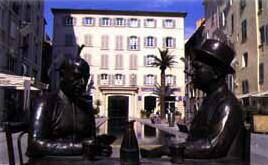 As I said, Toulon can have a certain charm if you forget the hideous urbanization, which was set up after WWII. All around the rue d'Alger, the oldest part stretches up to cours Lafayette. This is the basse ville, not at all sleaze with small attractive squares like the place Puget, place des Trois dauphins and place Camille Ledeau). They draw elegant locals and some lost tourist to their designer shops and shady cafes. Superb fish and, vegetable and flower markets characterise mornings in this cours Lafayette. On the place de la Cathedrale, the cathedral stands in full glory. Ste Marie de la Seds, going back to the 11th century. The nave is plain gothic and the façade was redone in the 17th century. As I said, Toulon can have a certain charm if you forget the hideous urbanization, which was set up after WWII. All around the rue d'Alger, the oldest part stretches up to cours Lafayette. This is the basse ville, not at all sleaze with small attractive squares like the place Puget, place des Trois dauphins and place Camille Ledeau). They draw elegant locals and some lost tourist to their designer shops and shady cafes. Superb fish and, vegetable and flower markets characterise mornings in this cours Lafayette. On the place de la Cathedrale, the cathedral stands in full glory. Ste Marie de la Seds, going back to the 11th century. The nave is plain gothic and the façade was redone in the 17th century.
Left from the cours Lafayette you arrive at the MUSEE DU VIEUX TOULON, with the history of the city and evocative, writhing figures of Puget's sculpted atlantes, now affixed to the front wall of city hall.
In your loitering you might encounter at the angle of the avenue de la Republique and the cours Lafayette, the EGLISE SAINT FRANCOIS DE PAULE, with a beautiful baroque façade.
Finally, the patchwork streets lead inexorably to wards Toulon's life tube : the port. The French war fleet anchored here during the 17th and 18th century. Galleys had not only sails but also oars lying at the back of the ships. Criminals and ordinary people, persecuted because of their ideas or beliefs, served as galleyslaves.
 Historically, Toulon's era of major expansions a port occurred during the 17th century, though Historically, Toulon's era of major expansions a port occurred during the 17th century, though it was a base fro the royal navy as early as 1487 but under Louis XIV, the arsenal was expanded and the city's fortifications enlarged. A century later, the city unwisely took the side of the English against the Revolutionary government and was promptly to heel by a very young officer, named Napoleon Bounaparte. it was a base fro the royal navy as early as 1487 but under Louis XIV, the arsenal was expanded and the city's fortifications enlarged. A century later, the city unwisely took the side of the English against the Revolutionary government and was promptly to heel by a very young officer, named Napoleon Bounaparte.
You can also visit the MUSEE NAVAL, a comprehensive museum wit giant maquettes, sail ships, pictures, engravings and colonial souvenirs.
For an excellent overall look, take the cable car ride to the top of the Mont Faron, you will have a terrific birds eye view of Toulon.
More on Toulon and the Cote d'Azur on my web site.
Bibliography
Mary Blume, "Cote d'Azur. Inventing the French Riviera" (Thames and Hudson, London 1982), The Twenties, From Notebooks and Diaries of the Period, by Edmund Wilson (Cannes 1921),"Les Sciences et Arts chez les Religieux de Toulon et de Marseille, by Froeschlé, Michel( Revue d'Histoire de l'Englise de France),"The devils of Toulon : demonic possession and religious politics in eighteenth-century Provence by B. Robert Kreiser
|
Back to Toulon contents
Back
to Cote d'Azur main page
|