|
 Leave Moustiers along a busy
route (in the summer) towards the GRAND CANYON DU VERDON also called LES GORGES
DU VERDON. You have two possibilities, when a fork in the road lass than 3 km
will offer you a choice. One via the D 952, shortest connection to Castellane
and the longer via D 957, D 19 and D 71, heading south skirting the spectacular
man-made Lac de Sainte-Croix, a 11 km stretch of perfect azure water created in
1970 by the installation of a hydroelectric dam. The southern route doglegs east
to follow the southern ridge of the canyon, known as THE CORNICHE SUBLIME. The
other route towards Castellane snakes along the northern ridge, veering away
from the canyon edge around halfway along its length. . Undoubtedly the Corniche
Sublime has the better views on the unendless deep valley that the Verdon eroded
in these calcareous mountains. The best view is from the PONT DE L’ARTUBUY on
the famous BALCONS DE LA MESCLA. The left bank has its own impressive belvedere,
the POINT SUBLIME, a dizzy 180 m above the river Leave Moustiers along a busy
route (in the summer) towards the GRAND CANYON DU VERDON also called LES GORGES
DU VERDON. You have two possibilities, when a fork in the road lass than 3 km
will offer you a choice. One via the D 952, shortest connection to Castellane
and the longer via D 957, D 19 and D 71, heading south skirting the spectacular
man-made Lac de Sainte-Croix, a 11 km stretch of perfect azure water created in
1970 by the installation of a hydroelectric dam. The southern route doglegs east
to follow the southern ridge of the canyon, known as THE CORNICHE SUBLIME. The
other route towards Castellane snakes along the northern ridge, veering away
from the canyon edge around halfway along its length. . Undoubtedly the Corniche
Sublime has the better views on the unendless deep valley that the Verdon eroded
in these calcareous mountains. The best view is from the PONT DE L’ARTUBUY on
the famous BALCONS DE LA MESCLA. The left bank has its own impressive belvedere,
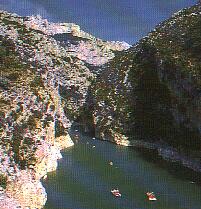
the POINT SUBLIME, a dizzy 180 m above the river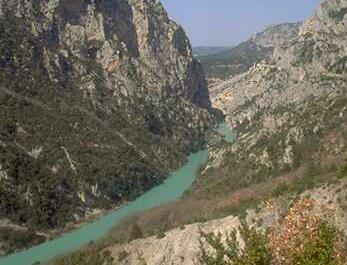 . .
Without pretending that the gorges du Verdon are comparable to the Grand Canyon in Colorado, these gorges are one of the most impressive in Europe. It is like
somebody used a big axe to notch a deep groove of 21 km long. Thirty years ago
the Verdon spouted 800 cubic meter water per second at his highest levels. Today,
two dams reduced this to 8 cubic meter a second giving us the opportunity to
access the bottom of the canyon. Vertiginous limestone cliffs crushing you with
their 300 to 600 m height, gouged by the waters of the Verdon river, in turn
glassy and crystalline or tumbling in white water chaos, chaotic rock
formations, wild river banks, etc..Colours are unreal: jewelled emerald and
turquoise contrasts in autumn with the ochres and russets of surrounding
deciduous trees. It’s a hikers paradise!! If any 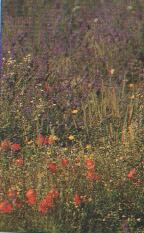 extraction of minerals and
fossils is strictly forbidden, fishing is permitted…in the legal boundaries of
course. Trouts, carps, pikes and a
lot of others. Ornithologists will enjoy the view of a few dozens of species,
while the flora amateurs will discover panels indicating the trees, bushes,
aromatic plants and more. extraction of minerals and
fossils is strictly forbidden, fishing is permitted…in the legal boundaries of
course. Trouts, carps, pikes and a
lot of others. Ornithologists will enjoy the view of a few dozens of species,
while the flora amateurs will discover panels indicating the trees, bushes,
aromatic plants and more.
But the Verdon is also the discovery of perched villages, gallo-roman ruins,
churches and local patrimony.
It is interesting to know that the Verdon was only really discovered in 1905 by
three men, of which Edouard Alfred Martel, also called “the father of
speleology”.. They explored the whole Canyon of which we can find today the
itineraries in all possible guidebooks.
Let’s not forget that this is not a
Sunday promenade but a risky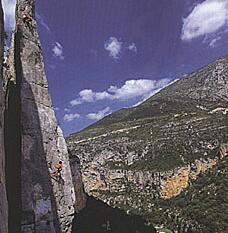 enterprise. Not only the weather forecast have to
be god but be also aware of the warnings by the Chaudanne and Castillon dams
when they prepare water transfers or cleaning. In the deep of the canyon there
is a constant semi-darkness and you walk though tunnels, chasms, grottos and
rapids.
enterprise. Not only the weather forecast have to
be god but be also aware of the warnings by the Chaudanne and Castillon dams
when they prepare water transfers or cleaning. In the deep of the canyon there
is a constant semi-darkness and you walk though tunnels, chasms, grottos and
rapids.
But all this remains “terra incognita” for the car driver on the D 952 and D
19 and D 71, unfortunately jammed during summer months. Tourism has now moved in
wholesale, and those in the know make strenuous efforts to avoid the area
completely during the month of August.
About the oppressive crowds in the summer, car queues and over commercialisation
I will write in next essay. But also more agreeable info about the gorges du
Verdon.
Bibliography
A
guide to Provence, by Michael Jacobs (Viking, London 1988), "Guide de la
Provence mysterieuse" and "Provence Antique"by Jean-Paul Clebert
(Ed.Sand, 1986 “Aspects of Provence, by Pope-Henessy James (Penguin Travel
1988), Guides du Routard, (1999) –« Towns in Provence », by
M.F.KFischer (New-York-Vintage books 1983), « Regain » by Jean
Giono, « Hannibal’s footsteps » by Bernard Levin (Sceptre
paperback 1987)
|