|
 We
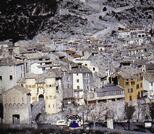
leave ANNOT taking the N 202 heading for ENTREVAUX. This is like a fairytale
town, and the 20th century recedes as if by magic. Right after my arrival, it
was We
leave ANNOT taking the N 202 heading for ENTREVAUX. This is like a fairytale
town, and the 20th century recedes as if by magic. Right after my arrival, it
was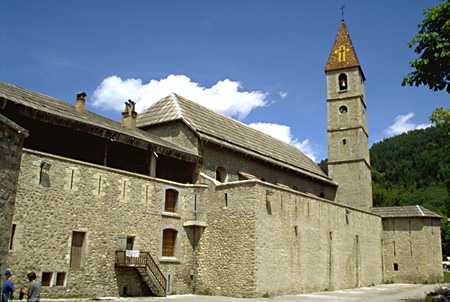 12.45, I had a lunch at Echaugette, at the corner of the small place
Saint-Martin with its plane and chestnut trees, giving me that rare moment of
deep satisfaction. The pace Saint-Martin boasts one pleasant café and a butcher
who dispenses the local speciality, the “secca” de boeuf, a type of
delicious dried salt beef eaten with lemon juice and olive oil. Reminded me of
the Swiss “viande des Grisons”.
12.45, I had a lunch at Echaugette, at the corner of the small place
Saint-Martin with its plane and chestnut trees, giving me that rare moment of
deep satisfaction. The pace Saint-Martin boasts one pleasant café and a butcher
who dispenses the local speciality, the “secca” de boeuf, a type of
delicious dried salt beef eaten with lemon juice and olive oil. Reminded me of
the Swiss “viande des Grisons”.
Entrevaux is Located on the eastern fringes of de Alpes de Haute Provence and
for centuries a frontier post defending Provence from Savoie, fighting the
numerous religious fanatics and bandit gangs, until Vauban got the order of
Louis XIV to build a fortress. It became maybe
Vauban’s most impressive work. Between 1692 and 1706 he walled the entire city
with ramparts, turrets, drawbridges and a deep moat formed by the Var river.
Even more spectacular is the chateau fort, also called the citadel, lying 135
meters higher and can be reached by an ascending path of nine zigzag ramps,
worth the 25 minutes climb. A remarkable feat of engineering that took 50 years
to complete. Beautiful panorama on the city and the Var valley. Entrevaux exudes
a history more redolent than any town in the department. Cars are firmly
relegated to the busy Nice road on the opposite bank of the river.
Entrevaux did not suffer from too much aggressive restorations. Walk, loiter and
stroll through 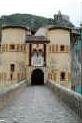 the
small, cool and sometimes steep streets with a stunning architecture. Most of
the facades are from the 17th and 18th century. Nice
esplanade on the place de la Mairie. The cathedral dates from the 17th
century and is curiously integrated in the fortifications. The interior is very
richly decorated, a baroque and classic masterpiece. At the rue Haute, you will
find the miniscule “musée de la Moto” with more than 70 machines dating
beginning 20th century and all still in working order. the
small, cool and sometimes steep streets with a stunning architecture. Most of
the facades are from the 17th and 18th century. Nice
esplanade on the place de la Mairie. The cathedral dates from the 17th
century and is curiously integrated in the fortifications. The interior is very
richly decorated, a baroque and classic masterpiece. At the rue Haute, you will
find the miniscule “musée de la Moto” with more than 70 machines dating
beginning 20th century and all still in working order.
As well as its history, Entrevaux entices with cultural and folkloric events of
16 th and 17th century music, organized by a British resident of the
town: the festival of Saint-John the Baptist, held annually on the weekend
closest to 24 June and sees locals in traditional costumes celebrating a mass,
dancing and a procession to the isolated Chapel of Saint-Jean du Desert.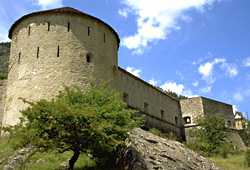
If Entrevaux seems uniquely untouched by the proximity of the Alps, COLMARS, 30
km to the north
is a fortified town crowned by two massive medieval castles, Fort de Savoie and
Fort de France. It is located at the border of the former frontier between the
royaume de France
and the House of Savoie and therefore it was completely surrounded by a defence
wall ordered by Louis XIV. The problem was indeed that there were only warriors
visiting at that time and not tourists like us!
Colmars was destroyed several times
during its history. First in 1390 by
mercenaries of the murderer Raimond de Turenne, in 1583 by the bandit Cartier (the
other one, not THE one) And in 1388 and 1713 by troops of the duke of Savoie and
soldiers of
Louis XIV. It was rebuilt each time. Notice when you approach Colmars that the
sloping roofs of wooden Alpine chalets see an universe away from the dry
stone" bories" of the Lure or low mas of the Var.
Inside the well-preserved ramparts of the town, houses are constructed with tidy
wooden balconies, known as solerets, (sun traps), locals sport jaunty Alpine
caps that would not seem out of place in Bavaria and shop windows display amber
bottles of “genepi” liqueur, made from Alpine flowers. Only the small
fountains and flowers at the balconies confirm that this is still Provence.
Sleepy in winter, Colmar’s unspoilt charm and beautiful setting make it a
popular centre for family holydays.
Bibliography
A
guide to Provence, by Michael Jacobs (Viking, London 1988), "Guide de la
Provence mysterieuse" and "Provence Antique"by Jean-Paul Clebert
(Ed.Sand, 1986 “Aspects of Provence, by Pope-Henessy James (Penguin Travel
1988), Guides du Routard, (1999) –« Towns in Provence », by
M.F.KFischer (New-York-Vintage books 1983), « Regain » by Jean
Giono, « Hannibal’s footsteps » by Bernard Levin (Sceptre
paperback 1987), “Franse Middelandse Zeekust”, by Henk Zwijnenburg (Ed.
ANWB)
|