|
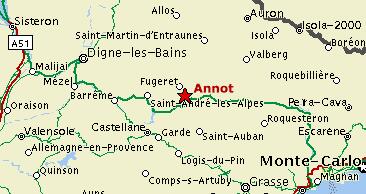
Warm Provencal and yet
markedly Alpine, that’s how you could characterize the Vaire valley where
ANNOT is located. I liked this village, fresh, offering numerous hiking
possibilities in a wonderful mountainous setting. Long before the Romans
conquered the area, Ligurians had settled here. A shaky sandstone rocky wall
formed a natural defence until the day it collapsed on the village. A new
settlement was built on top of which we see now the 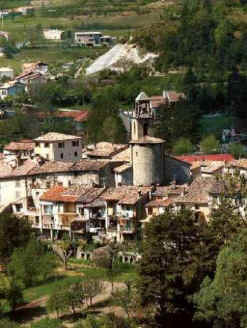 chapel
Notre-Dame. Annot developed in the 15th and 16th century chapel
Notre-Dame. Annot developed in the 15th and 16th century 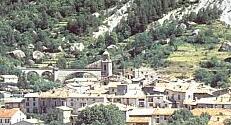 into
a lively small town. One of the 5 Provence’s courts of justice housed here and
the place was also considered by nobility as a mountain resort. A weekly market
was created attracting a lot of people, like it still is today. A textile
industry developed in the 18th century, together with tile and hat
manufactories. Lavender distilleries were not forgotten. into
a lively small town. One of the 5 Provence’s courts of justice housed here and
the place was also considered by nobility as a mountain resort. A weekly market
was created attracting a lot of people, like it still is today. A textile
industry developed in the 18th century, together with tile and hat
manufactories. Lavender distilleries were not forgotten.
Today, the old quarter of Annot is full of long gone memories: fortifications,
old bridges, and small houses in narrow streets, wrought iron balconies and
stone “lavoirs”. 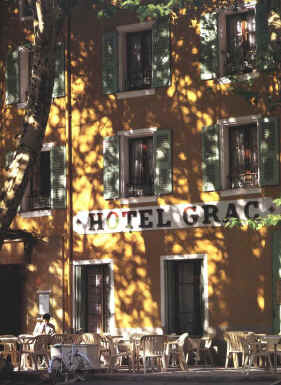 They
are as classically Provencal as anything found further south. A They
are as classically Provencal as anything found further south. A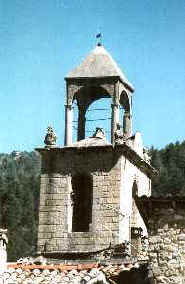 sizeable main square, planted with plane trees, leads to a steep climb. Vaulted
archways and a predominance of carved stones lintels line the tall houses on
Grand Rue. The fortified church with Roman and Gothic elements dates from the 15th
century and the bell tower is in Renaissance style.
sizeable main square, planted with plane trees, leads to a steep climb. Vaulted
archways and a predominance of carved stones lintels line the tall houses on
Grand Rue. The fortified church with Roman and Gothic elements dates from the 15th
century and the bell tower is in Renaissance style.
The majesty of the Alps leaves its mark in the pure clarity of the air and the
steely grey waters of the numerous streams that tumble through the town. In
winter, Annot sleeps under thick coverings of snow. It is the oldest populated
centre in the area but was only reachable by carriage as recently as 1830.
Access was provided by the network of mule tracks that crisscrossed the
mountainous landscape.
For years the town has attracted painters, since the area smells so heavenly in
the summer with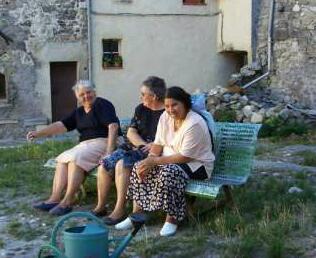 all the lavender and tile flowers. And there is no shortage of fine hotels and
restaurants, tennis courts, solar swimming pool, equestrian centre, etc….
all the lavender and tile flowers. And there is no shortage of fine hotels and
restaurants, tennis courts, solar swimming pool, equestrian centre, etc….
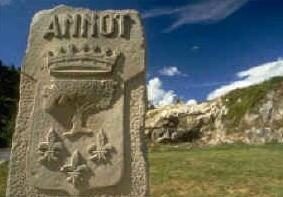 Just
outside the town to the south is a vast cluster of massive rocks scattered far
across the hillside, known as the “Grés d’Annot”, house-sized sandstone
boulders that seem to have flung to earth from the cliff behind by an angry
giant. Locals have built their homes next to them. Local legends, featuring
troglodytes and primitive religions, surround them to this day. Just
outside the town to the south is a vast cluster of massive rocks scattered far
across the hillside, known as the “Grés d’Annot”, house-sized sandstone
boulders that seem to have flung to earth from the cliff behind by an angry
giant. Locals have built their homes next to them. Local legends, featuring
troglodytes and primitive religions, surround them to this day.
Taking now the N 202 towards
the spectacular hiking trails rendezvous of nearby altitude COULOMP VALLEY. You
can follow the Coulomp river for a few miles and at the Pont de Geydan head
straight to ENTREVAUX, or make some quick detour to the typical mountain village
of MEAILLES or further north the ancient village of PEYRESQ, in ruins until 1955
when a group of Belgian students (yes!) decided to transform it into a tiny but
thriving cultural centre.
Bibliography
A
guide to Provence, by Michael Jacobs (Viking, London 1988), "Guide de la
Provence mysterieuse" and "Provence Antique"by Jean-Paul Clebert
(Ed.Sand, 1986 “Aspects of Provence, by Pope-Henessy James (Penguin Travel
1988), Guides du Routard, (1999) –« Towns in Provence », by
M.F.KFischer (New-York-Vintage books 1983), « Regain » by Jean
Giono, « Hannibal’s footsteps » by Bernard Levin (Sceptre
paperback 1987), “Franse Middelandse Zeekust”, by Henk Zwijnenburg (Ed.
ANWB)
|