|
Take the large D 900
westwards in the Ubaye valley passing LE LAUZET-UBAYE, before
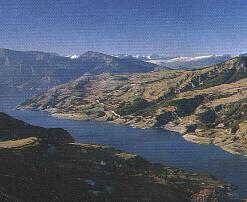
arriving at the LAC DE SERRE PONCON.
 |
|
Lac Serre-Poncon |
Follow the southern shores
of the lake, which means continuing to drive on the D 900 after the junction
with the D 954.We arrive straight on the hamlet of LES CELLIERS and LES
ESPINASSES .
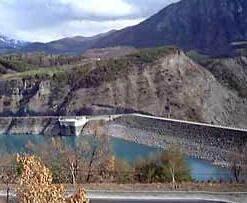
For centuries, the Durance was known one of the “three scourges of Provence”
(mistral and parliament at Aix complete the triumvirate). I recent years, its
unpredictable surges have been harnessed by a series of major dams like this
masterpiece, crushing all around with its majesty.
 |
|
Barrage Serre-Ponçon |
We have taken down our hats
in Provence for many admirable monuments, sites, cathedrals and churches, all
witnesses of the past. So should we bow in admiration for this contemporary
realisation: LE BARRAGE DE SERRE PONCON, a powerful dam which is to compare with
St.Trophime in Arles or the palais des Papes in Avignon.
Imagine a lake of 1 billion 270 million square meters, 20km long on 2,900
hectares, surrounded by peaks of 2,000 metres and closed by a dam 600 m wide and
110 meters high. The rough climate with great heats and droughts, lasting
sometimes for 9 months, the all destructing, howling, ice cold Mistral blowing
from the northwest, is a disaster for the soil here, mostly sand and calcareous.
Inexploitable without human intervention. The building of this lake and dam
started in 1960 and awakened the region out of its lethargy, also enabling the
development of touristy activities during the summer on the shores of the
Hautes-Alpes. Apple and pear orchards, created over the past 30 years on the
newly irrigated alluvial plains, have brought a refreshing vigour o the once
ailing economy hereabouts. And hydroelectric power, nicknamed by locals
”houille blanche” (white coal), has brought added prosperity to the region.
Nonetheless the Durance remains tortuous, complexed and peppered with islets.
It’s one of the few rivers in Provence that contains more than a thin trickle
of water in the summer.
To reach our next destination we will have to drive quite a long away, following
the Durance, first on the D 900, changing onto the D 942 and N 85 towards
SISTERON.
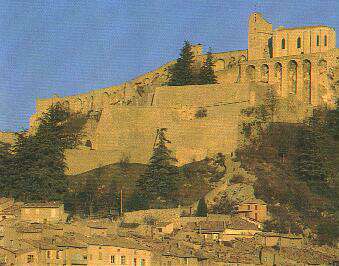 SISTERON,
the natural gateway to “smiling” Provence, funny enough, seems hardly
Provencal at all. A pretty, tidy town, with entangled roofs, a maze of small
streets dominated by a stark towering citadel, facing the rocher de la Baume.
Just to the north, the olive trees stop and, to all intents and purposes, you
say goodbye to Provence. SISTERON,
the natural gateway to “smiling” Provence, funny enough, seems hardly
Provencal at all. A pretty, tidy town, with entangled roofs, a maze of small
streets dominated by a stark towering citadel, facing the rocher de la Baume.
Just to the north, the olive trees stop and, to all intents and purposes, you
say goodbye to Provence.
A short promenade through town will lead us to the old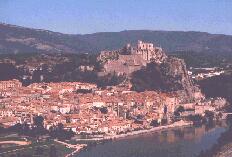 part with its tortuous streets, descending mostly steep to the river. Some
houses are said dating from the 13th century. A mixture of modern
boutiques and pleasant old-fashioned shops line the narrow streets, known here
as “andrones”. The town’s bakers sell the local speciality, “fougasse à
l’anchois”, delectable bread dough smeared with anchovies and sold by the
kilo. Butchers display justly the famous SISTERON LAMB,
part with its tortuous streets, descending mostly steep to the river. Some
houses are said dating from the 13th century. A mixture of modern
boutiques and pleasant old-fashioned shops line the narrow streets, known here
as “andrones”. The town’s bakers sell the local speciality, “fougasse à
l’anchois”, delectable bread dough smeared with anchovies and sold by the
kilo. Butchers display justly the famous SISTERON LAMB, 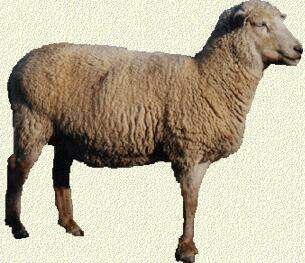 given
a fragrant herbal flavour by the wild thyme and the rosemary culled from
pastures of the upper Durance valley. given
a fragrant herbal flavour by the wild thyme and the rosemary culled from
pastures of the upper Durance valley.
The citadel was built originally in the 13th century and redesigned
by Erard (like we see it now) in the second half of the 16th. It’s
Sisteron ‘s most obvious crowd puller. As the Germans occupied it in 1945, our
own allied bombers took it as target: more than 300 people died and a quarter of
Sisteron’s fine medieval town was destroyed. You can listen to a dramatised
version of the fateful day, relayed through small speakers dotted around the
ramparts. Questionable quality of the sound effects does nothing to dim the
poignancy of the tragedy.
Imagine that for centuries, people have passed through this strategically placed
gateway, lending it a feeling of lively, if not exactly cosmopolitan, activity.
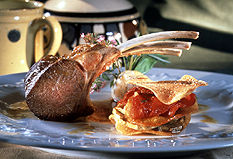 |
|
Sisteron
lamb chops |
Still standing in the rue de
la Saunerie is the now private “Bras d’Or Inn”, owned at the time by the
grandfather of the Sisteron novelist Paul Arene. Napoleon is supposed to have
lunched here on a misty March day in 1815, when returning from exile from Elba.
A bustling market, some light industry and a steady wave of tourists maintain
still some atmosphere today.
Bibliography
A
guide to Provence, by Michael Jacobs (Viking, London 1988), "Guide de la
Provence mysterieuse" and "Provence Antique"by Jean-Paul Clebert
(Ed.Sand, 1986 “Aspects of Provence, by Pope-Henessy James (Penguin Travel
1988), Guides du Routard, (1999) –« Towns in Provence », by
M.F.KFischer (New-York-Vintage books 1983), « Regain » by Jean
Giono, « Hannibal’s footsteps » by Bernard Levin (Sceptre
paperback 1987), « Les Alpes de Lumière »(Edisud, Aix en Provence)
|