|
 Alpes de Haute Provence, a
name bearer of images, odours, dreams which, outside the sea, Alpes de Haute Provence, a
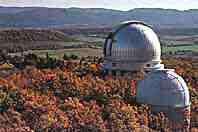
name bearer of images, odours, dreams which, outside the sea,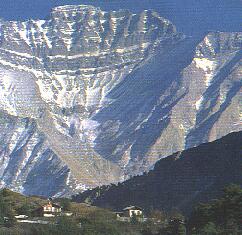 concentrate the Provencal image with a sky of incredible brightness and
unequalled transparency, the clearest of Europe according to the specialists who
installed an observatory on the plateau de Forcalquier. Of course this is due
tanks to a hard blowing wind, later blocking and dissolving in the mountain
range, but the absence of large cities helps also a great deal. Digne-les-Bains
counts hardly 18,000 inhabitants and it is the capital. MANOSQUE with 20,000 and it
is the largest city. It has an elegance and sense of refinement that sets it apart of the rest of the Haute-Provence.. It has become the principal economic axis of the department. Twenty years ago it was sleeping town with a population less than 5,000. Blossoming agriculture (especially yellow peaches) in the Durance valley has increased the population more than fourfold. The city remains mostly medieval in layout and character, covering a small hill over the Durance. Like it's most famous writer and poet, Jean Giono, said: "a tortoise on shell in the grass". Loiter through the two main arched entrance portals, Porte Saunerie and Porte Soubeyran, linked with the Grand Rue , main artery.. It will bring you to pedestrian areas, narrow streets, honey coloured churches and fountain filled squares. Outwardly,
MANOSQUE has survived the onslaught or its astonishing growth, through the rows of chique modern shops and small pretty squares. Manosque's greatest man Jean Giono was born here in a simple family of Italian immigrants. He developed a real passion of the life of the peasants and described all the happiness but also all the tragedies that occur in this society. His most famous book was written in 1951, "Le Hussard sur le toit" about a cholera epidemics in 1838.
concentrate the Provencal image with a sky of incredible brightness and
unequalled transparency, the clearest of Europe according to the specialists who
installed an observatory on the plateau de Forcalquier. Of course this is due
tanks to a hard blowing wind, later blocking and dissolving in the mountain
range, but the absence of large cities helps also a great deal. Digne-les-Bains
counts hardly 18,000 inhabitants and it is the capital. MANOSQUE with 20,000 and it
is the largest city. It has an elegance and sense of refinement that sets it apart of the rest of the Haute-Provence.. It has become the principal economic axis of the department. Twenty years ago it was sleeping town with a population less than 5,000. Blossoming agriculture (especially yellow peaches) in the Durance valley has increased the population more than fourfold. The city remains mostly medieval in layout and character, covering a small hill over the Durance. Like it's most famous writer and poet, Jean Giono, said: "a tortoise on shell in the grass". Loiter through the two main arched entrance portals, Porte Saunerie and Porte Soubeyran, linked with the Grand Rue , main artery.. It will bring you to pedestrian areas, narrow streets, honey coloured churches and fountain filled squares. Outwardly,
MANOSQUE has survived the onslaught or its astonishing growth, through the rows of chique modern shops and small pretty squares. Manosque's greatest man Jean Giono was born here in a simple family of Italian immigrants. He developed a real passion of the life of the peasants and described all the happiness but also all the tragedies that occur in this society. His most famous book was written in 1951, "Le Hussard sur le toit" about a cholera epidemics in 1838.
Bypassed a long time by the main artery of communications down the Rhone valley,
the Alpes de Haute Provence shows at first a wild, rugged face. It is brought to
life in summer by countless rows of lavender bushes, vertiginous gorges and
bizarre rock formations in inaccessible mountainous terrain. Colours and light
associate to create hallucinating, beautiful landscapes.
Here a clock tower takes on golden tints, there a forest of oak trees gives
birth to a green sea as far as eyes reach, if its is 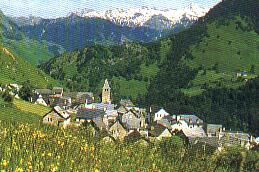 not a lake which takes on
the sight of a tropical, blue turquoise sea. One can question if this is not the
REAL Provence, guardian of ancient traditions and genuine authenticity. It’s
the highest concentration of fairy tale postcards. A popular ski area in the
winter, and a perfect hike region in the summer, wandering in the small villages
in the north of Manosque and diverse countryside roads leading us to
inaccessible, lonely plateaus. not a lake which takes on
the sight of a tropical, blue turquoise sea. One can question if this is not the
REAL Provence, guardian of ancient traditions and genuine authenticity. It’s
the highest concentration of fairy tale postcards. A popular ski area in the
winter, and a perfect hike region in the summer, wandering in the small villages
in the north of Manosque and diverse countryside roads leading us to
inaccessible, lonely plateaus.
Simplicity, austerity and practicality characterise the region’s architecture.
Many towns house stark citadels and villages were built to give maximum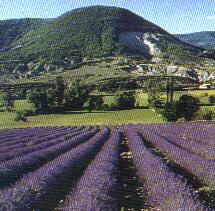 protection against the elements, as well human or natural.
In the past 30 years, the Alpes de Haute Provence have changed beyond
recognition.
The Durance River has been tamed by a complicated system of dams, providing
fertile grounds for fruit growing. New jobs in hydro-electricity and at a
nuclear plant have been created. Tourism has gained impetus. The spa towns of
Digne and Greoux-les-Bains attract health cure seekers, skiers and surfers find
their taste in winter or summer. Wealthy Parisians spend now the summer in
Manosque and an increasing amount of city dwellers buy holiday homes in the
mountain.
To explore this extraordinary region we will start from Aix en Provence, the A
51 direction Sisteron but we exit at Pont-Mirabeau to take the D 952 towards
Vinon-sur-Verdon.
Bibliography
A
guide to Provence, by Michael Jacobs (Viking, London 1988), "Guide de la
Provence mysterieuse" and "Provence Antique"by Jean-Paul Clebert
(Ed.Sand, 1986 “Aspects of Provence, by Pope-Henessy James (Penguin Travel
1988), Guides du Routard, (1999) –« Towns in Provence », by M.F.K
Fischer (New-York-Vintage books 1983), « Regain » by Jean Giono,
« Hannibal’s footsteps » by Bernard Levin (Sceptre paperback 1987)
|