|
Driving to Vinon on the D
952 we pass the enormous electricity plant of Cadarache, remembering us what a
big part the Durance plays in the agricultural development of the Provence. We
arrive soon in GREOUX-LES-BAINS, once a famous heath resort under the Romans.
Continue along the same D 952 towards Riez, passing St.Martin des Bromes,
Allemagne en Provence.
RIEZ, the oldest of cities in Haute-Provence, is now a sleepy Provencal
provincial town, mainly visited by tourists for the remains of a Roman temple
and a baptisterium from the 5th century. Of the temple only four
granite pillars with marble capitals remain. The baptisterium looks like a cube
but inside it is octagonal.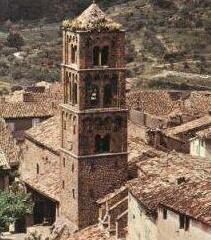
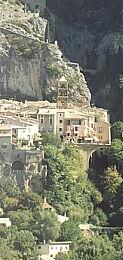 I was touched by the magnificent urban ensemble with its medieval houses
skirting Renaissance edifices. The place de Quinconce and the Grand rue show a
series of 16th and 18th century houses. Pushing some doors
you might discover a gyps manufacture. Gyps is to
Riez like faience to Moustiers....
I was touched by the magnificent urban ensemble with its medieval houses
skirting Renaissance edifices. The place de Quinconce and the Grand rue show a
series of 16th and 18th century houses. Pushing some doors
you might discover a gyps manufacture. Gyps is to
Riez like faience to Moustiers....
Wealth level of population is not so brilliant, just a small industry of
“santons”, leatherwear and ceramics making, the harvest of truffles and
lavender. During the summer it is a very well visited healthcare centre.
On our way now to
Moustiers-Sainte-Marie, the Alps get nearer and an astonishing backdrop of
craggy cliffs provides a taste of the glories to come.
MOUSTIERS-SAINTE-MARIE, one of the prettiest sites of thé region, one of the
most original, I would say. Hooked on the mountain, the village is perched on
the edge of a ravine, cut in two by the Rioul river. The two sides seem to be
held together by a massive iron wrought chain (where you can see a man-sized
star suspended on the chain) that is around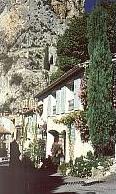 220 meters long .It is said that it
was donated by a crusader, the knight of Blacas, in the 13th century
to thank the lord for his return to his country. 220 meters long .It is said that it
was donated by a crusader, the knight of Blacas, in the 13th century
to thank the lord for his return to his country.
The environment is incredibly flourished and green with picturesque humpbacked
bridges. The village has often been compared to a crib “grandeur nature”.
But, Moustiers, which was born in the 5th century on an initiative of
Maximus,
a disciple of the 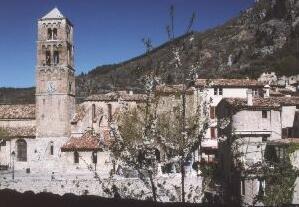 legendary
Honoratus, the hermit who retired with his followers on the Iles de Lerins (see
the chapter on the Cote d’Azur section) is world known for its “faience”.
The narrow village streets are crammed to bursting with shops and studios
producing the white glaze-decorative pottery, unfortunately everywhere the same
cheap stuff. Sadly, many of the displayed items have fallen prey to the
depressing combination of high prices and low quality. During the summer it is
sometimes as crowded as the Mont Saint-Michel! legendary
Honoratus, the hermit who retired with his followers on the Iles de Lerins (see
the chapter on the Cote d’Azur section) is world known for its “faience”.
The narrow village streets are crammed to bursting with shops and studios
producing the white glaze-decorative pottery, unfortunately everywhere the same
cheap stuff. Sadly, many of the displayed items have fallen prey to the
depressing combination of high prices and low quality. During the summer it is
sometimes as crowded as the Mont Saint-Michel!
Established in the late 17th century by Antoine Clerissy, the recipe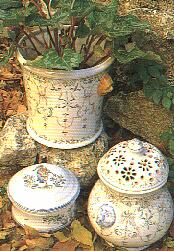 for the white glaze was said to have come from Faenza. The industry prospered
for the following 200 years,
for the white glaze was said to have come from Faenza. The industry prospered
for the following 200 years, 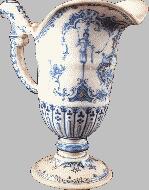 counting
Mme de Pompadour among its customers. More than 700 ovens, 30 ateliers and 400
people worked on it at that time. Changing fashions however, brought about its
decline in the 19th century and the art was not revived until 1927. counting
Mme de Pompadour among its customers. More than 700 ovens, 30 ateliers and 400
people worked on it at that time. Changing fashions however, brought about its
decline in the 19th century and the art was not revived until 1927.
Finally, the most rewarding is a visit to the MUSEE DE LA FAIENCE, in the
Placette du Prieuré, where you can discover the secrets of manufacturing these
ceramics. Open from April 1 to October 31, every day except Tuesday, 9.00-12.00
and 14.00-18.00, July and August 19.00.
Another must see is the EGLISE NOTRE-DAME-DE-BEAUVOIR, high perched above the
village and only accessible through a steep path.
Bibliography
A
guide to Provence, by Michael Jacobs (Viking, London 1988), "Guide de la
Provence mysterieuse" and "Provence Antique"by Jean-Paul Clebert
(Ed.Sand, 1986 “Aspects of Provence, by Pope-Henessy James (Penguin Travel
1988), Guides du Routard, (1999) –« Towns in Provence », by
M.F.KFischer (New-York-Vintage books 1983), « Regain » by Jean
Giono, « Hannibal’s footsteps » by Bernard Levin (Sceptre
paperback 1987)
|