|
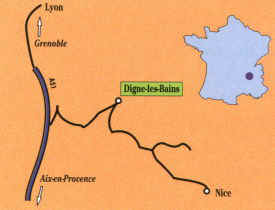
From Forcalcquier take the N
100 eastbound to the D 4, which you take northbound. Passing Les Mees you will
arrive at the “Route Napoleon” on the N 85, which you take eastbound again.
Up to DIGNE–LES-BAINS.
 |
|
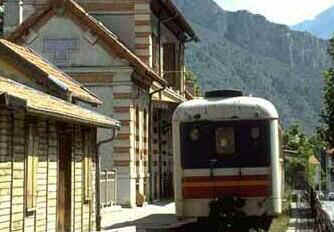
Train de Pignes |
Digne-les-Bains is the last
stop of the famous train des Pignes about which I will dedicate a special essay
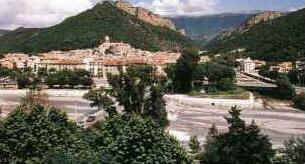
some other time. Capital of the Alpes de Haute Provence, Digne is spread at your
feet (608 m) at the shores of the Breone, set in a casket of mountains and
amidst superb lavender fields.
You enter along the hotel Napoleon Hermitage and turn right at the Place de la
Liberation into the boulevard Gassendi. This is the shopping street with vast,
shady plane-trees running up top the Grande Fontaine, pleasant cafes along its
length and, in early August, Digne asserts its position, every year in the first
week of August, with a boisterous festival and procession called “Corso de la
Lavande”. Cunning Dignois reserve their tables at the boulevard’s cafes for
lunch and a good view of the parade. Lavender, or its more common hybrid
“lavandin” is sold in Digne in every conceivable form from soap to essence
to sachets of the dried plant.
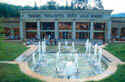 Digne les Bains was
already named by Plinius and Ptolemaeus because of his water sources good for
rheumatism and breathing problems. These sources were used again in 1982. The
water heats up to 42 Celsius and contains sulphur, lime, and minerals and is even
a bit radioactive. Digne les Bains was
already named by Plinius and Ptolemaeus because of his water sources good for
rheumatism and breathing problems. These sources were used again in 1982. The
water heats up to 42 Celsius and contains sulphur, lime, and minerals and is even
a bit radioactive.
Digne became famous since Napoleon stopped here when he came back from Elba and
Victor Hugo started his novel “Les Miserables “in Digne where Jean Valjean
was sheltered by the good bishop.
But the great personage of Digne is a backpacker woman: a certain ALEXANDRA
DAVID-NEEL. 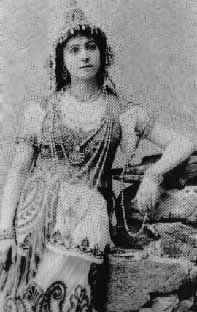 She
was a Parisian adventurer, born in 1868 from a protestant father and a catholic
mother. Very individualistic and of a great intellectual curiosity, she leaves
for India from where she returns completely fascinated and bewildered. She left
again and spent most of her life travelling in remote parts of Asia, including
perilous trips to the forbidden Tibetan capital Lhassa. She met a lot of people
including Mahatma Gandhi. Seduced by the beauty of the Alpes de Haute Provence,
she buys a house in 1927 and named it “Samten Dzong”, meaning “the
fortress of meditation”. But she returns to China and the Orient and returns
when she is 80 years old. She will die in Digne in 1969 at the age of 101. To
see her foundation, head south towards the outskirts of town to the eccentric
ALEXANDRA DAVID NEEL FOUNDATION, The house contains a fascinating collection of
objects and documents that she acquired during her long trips. Most of the
visitors are Buddhist pilgrims. She
was a Parisian adventurer, born in 1868 from a protestant father and a catholic
mother. Very individualistic and of a great intellectual curiosity, she leaves
for India from where she returns completely fascinated and bewildered. She left
again and spent most of her life travelling in remote parts of Asia, including
perilous trips to the forbidden Tibetan capital Lhassa. She met a lot of people
including Mahatma Gandhi. Seduced by the beauty of the Alpes de Haute Provence,
she buys a house in 1927 and named it “Samten Dzong”, meaning “the
fortress of meditation”. But she returns to China and the Orient and returns
when she is 80 years old. She will die in Digne in 1969 at the age of 101. To
see her foundation, head south towards the outskirts of town to the eccentric
ALEXANDRA DAVID NEEL FOUNDATION, The house contains a fascinating collection of
objects and documents that she acquired during her long trips. Most of the
visitors are Buddhist pilgrims.
 |
|
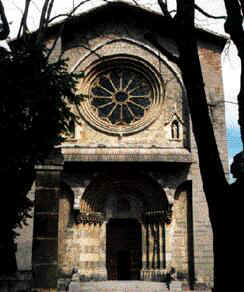
Notre Dame du Bourg |
Another interesting
site in Digne is the CATHEDRAL CHURCH OF NOTRE DAME DU BOURG,with stunning 13th
century portals in blue and white limestone.
There is also an averagely interesting municipal museum in an ancient 16th
century hospice with a few archaeological finds in the area and a collection of
butterflies (for the amateurs).
But all well considered, as a town, Digne is a place where you should not spend
more time than necessary: you are again in the typical Provence ambience like we
all know out of touristy literature.
Bibliography
A
guide to Provence, by Michael Jacobs (Viking, London 1988), “Aspects of
Provence, by Pope-Henessy James (Penguin Travel 1988)–« Towns in
Provence », by M.F.KFischer (New-York-Vintage books 1983), « Regain »
by Jean Giono, « Hannibal’s footsteps » by Bernard Levin (Sceptre
paperback 1987), « Les Alpes de Lumière »(Edisud, Aix en Provence),
Food and flavours of Haute-Povence, by Georgeanne (Brennan, Jeffrey Fisher ),
“The Secret Lives
of Alexandra David-Neel” by Barbara Foster and Michael Foster (The Overlook
Press)
|