Montagne de la Lure Haute Provence Site Home - What's New? -Feedback - About Jack- Travel/Art Links

Haute Provence
|
Montagne de la Lure Haute Provence Site Home - What's New? -Feedback - About Jack- Travel/Art Links |
|
|
|
Haute Provence |
|
Jack's Provence travels |
|
B B Riez and Moustiers-Sainte-Marie From Castellane to Saint-André-les-Alpes
|
Haute Provence-Montagne de la Lure-A forgotten paradise and model of authenticity |
|
||
|
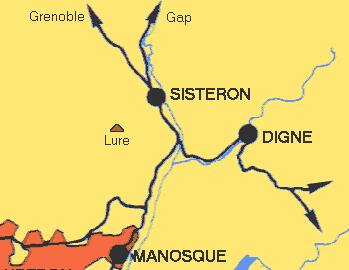
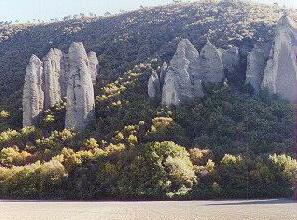
Head south on the N 95. After Chateau-Arnoux head on the N 96 and turn left as soon you LES MEES. You can see from far the ROCKS of LES MEES standing eerily over miles of flat maize field. The village of Les Mees doesn’t tempt much but the staggering “Penitents”, name given to the curious rows of limestone pinnacles outside it, do. What seems a dwarfed, stunted forest has these smooth dolmen-shaped formations, rising sheer and bar. Legend says that the Saracens invaded the area, when a group of monks from the MONTAGNE DE LA LURE are said to have been attracted by the beauty of the Moorish girls. It turned into cowled, disfigures stone statues, by St. Donatus, as a punishment for their impropriety. On the opposite bank of of the Durance, are these famous montagne de la Lure. To make a comparison with the Luberon, let’s say it is less snobbish with an open, frankly luminous landscape. Here, the sky is bluer than elsewhere.
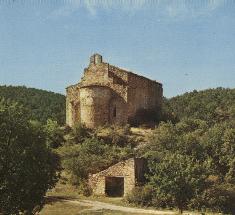
The evocative ruins of the CHURCH OF SAINT DONAT reached by the narrow D 101, is
isolated in the thick woods. Itvs today in a sorry state, its floor covered with
rubble and graffiti etched on its venerable stoen. It’s one of Provence’s
few remaining examples of early medieval Romanesque architectutre. Bibliography A guide to Provence, by Michael Jacobs (Viking, London 1988), "Guide de la Provence mysterieuse" and "Provence Antique"by Jean-Paul Clebert (Ed.Sand, 1986 “Aspects of Provence, by Pope-Henessy James (Penguin Travel 1988), Guides du Routard, (1999) –« Towns in Provence », by M.F.KFischer (New-York-Vintage books 1983), « Regain » by Jean Giono, « Hannibal’s footsteps » by Bernard Levin (Sceptre paperback 1987), « Les Alpes de Lumière »(Edisud, Aix en Provence) |
 which
boast on of the one of the most impressive panoramas to be found anywhere in
Provence. Views of the Cevennes and Mont Ventoux are interrupted only by the
sight of soaring black buzzards. Jean Giono who was born I Manosque wrote in his
book “Regains” about the inevitable destruction in the region, the
inexorable end of the traditional patterns of rural life.
which
boast on of the one of the most impressive panoramas to be found anywhere in
Provence. Views of the Cevennes and Mont Ventoux are interrupted only by the
sight of soaring black buzzards. Jean Giono who was born I Manosque wrote in his
book “Regains” about the inevitable destruction in the region, the
inexorable end of the traditional patterns of rural life.