|
 To
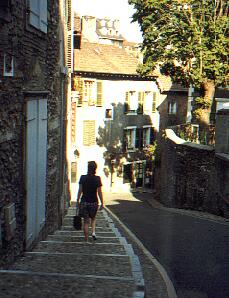
get back to centre town, take the rue Jeanne d'Arc (1st street
to the right in the rue de Puy-des-Bans) which leads you to the RUE VOLTAIRE,
the main medieval street of Chinon, pedestrian and superbly enhanced by medieval
houses and wooden facades, bordered almost along its entire length by houses
from the 15th, 16th and 17th century, one more beautiful and superb as the
other. Loitering around in the ADJACENT STREETS of the rue Voltaire will enable
you to discover a lot of hidden treasures: sculpted wood panels, armories,
corbellings, etc You can't get enough of them! Return to the place du
General-de-Gaulle and enter valiantly the rue Jean-Jacques-Rousseau because the
promenade continues!! At the corner of the rue de la Lamproie, on the right
side, a beautiful edifice of the 15 and 16th century. A plaque tells us that
Rabelais lived at no. 15, a house turned into a cabaret in the 16th century:
"La Lamproie". Come back to the street is continuing the rue Voltaire
and named now rue To
get back to centre town, take the rue Jeanne d'Arc (1st street
to the right in the rue de Puy-des-Bans) which leads you to the RUE VOLTAIRE,
the main medieval street of Chinon, pedestrian and superbly enhanced by medieval
houses and wooden facades, bordered almost along its entire length by houses
from the 15th, 16th and 17th century, one more beautiful and superb as the
other. Loitering around in the ADJACENT STREETS of the rue Voltaire will enable
you to discover a lot of hidden treasures: sculpted wood panels, armories,
corbellings, etc You can't get enough of them! Return to the place du
General-de-Gaulle and enter valiantly the rue Jean-Jacques-Rousseau because the
promenade continues!! At the corner of the rue de la Lamproie, on the right
side, a beautiful edifice of the 15 and 16th century. A plaque tells us that
Rabelais lived at no. 15, a house turned into a cabaret in the 16th century:
"La Lamproie". Come back to the street is continuing the rue Voltaire
and named now rue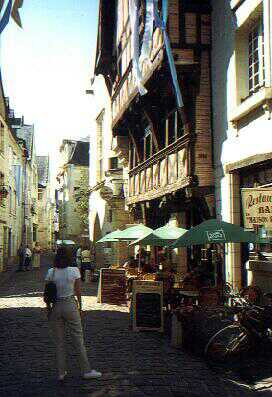 Haute-Sainte-Maurice under the walls of the castle ending at the “Grand
Carroi”(the big square). To the right the rue de Grand-Carroi and to the left
the rue Jeanne d’Arc leading to the castle. This is the medieval centre of
Chinon. Notice in the rue Haute-St-Maurice on houses nos.38-42, the
well-conserved 14th century, red brick and wooden “Maison Rouge”. The "hotel des Etats-Generaux,
at no44 houses today the museum "des Amis du Vieux Chinon et de la
Batellerie". It is said that Richard Lion Heart, son of Henry II,
injured in the Limousin during a battle against Philippe Auguste, died here in
1199. At no.48 the Hotel du Gouverneur. At no. 58 "maison Poirier de
Beauvais" 16th century, flanked by a turret. At no.73 Palais du Bailliage
from the 15th century, where it is said that the father of Rabelais worked as
lawyer, housing today a very comfortable hotel-restaurant (chic): Hostellerie
Gargantua. A little lower, from the rue du Palais or rue Jacques-Coeur, you can
admire its south façade and angle-turret and no.82, the 16th century
Maitrise des Eaux et Forets with its moulded fronton, its square turret and
spiral staircase.
Haute-Sainte-Maurice under the walls of the castle ending at the “Grand
Carroi”(the big square). To the right the rue de Grand-Carroi and to the left
the rue Jeanne d’Arc leading to the castle. This is the medieval centre of
Chinon. Notice in the rue Haute-St-Maurice on houses nos.38-42, the
well-conserved 14th century, red brick and wooden “Maison Rouge”. The "hotel des Etats-Generaux,
at no44 houses today the museum "des Amis du Vieux Chinon et de la
Batellerie". It is said that Richard Lion Heart, son of Henry II,
injured in the Limousin during a battle against Philippe Auguste, died here in
1199. At no.48 the Hotel du Gouverneur. At no. 58 "maison Poirier de
Beauvais" 16th century, flanked by a turret. At no.73 Palais du Bailliage
from the 15th century, where it is said that the father of Rabelais worked as
lawyer, housing today a very comfortable hotel-restaurant (chic): Hostellerie
Gargantua. A little lower, from the rue du Palais or rue Jacques-Coeur, you can
admire its south façade and angle-turret and no.82, the 16th century
Maitrise des Eaux et Forets with its moulded fronton, its square turret and
spiral staircase.
In a dead end street of the rue Voltaire are the “Caves Paintes”(no visits
allowed), corridors in the tuff hill that were painted in Rabelais epoch with 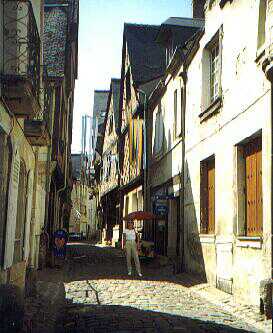 dancing
satyrs. Rabelais celebrated these “CAVES PEINTES” in his pages telling the
joy of life of Pantagruel. The paintings have disappeared but the ancient
quarries are still the temple of the divine bottle. Today, the local “Confrerie bachique des Etoneurs
rabelaisiens” still holds meetings here. In the rue de Lamproie an 18th
century hotel particulier was built at the spot where the house of the parents
of Rabelais lived. You can also visit the “MUSEE ANIME DU VIN ET DE LA
TONNELLERIE “tel 0247932563 in a
wine cellar where animated small-scale models explain the process of wine
making. About 15 natural sized automates give life to a series of tools and
reproduce the gestures of the winegrower during his work in the vineyard. A lot
of instruments used in the past to grow, harvest and make wine are exposed. Open
every day except on Thursday from April to September. There is an entrance fee
and the tasting included! dancing
satyrs. Rabelais celebrated these “CAVES PEINTES” in his pages telling the
joy of life of Pantagruel. The paintings have disappeared but the ancient
quarries are still the temple of the divine bottle. Today, the local “Confrerie bachique des Etoneurs
rabelaisiens” still holds meetings here. In the rue de Lamproie an 18th
century hotel particulier was built at the spot where the house of the parents
of Rabelais lived. You can also visit the “MUSEE ANIME DU VIN ET DE LA
TONNELLERIE “tel 0247932563 in a
wine cellar where animated small-scale models explain the process of wine
making. About 15 natural sized automates give life to a series of tools and
reproduce the gestures of the winegrower during his work in the vineyard. A lot
of instruments used in the past to grow, harvest and make wine are exposed. Open
every day except on Thursday from April to September. There is an entrance fee
and the tasting included!
Go back to the Grand-Carroi and walk to the rue-de-Grenier-a-Sel (ancient rue de
la Juiverie) going to the right. It's here that the Jewish community lived in
the 15th century, before being wiped out.
In the rue Voltaire, 44 in a building of the 15-16th century, the “MUSEE DU
VIEUX CHINON ET DE LA BATELLERIE » is housed in a large medieval hall
where it is said that Richard Lion Heart died in 1199. It is a museum to see,
not only for the museum itself bu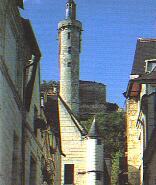 t also for the splendour of the interior
architecture. Local craftsmanship
and small scale ship models are exhibited, as well as a portrait of Rabelais by
Delacroix. Admirable hall on the first floor and also the second floor with its
beautiful vessel framework. On the ground level, eclectic exhibition of objects
relative to daily
life and popular traditions. But the MUST of the visit is without any doubt this
oriental cloth of the 11th century: "the cope of saint-Mexme". Birds
and animals are embroidered on three horizontal bands. On the braid bordering
the superior part, a repetitive Arab inscription:" Happiness to its
owner". Very mysterious, all this!! t also for the splendour of the interior
architecture. Local craftsmanship
and small scale ship models are exhibited, as well as a portrait of Rabelais by
Delacroix. Admirable hall on the first floor and also the second floor with its
beautiful vessel framework. On the ground level, eclectic exhibition of objects
relative to daily
life and popular traditions. But the MUST of the visit is without any doubt this
oriental cloth of the 11th century: "the cope of saint-Mexme". Birds
and animals are embroidered on three horizontal bands. On the braid bordering
the superior part, a repetitive Arab inscription:" Happiness to its
owner". Very mysterious, all this!!
And to finish this visit and walk of Chinon come back to the place saint-Mexme
and, at the entrance of the rue Diderot, take right into the rue Buffon to
arrive at the place Jeanne-d'Arc and the promenade du Docteur-Mattrais, planted
with beautiful trees along the Vienne river. A very agreeable place for late
afternoon in the summer and fit for mediation.
-----An excursion you could make in
the summer is the STEAM TRAIN from Chinon to Richelieu (25 km), every Saturday
and Sunday. Sometimes, in very high season, the train runs also during the week.
Tel 0247581297.
Aboard a genuine express of the 1920's, pulled by a picturesque steam
locomotive, you can enjoy some cute spots along the way like Champigny-sur-Veude,
Richelieu etc...and have a taste of the local products in the bar-wagon.
Bibliography
Guide du Patrimoine, Centre, Val de Loire ,
by Perouse de Montclos (ed.Hachette 1992)—Het dal van de Loire, by A.Sperber
(Brussels, ed.Harenberg 1997)—Guide du Routard 1998 (ed.Hachette)—de
kastelen van Frankrijk, by L.P.Boon (1956)-Histoire de la Touraine, by Pierre
Leveel (ed.LCD 1988), Histoire de l’Anjou, by J.L.
Ormieres (ed.Que sais-je, P.U.F.1998 -Rabelais et Chinon, by G. Bassompierre (ed.Dupuis
1986)
|