|
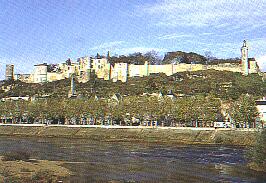 Gently
and friendly, enhanced by palm trees already evoking the south,
the city of Chinon extends all along the Vienne river. Its medieval houses
nestle against a hillock dominated by the vestiges of a chateau and its
ramparts. This is the region of France where François Rabelais passed his
childhood, the region of the lively wines of Chinon, these perfumed red and
dry white wines that you can savour in the cellars and wine bars scattered in
the city. Gently
and friendly, enhanced by palm trees already evoking the south,
the city of Chinon extends all along the Vienne river. Its medieval houses
nestle against a hillock dominated by the vestiges of a chateau and its
ramparts. This is the region of France where François Rabelais passed his
childhood, the region of the lively wines of Chinon, these perfumed red and
dry white wines that you can savour in the cellars and wine bars scattered in
the city.
Chinon was used as a fortified place from the 10th to 15th century. A certain
Thibault (Thibault le Tricheur), duke of Blois, being the almighty ruler in
the 10th century started a first attempt to build a castle. Called fort
Saint-Georges east of the tour de l'Horloge. But the comtes d’Anjou made an
end to it in 1044 and kept the hegemony for 160 years. Henry II of
Plantagenet, just crowned king of England, considered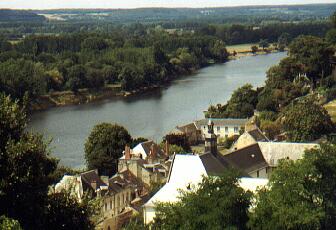 Chinon as a very
important strategic position and chooses Chinon as his favourite residence
reinforces and builds the greatest part of the fortress into the dimensions we
see today. Contemporary sources say that he died in 1189 on the altar of
Chapelle Sainte-Madeleine, which remains you can still see on the middle
terrain of the chateau
.
Chinon as a very
important strategic position and chooses Chinon as his favourite residence
reinforces and builds the greatest part of the fortress into the dimensions we
see today. Contemporary sources say that he died in 1189 on the altar of
Chapelle Sainte-Madeleine, which remains you can still see on the middle
terrain of the chateau
.
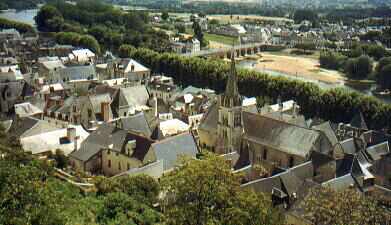 In
1205, the Touraine is definitively annexed to the kingdom of France, and since
then illustrious Capetiens will sojourn here. Since then the chateau was
fortified several times to house its illustrious guests: a dungeon, a tower,
like the tour de Coudray where Philippe le Bel imprisoned in 1307, the
Templars he arrested and whose graffiti are still visible on the walls. In
1205, the Touraine is definitively annexed to the kingdom of France, and since
then illustrious Capetiens will sojourn here. Since then the chateau was
fortified several times to house its illustrious guests: a dungeon, a tower,
like the tour de Coudray where Philippe le Bel imprisoned in 1307, the
Templars he arrested and whose graffiti are still visible on the walls.
The period following the Templars episode can be qualified as not very happy
for the Jewish population. As it happens unfortunately often in these
times, people, church and nobility look for something to amuse the people,
make them forget their misery and awful life conditions, give them a little
vibe, a thrill. Chinon, unfortunately, followed the general trend of those
times in France and didn’t escape the virulent anti-Semitism that rages
through the country. In 1321, 178 Jews are arrested, thrown in jail, judged
(?). Let’s be honest: not judged but sentenced right away burned alive and
thrown in a pauper's grave. The grave was set up for them on the ile de Tours,
just in front of the city
The ultra-classic, archi-famous and fallacious motive of this “rightful
executions” were that the Jews poisoned the wells with the excrements of the
leprous, my oh my !!
|
|
|
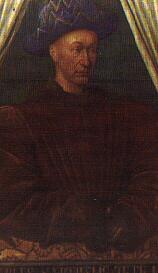
Charles VII |
It’s with a rare and
extreme violence that the Hundred Years War, will spread out, bringing many
evils and senseless dramas. It’s the era of Joan of Arc. She met the
dauphin (future king still to be crowned) Charles VII on March 8 1429. To be
sure that she acted by orders of divine origin, Charles VII dressed as a
courtesan and mixed with the 300 gentlemen (?) in the great hall of the
castle. Jeanne, the "Pucelle"(Maid of Orleans) recognized him
immediately. After she transmitted him the divine message, that he would beat
the English in Orleans and would be crowned in Reims (to regularize the
situation, I suppose), after all, he was only the "dauphin".
|
|
|
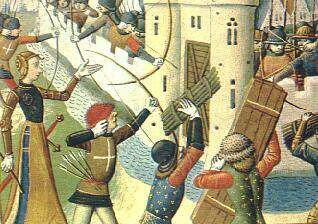
Joan of Arc at the siege d'Orleans
(old enlightening) |
But, under the pressure of
his advisers, who pretended that he dealt with an"illuminated"
(which was not entirely wrong), Charles VII sent her to be examined by the
shrinks of that epoch, the theologians of Poitiers. After three weeks, they
decided she was not a “witch” and she was armed and trusted with the
leading of an army to liberate Orleans, thus “La Douce France”. Everybody
knows the suite of this affair: the Englishmen were chased, the dauphin sacred
king and Joan of Arc burned alive in Rouen, practically abandoned by her
majesty and friends.
Charles VII declared Chinon as the siege of government. He enhanced the city
and still today we can appreciate the considerable vestiges of its past
splendour. But after his death the royal court prefers to move away from the
medieval castle to the more comfortable Renaissance chateaux like Amboise and
Chenonceau, and then Fontainebleau and Paris. Chinon loses slowly its aura and
the chateau, as the one in Loches, is used as a prison. And finally, when
Richelieu gets it in 1634, he starts to demolish it but a double petition of
the inhabitants of Chinon stops him. Democracy???? It’s a mystery. He
stopped the demolishing but for centuries the castle remained unattended and
the heirs of the chateau left what remained to run wild.
Bibliography
Guide du Patrimoine,
Centre, Val de Loire , by Perouse de Montclos (ed.Hachette 1992)—Het dal van
de Loire, by A.Sperber (Brussels, ed.Harenberg 1997)—Guide du Routard 1998
(ed.Hachette)—de kastelen van Frankrijk, by L.P.Boon (1956)-La Terreur en
1418, Charles VII, by Ch .de la Maurienne (Livtours 1986)-Histoire de la
Touraine, by Pierre Leveel (ed.LCD 1988), Histoire de l’Anjou, by J.L.
Ormieres (ed.Que sais-je, P.U.F.1998)
|