|
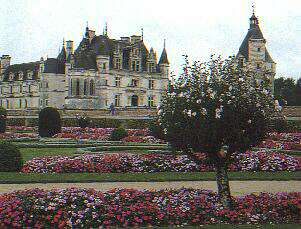 When
you walk up the long avenue leading to the chateau, the “wax portraits
museum” representing all the famous personalities having lived in the chateau.
Not genial and very medium (softly said) decors. Entrance fee, but I would skip
that one! A restaurant/tea salon is at your right. Left is the garden of Diane
de Poitiers and the Tour des Marques, just in front of the castle is used as
souvenir shop. At the right side of that tower you will find the garden of
Catherine de Medici, where you can admire the spectacular reflecting castle at
sunset. When
you walk up the long avenue leading to the chateau, the “wax portraits
museum” representing all the famous personalities having lived in the chateau.
Not genial and very medium (softly said) decors. Entrance fee, but I would skip
that one! A restaurant/tea salon is at your right. Left is the garden of Diane
de Poitiers and the Tour des Marques, just in front of the castle is used as
souvenir shop. At the right side of that tower you will find the garden of
Catherine de Medici, where you can admire the spectacular reflecting castle at
sunset.
When you get inside you can admire the pavements in Italian majolica and the
impressive Flemish tapestries of the 16th century in the Salle des Gardes. In
the adjacent chapel a marble bas-relief representing Virgin and Child and then
the sculpted cheminee in the Room of Diane de Poitiers with other Flemish
tapestries of the 16th and a " Vierge au rosaire" attributed to
Murillo. The portrait of Diane de Poitiers hangs on the wall of the room of François
1er. Room with Louis XIII furniture, a window display of autographs,
"Archimedes" by Giordano, etc...The gallery or Grand Salon houses
Louis XIV furnishing, "Jesus and St.John as a child" attributed to
Rubens, "Louis XIV" by Rigaud, "Madame Dupin" by Nattier,
Samuel Bernard, banker of Louis XIV, attributed to Mignard.
|
|
|
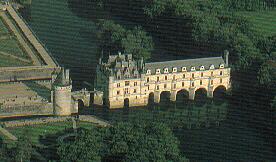
Aerial view (scan of brochure) |
Except the room of Diane de
Poitiers with the canopy bed that excited Flaubert, you can admire the rooms of
all other female owners. What appealed me most was the gallery over the Cher.
The high windows give a magnificent light on the black-and –white marble
floor. This gallery was a hospital during WWI. According to a souvenir plaque on
the wall it housed 2254 wounded.
Besides, this bridge gallery, like I told in previous article, would fulfil
another utile role in WWII.
The Cher was the borderline of the part of France occupied by the Germans and
the moreless independent (?) republic of Vichy, called “L’Etat Français”.
In July and August you can have promenades in barges in the doves and on the
Cher.
Maybe you didn't know but the chateau de Chenonceau is also a viticultural
domain of 36 hectares appellation Touraine. In a wing of the commons section of
the castle a cave with the most modern installations has been installed. You can
visit on demand, taste and buy the wines of the chateau de Chenonceau. I
recommend you especially the sweet, white wines of 1989 and 1990. Genuine
marvels, aromatic and powerful, products of two exceptional millesimes.
At Chissay-en-Touraine, you can
visit Fraise d’Or, a distillery of liqueur-eau-de-vie.
Bibliography
Guide du Patrimoine, Centre, Val de Loire ,
by Perouse de Montclos (ed.Hachette 1992)—Het dal van de Loire, by A.Sperber
(Brussels, ed.Harenberg 1997)—Guide du Routard 1998 (ed.Hachette)—de
kastelen van Frankrijk, by L.P.Boon (1956)-Six femmes qui firent Chenonceau, by
G.Wolckowicz (ed. Dominicus 1993)-Chenonceau, visit guide (brochure)
|