|
Le Havre
has a suburb, really completely different. SAINTE-ADRESSE, giving a
fashionable impression of Nice, but which was a fisher village in the
Middle Ages. The station became fashionable in 1841, when the director of
the Figaro newspaper, Alphonse Karr, fell in love with it and bought a
house surrounded by prairies and farmland. In no time to say
"hello", a lot of artists followed his example and by WWI, the
last farm had disappeared. What artists? Sarah Bernhardt, Alexandre Dumas
(son), Dufy, Monet, the composer Gabriel Fauré.
The funny thing is that Sainte Adresse became the siege of the Belgian
government during WWI and the American Army used it also as headquarters. 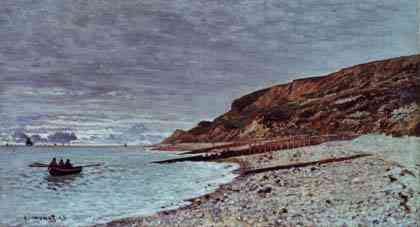
Today, Sainte Adresse is a wealthy station with villas crowding the slopes
above the Seine estuary, nudging each other for a share of the magnificent
view. For the amateurs of fun board its one of the best spots in France.
From the terrace of the Fort, you can enjoy a marvelous panorama over the
port across the Seine estuary to the Cote de Grace. A great fish
restaurant in town, with a great view is the "Nice-Havrais"
restaurant. Another favourite excursion skirts the hill past the
"Pain de Sucre", the sugar loaf-shaped mariner's monument, the
nearby Sarah Bernhardt villa with its mosaics, and continues to the
lighthouse on LA HEVE headland. Unforgettable views!!
 East
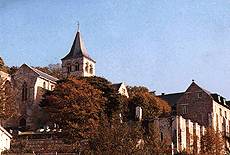
of Le Havre, the small PRIORY OF GRAVILLE stands on a hilltop. Worth a
visit if you are interested in sacred art, small-scale models of castles,
abbeys and Norman houses. Also the tomb of Sainte-Honorine. East
of Le Havre, the small PRIORY OF GRAVILLE stands on a hilltop. Worth a
visit if you are interested in sacred art, small-scale models of castles,
abbeys and Norman houses. Also the tomb of Sainte-Honorine.
Let's get further into Haute Normandie and take the D 940 towards ETRETAT.
But before arriving at the scene of the famous cliffs, we see the
lighthouse of Cap d'Antifer, which was supposed not to work on the night
of 27 February 1942, when British paratroops destroyed German radar at
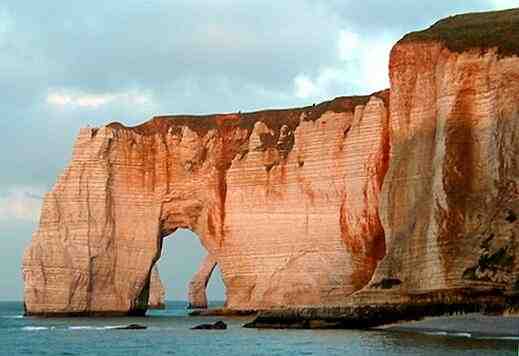
Bruneval, near the beach and re-embarked. Finally we arrive at ETRETAT,
the most popular bathing resort of the alabaster coast, world known thanks
to its spectacular cliffs, embracing a curved beach and tiny esplanade in
the arms of Porte d'Amont on the right, and Porte d'Aval on the left.
Being filmed a thousand times in all sorts of movies, being a perfect
background for fashion photography.
|
|
|
Cliffs at
Etretat
|
And above all, Etretat is
not a pushy, modern holiday resort, let me tell you that! The village has
its museums: the interactive Clos Lupin, museum of the gentleman burglar.
The old halles, a superb wooden building with its interior boutiques, the
church Notre-Dame, 11th and 12th century and the aquarium. Numerous villas
are scattered around, style late 19th and Belle Epoque, one more beautiful
than the other.
But let's concentrate on the cliffs. Both sides of the cliffs are pierced
by doorways worn through the chalk by the sea, and near the Porte d'Aval
is the famous needle-pointed Aiguille d'Etretat. The Porte d'Aval is
splendour, considered as one of the world marvels.
|
|
|
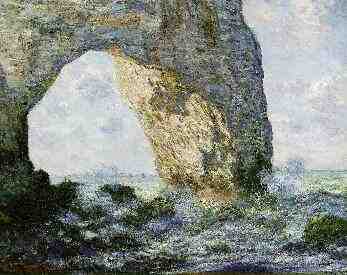
"Manneporte"
Etretat by Monet
|
Incredible harmony, the
arch is a delicate cutout. Maupassant compared it to an elephant plunging
its trump into the sea. The needle is a little behind the Porte, you can
see it from the beach. 70 m high but not hollow. It's the perfect
complement to the Porte d'Aval. Other sites just next to these are the
"Trou à l'Homme " and the "Manneporte".
It was artists like Corot, Offenbach who brought popularity to the resort.
Sadly, the thatched boats used as stores by the fishermen have become
restaurants. To get to the falaise d'Amont by car, take the rue Jules
Gerbeau to accede to a memorial and museum, devoted to two aviators,
Nungesser et Coli, who set off from here to make a first crossing of the
Atlantic and died trying.
Bibliography
"Region Normandie, ses merveilles, ses cicatrices", by Louis
Letellier (ed. Cloison, Rouen 1995, "Claude Monet : impressions of
France : from Le Havre to Giverny" by John Russell Taylor, "Le
peuple du Havre et son histoire" by Jean Legoy, "Hoog
Normandie" by Sandra Vermoolen( ANWB reisgidsen,Den Haag)
|
