|
Honfleur Normandy thorough visit Site Home - What's New?-Feedback - About Jack-Travel/Art Links |

NORMANDY
Honfleur -More thorough visit
Honfleur
became an important strategic point in the Hundred Years War when Charles V
fortified it. The Saint-Etienne church was built from 1419 to 1450, now housing
the Musée de la Marine. It was occupied by the English whose ultimate
departure was finally celebrated with the building of the wonderful wooden
church and picturesque belfry of Sainte-Catherine at the heart of the old town.
This church is the most original monument in Honfleur. The interior reminds us
of an upside down boat with two naves. Just behind the clock tower lays the RUE
DES LINGOTS, one of the most characteristic of old town. It conserved its
pavements, and most of its wooden houses are ancient. Look at no.30, the house
where general Bonaparte, then first consul, stayed for a while.
Quebec citizens should know that it is from Honfleur that Samuel Champlain set
sailing from. The town commerce boomed with shipbuilding and surrounding salt
marshes gave the town a commodity to trade on. On the quai de la Tour you can
still see salt stores with impressive oak roof timbers, put up by Colbert,
minister of Louis XIV, who greatly improved 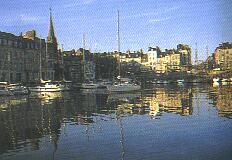 the
port, adding the VIEUX PORT, top of the hit-parade on postcards and calendar
pictures, around which the town is centred today.. The narrow houses lined on
the quay, slate roofed, are packed one upon each other, sometimes seven stories
high with only two front-windows. The curious edifice built on the riverside is
the only remnant of the old town wall: the LIEUTENANCE. It used to be the
residence of the king’s lieutenant. It’s on its wall that you can see the
plaque commemorating the departure of Champlain to Quebec.
the
port, adding the VIEUX PORT, top of the hit-parade on postcards and calendar
pictures, around which the town is centred today.. The narrow houses lined on
the quay, slate roofed, are packed one upon each other, sometimes seven stories
high with only two front-windows. The curious edifice built on the riverside is
the only remnant of the old town wall: the LIEUTENANCE. It used to be the
residence of the king’s lieutenant. It’s on its wall that you can see the
plaque commemorating the departure of Champlain to Quebec.
|
|
|
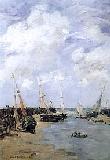
Boudin |
|
|
|
Seurat |
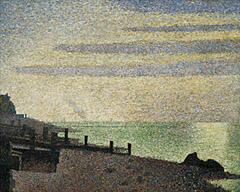
A visit to
the MUSEE BOUDIN is essential. Open every day except Tuesday from 15 March
to 30 September hours 10-12 and 14-18, same days the rest of the year but 10-12
and 14.30-17.
This museum is of course dedicated to the city’s child and favourite Eugene
Boudin. But also about all those forming the “Rencontres de Saint-Simeon”
avant-garde of Impressionism. Boudin had a great circle of friends: Jongkind,
Monet, Courbet, Sisley and Baudelaire. Expanded by various gifts over the years
it house snow, besides works of Boudin and his friends, an ethnographic Norman
collection: traditional clothes, old gears, old dishes, lace and ancient
puppets.
All over town you will meet plaques for the famous composer Erik Satie, born in
1866 in Rue Haute.
|
|
|
Maisons Satie |
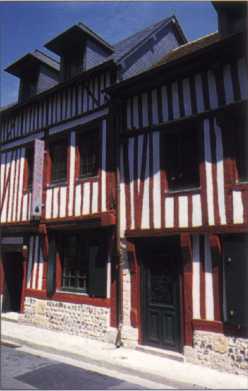
His museum, called “LES MAISONS SATIE” is on the bd. Charles V. Count an hour for the visit. It is funny to think that even until today all avant garde musicians and even “techno” claim its musical heritage and influence. The visit in this house was very carefully planned. Not to show a few outdated, old scores, a coat and a piano the organizers made a stupefying itinerary though the personal and artistic universe of the composer. First the music which can be heard through an infrared helmet given at the entrance and strolling though incredible fantasy rooms with visual and sound effects. A place where you live in more tan that you visit. Even after having left he place it will stick in your mind for quite a time. It’s genial!
Bibliography
A holiday history of France, by Ronald Hamilton (London-Hogarth press), Region Normandie, ses merveilles, ses cicatrices, by Louis Letellier (ed. Cloison, Rouen 1995, La France des petits chemins: Normandie, by J. de la Valléé (ed. Cité presse, Paris 1998), Identity of France, by Fernand Braudel (London, Fontana Press), The French, by Theodore Zeldin (New York-Random House), Découverte de Honfleur, by André Hambourg (Revue du Pays d'Auge -July 1986), ) Erik Satie, by Pierre-Daniel Templier.
Honfleur's more thorough visit