|
|
|
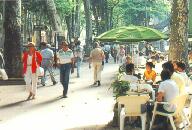
Cours Mirabeau |
Aix-en-Provence
is the cours Mirabeau, the sunny plane-trees planted avenue with its terraces,
restaurants, bookshops, and wonderful hot water fountains. Aix is also a maze of
small streets, swarming with shops and squares where we have to be on
market days, that is Tuesday, Thursday and Saturday. Totally in opposition with
Arles, Aix is the city where we can loiter around peacefully for hours,
without having the slightest feeling at any moment, that we are missing
something by lack of historical knowledge. So, if you decide to dedicate your
stay in Aix only for "day-dreaming" walks, don't continue to read my
post ;-). You will do fine without it. But if you'd like to know more about what
there is to see, I think it's a good idea to follow the following instructions.
Supposing you are coming from the AutoRoute "La Provencale", you will
arrive at a certain moment at the end of the cours Gambetta. You'll find on the
ring boulevard , at the right side of the boulevard Carnot, the parking garage
"Carnot". Yes, Aix is, like almost all French provincial towns with a
centuries old street layout, a hell for car drivers!! If you don't want to end
up a nervous wreck, leave you car in the garage! Visit everything the pedestrian
way and float away wit the charm and the maze of the alleys and passages of Aix.
From there the old quarters are not far and walking around is a real delight.
The city has an atmosphere you will find only in small Italian towns in Tuscany.
When Consul Gaius Sextus destroyed the Celtic city of Entremont in 122 BC, he
founded "not far from a hot water source , a castellum at the foot of the
conquered oppidum". It was the first settlement (122 BC) of the Romans in
ancient "Gaule". He called it "Aquae Sextiae Saluviorum".
Aix en Provence has a charm that no other French city has . It's
mostly due to a very rare and remarkable architectural unity. The roofs, warm
colored limestones, the style unity of the beautiful facades influenced by
Italian baroque. Of course , your first meeting with Aix will be the cours
Mirabeau. We are immediately overwhelmed by the cheerful turmoil of this
majestic avenue. This famous plane tree planted street was built in the 17th
century on the foundations of the medieval city walls. We can see the
sharp contrast of the south side (quartier Mazarin) with its stately hotels
particuliers and the cheerful north side where the old city is hidden. The Cours
and the Quartier Mazarin was built at the same time by a brother of the
almighty cardinal Mazarin of that time.
What gives the cours Mirabeau that relaxing atmosphere, evoking Northern
Italy? It must be the charm of his plane-trees and the cafes lining this
beautiful avenue . But did you know that originally it was planted with
elm-trees, which died in the days of Louis-Philippe (1830-1848) and were briefly
replaced by acacias. And it's under the same king that the elegant meetings in
the hotels particuliers, happening on the "bel etages" of the houses,
had to see with furious eyes the settling of cafes, bars and shops on the street
and this was what the "better bourgeoisie" despised most. The
plane-trees came later.
One of the most famous cafes was the "Cafe des Deux Garcons",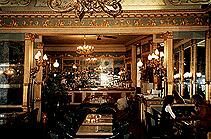 decorated during the reign of Napoleon III (1852-1870) by a genuine artist. Two
"garcons de cafe" had bought the place in the days of Louis-Philippe
and soon it played a very important role in the day and nightlife of Aix like
the most famous cafes of Paris. Even Cezanne wrote in 1906 to his son that he
stayed the night before in his favourite hangout "Cafe des Deux
Garcons". So, a visit to Aix would not be complete if you will not spend at
least a little hour sitting at the large terrace ---amongst the local students,
local bohemians and intellectual Parisians---and admiring the pretty women that
pass by. Even Stendhal praised Aix as a city "ville de bonne compagnie ou
les dames ont conserve leur empire" ( a city of good company where the
ladies have kept their empire). And what doesn't hurt at all is that the cuisine
of the "Cafe des Deux Garcons" is very edible. We can appreciate it;-)
decorated during the reign of Napoleon III (1852-1870) by a genuine artist. Two
"garcons de cafe" had bought the place in the days of Louis-Philippe
and soon it played a very important role in the day and nightlife of Aix like
the most famous cafes of Paris. Even Cezanne wrote in 1906 to his son that he
stayed the night before in his favourite hangout "Cafe des Deux
Garcons". So, a visit to Aix would not be complete if you will not spend at
least a little hour sitting at the large terrace ---amongst the local students,
local bohemians and intellectual Parisians---and admiring the pretty women that
pass by. Even Stendhal praised Aix as a city "ville de bonne compagnie ou
les dames ont conserve leur empire" ( a city of good company where the
ladies have kept their empire). And what doesn't hurt at all is that the cuisine
of the "Cafe des Deux Garcons" is very edible. We can appreciate it;-)
Bibliography:
"Evocation
du Vieil Aix-en-Provence", by Andre Bouyala d'Arnaud (Les Editions de
Minuit, Paris 1964), "Memoires d'un touriste" by Stendhal (La Pleiade,
Paris 1992), "Provence, textes inedits" by Andre Suares (Edisud,
Aix-en-Provence 1993)
|