|
Shortly before arriving at
the Celto-Ligurian excavations, south of Saint-Remy, you see at the right side
of the road a sign leading to Saint-You are standing here on a plateau named
after two very well conserved Roman monuments known as “LES ANTIQUES”. Two
different buildings at the side of the road. The left one is in fact a cenotaph
or a mausoleum, a decorative grave not standing on the 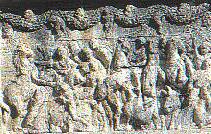 spot where the deceased
was buried. The monument, dating 1st century is in an extraordinary
good condition. On the frieze you can still read (translated in
English):”Sextius, Marcus, sons of Gaius Julius, to their parents”. At the
right side of the cenotaph stands an impressive Arc de Triomphe called Arc
Municipal. This arch, being the entrance gate to Glanum is undoubtedly one of
the oldest existing Roman gates. The proportions are perfect and so are the
sculptures. This place radiates a sort of magic. But the most incredible of this
spot, one of the oldest in France, is the behaviour of unscrupulous tourist,
whose way they utilise their cameras under the breath of eternity to get to into
eternity by posing for eternity, huge families together, would be an interesting
subject of a book. spot where the deceased
was buried. The monument, dating 1st century is in an extraordinary
good condition. On the frieze you can still read (translated in
English):”Sextius, Marcus, sons of Gaius Julius, to their parents”. At the
right side of the cenotaph stands an impressive Arc de Triomphe called Arc
Municipal. This arch, being the entrance gate to Glanum is undoubtedly one of
the oldest existing Roman gates. The proportions are perfect and so are the
sculptures. This place radiates a sort of magic. But the most incredible of this
spot, one of the oldest in France, is the behaviour of unscrupulous tourist,
whose way they utilise their cameras under the breath of eternity to get to into
eternity by posing for eternity, huge families together, would be an interesting
subject of a book.
Let’s break loose of all this magic and let’s juts cross the road for a
visit to old GLANUM. The
excavations are the pride of the French ministry of Culture. GLANUM was once a
very rich Gallo-Roman city with the precited Arc de Triomphe and mausoleum, but
was destroyed in the 3rd century by “barbarians”. The ruins of
Glanum are very interesting and thrilling to visit.
The excavated foundations,
which you can see right after entering, are from buildings of the temple area.
Glanum was already populated in the Greek period, where rich Romans settled down
as retirement after a working life. Sort of Miami;-)
You have two Glanums. The first one dates from the 2nd century AC,
but the second was created around the end of the 2nd BC. when most of
the original buildings and monuments were destroyed or heavily damaged. It is
said that these destructions were perpetrated by Teutons and Kimbrians from
Northern Europe. Anyway, new excavations in Glanum show new residential areas
that rose after this period.
Now, GLANUM grew out to the most important excavation sites of France. And the
most attractive for the informed tourist. A new, discreet but well proportioned
small museum houses copies of the most important discoveries. Clear small scale
models informative illustrations. The original and coins, jewellery etc are kept
in the archaeological museum Hotel de Sade in Saint-Remy. On the terrain of the
excavations itself, distinct panels, easy to read and understand give the right
information.
A new and very controversial issue today is the partial reconstruction of one of
the destroyed temples. Built with the shiny white stones out of one the quarries
that were supposedly used for the original Glanum. This sort of reconstruction,
called “anastylosis” is a premiere for France and had a lot of discussions
and loosened passionate debates, typical French) before it was started.
Enough archaeology now. Let’s continue to Les Baux de Provence.
Bibliography
"La
Provence devient francaise", by Roger Duchène (Fayard, Paris 1986)
"Guide de la Provence mysterieuse" and "Provence Antique"by
Jean-Paul Clebert (Ed.Sand, 1986), "Provence", by Jacques-Louis Delpal
(ed.Natahn Paris 1987), "The Roman remains of Southern France", by
James Bromwich (Routledge London 1993), « Old Provence », by
Th.A.Cook (Rivingto,ns, London 1914), « Dictionnaire de la France médievale »,
by Jean Favier (Fayard, Paris 1993)
|