Site Home - What's New? -Feedback - About Jack- Travel/Art Links

Amsterdam
|
Site Home - What's New? -Feedback - About Jack- Travel/Art Links |
|
|
|
Amsterdam |
|
Concertgebouw, Sarphatipark and Albert Cuypstraat market |
|||||
|
Westerkerk
and Van Gogh museum
|
|||||
|
Exit the Stedelijk Museum, turn left and, at the end of the Paulus Potterstraat, left again on van Baerlestraat. Cross the street and walk to the grandiose pillared portico of the Concertgebouw (Concert Hall), with a new glass corridor and protected by a giant glass case due to recent renovation works. This cultural landmark was built in the 1880’s by six Amsterdam entrepreneurs in a bid to erase the city’s philistine reputation. Among those who commented on the money-minded Amsterdammers’ lack culture was Johannes BRAHMS (1833-1897), who, invited to visit the city in 1879, characterized the Dutch as “schlechte Musikanten” (dreadful musicians) and bemoaned the lack of an acceptable venue for his music. Stung into action, the consortium hired architect AL van Gendt (1835-1901) and saw the neo-Renaissance building completed in 1888.
Its acoustics—as much by good luck as by good planning—are superb, andit has become a sought-after venue for orchestras and musicians from all over the world. The orchestra which has its home here” Het Koninklijk Concertgebouworkest” is one of the best in the world. First concert took place on 3 November 1888. Willem Mengelberg, who was its conductor for many years (and fired after WWII due to behaviour during the war) had a great influence.
Among the great names
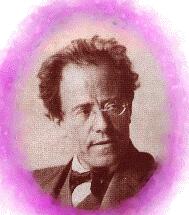
that conducted the orchestra are Richard Strauss, Gustav Mahler, Maurice Ravel,
Arnold Schoenberg, Darius Milhaud, Bernard Haitink and Eugen Jochum. Bibliography Holland, by Adam Hopkins (Faber and Faber, 1988), Penguin Guide to Amsterdam (ed.Vincent Westzaan, Penguin 1990), Dwalen door Amsterdam en reizen door de Benelux, ( ed. Lekturama 1984), “Amsterdam: The life of a city” by Geoffrey Cotterell (Saxon house 1974), “Muziekleven in Amsterdam”, by H.Van der Auwera (Pinguin, Utrecht 1998) |
|||||

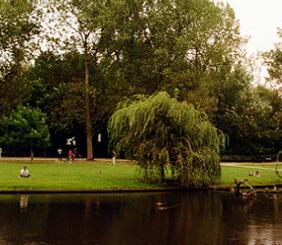 street, turn left into the SARPHATIPARK. This small patch of green is named
after Samuel Sarphati (1813-1866), a Jewish energetic doctor and do-gooder who
almost single-handedly dragged Amsterdam out of the torpor that beset it in the
early 19th century. Among his many innovations were a garbage-removal
service, a building company, a bank an industrial development organisation and
an exhibition centre. He seems to have been the kind of person with the ability
to be everywhere at the same time. The pretty little park hardly seems a big
enough memorial. Every morning there is a typical market: herrings, Chinese
brochettes, Indonesian dishes.
street, turn left into the SARPHATIPARK. This small patch of green is named
after Samuel Sarphati (1813-1866), a Jewish energetic doctor and do-gooder who
almost single-handedly dragged Amsterdam out of the torpor that beset it in the
early 19th century. Among his many innovations were a garbage-removal
service, a building company, a bank an industrial development organisation and
an exhibition centre. He seems to have been the kind of person with the ability
to be everywhere at the same time. The pretty little park hardly seems a big
enough memorial. Every morning there is a typical market: herrings, Chinese
brochettes, Indonesian dishes.