Site Home - What's New? -Feedback - About Jack- Travel/Art Links

Amsterdam
|
Site Home - What's New? -Feedback - About Jack- Travel/Art Links |
|
|
|
Amsterdam |
|
Amsterdam-Prinsengracht to Boeremarkt |
||
|
Westerkerk
and Van Gogh
|
||
|
IN CONSTRUCTIE |
||
|
|
Our third walk will take us
round one of the most elegant of Amsterdam’s canal rings, calling at two
lively markets, two historic churches, a moving and world famous memorial to the
victims of the holocaust and two contrasting art museums.
Leaving Stationsplein, turn right, follow Prins Hendrikkade to where it crosses
the Singel, turn left, then right along Brouwersgracht, a charming canal,
despite it is here that in the 17th century all polluting industry of
the city was assembled: gun powder, saltpetre, heavy oils, as well as the
largest breweries. Then left again across the first bridge you reach and follow
Brouwersgracht to its junction with Prinsengracht. If a boat is passing, pause
to admire the skill with which the vessel is piloted through the two narrow
bridges, which span the two canals here. From here cross Prinsengracht by
Lekkeresluis (Sweet bridge, named after the pancakes once sold there).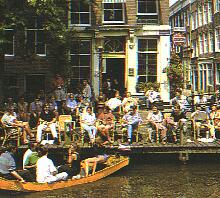 CAFÉ PAPENEILAND, at no.2 Prinsengracht is one of the several “brown cafés”
which claim the title of Amsterdam’s oldest. None have firm historical proofs
to back up their claim. The café, with its fine step-gables, dates from 1642,
although it is said that a coffin-maker and undertaker sold drink here as early
as 1600, probably finding a market among the mourners.
CAFÉ PAPENEILAND, at no.2 Prinsengracht is one of the several “brown cafés”
which claim the title of Amsterdam’s oldest. None have firm historical proofs
to back up their claim. The café, with its fine step-gables, dates from 1642,
although it is said that a coffin-maker and undertaker sold drink here as early
as 1600, probably finding a market among the mourners.
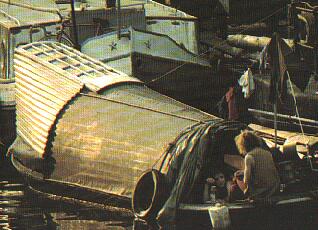 The
PRINSENGRACHT is the outermost of three canal rings built during Amsterdam’s
Golden Age to house its fresh aristocracy and wealthy merchants. It owes its
name to the Prince of Orange, hero is the revolt against the Spaniards. This
canal has a different charm as the others. Poorer in fine sculptured facades, it
is bordered by inhabited barges, sort of floating houses, symbolizing a
different way of living. When weather permits, people sip a coffee on their
terrace and certain even cultivate a small garden. Astonishing!
The
PRINSENGRACHT is the outermost of three canal rings built during Amsterdam’s
Golden Age to house its fresh aristocracy and wealthy merchants. It owes its
name to the Prince of Orange, hero is the revolt against the Spaniards. This
canal has a different charm as the others. Poorer in fine sculptured facades, it
is bordered by inhabited barges, sort of floating houses, symbolizing a
different way of living. When weather permits, people sip a coffee on their
terrace and certain even cultivate a small garden. Astonishing!
On the canal stand two churches built by the newly triumphant Protestant
Reformers of the 17th century, plus a fine array of prosperous
merchant’s mansions of the Golden Age. Walk from Lekkeresluis southwards down
the Westside of the canal towards our first landmark, the NOORDERKERK (North
Church). Not a superb edifice, massive, heavy and without grace, built in brown
brick and grey slate. Only the façade
windows have a little bit of elegance. Notice also the departure from the
earlier architectural traditions of the Catholic Church. Instead of having nave,
transept, choir and altar, it has the plan of a Greek cross.
On a Saturday, the square between the church and the canal is lined with the
stalls of the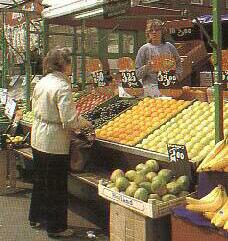 BOERENMARKT also called the NOORDERMARKT. Sympathetic and popular. Cereals,
cheeses, vegetables, flowers and many more. If you happen to be in the Jordaan
area you can always come and loiter here.
BOERENMARKT also called the NOORDERMARKT. Sympathetic and popular. Cereals,
cheeses, vegetables, flowers and many more. If you happen to be in the Jordaan
area you can always come and loiter here.
On the north side of the square bird-fanciers gather with cages full of fancy
poultry, racing pigeons, parrots, exotic finches and songbirds. The chickens and
cockerels do not look too unhappy, but the cramped cages full of tiny songbirds
are depressing.
If you need a break now, sit down at the “Winkelcafé”, corner Westerstraat
and no.43 Noordermarkt. Have a thick piece of apple tart with whipped cream,
like the Dutch women, coming from their shopping and making here their gourmand
stop.
Bibliography
Holland, by Adam Hopkins (Faber and Faber, 1988), Penguin Guide to Amsterdam (ed.Vincent Westzaan, Penguin 1990), Guide du Routard 1998 (ed.Hachette), -Dwalen door Amsterdam en reizen door de Benelux, ( ed. Lekturama 1984), “Amsterdam:The life of a city” by Geoffrey Cotterell (Saxon house 1974)