|
Walk on down Prinsengracht
towards the Westerkerk with its florid globe and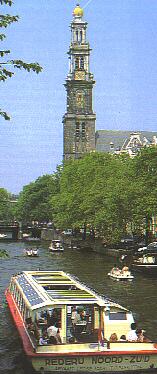 crown symbol granted to the city by the emperor Maximilian in 1489. For years
this was the culminant point of Amsterdam. It is Amsterdam’s tallest (85 m).
crown symbol granted to the city by the emperor Maximilian in 1489. For years
this was the culminant point of Amsterdam. It is Amsterdam’s tallest (85 m).
 |
|
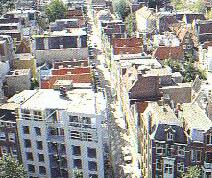
Bird's eye view
from Westerkerk |
Climb to the top for a
bird’s eye view of the city-centre, its rings of canals and, beneath you, the
Jordaan district. The graceful Neoclassical interior is lighter and airier than
that of the nearby Noorderkerk. It has the shape of a double cross. Rembrandt is
said to be buried here, although there is no sign of his tomb. A plaque marks
the grave of Rembrandt’s son, Titus. Although the church kept its religious
role, concerts are organized from time to time. A memorial to Rembrandt was
built near the church (open 10.00-16.00 from Monday to Saturday).
Now if you cross the canal to have a better view of the Westerkerk on the other
side of the Prinsengracht, it gives you an excuse to visit another venerable café
with a claim of Amsterdam’s oldest.
Turn right at the end of the bridge and you will find café Chris at the corner
of Prinsengracht and Bloemstraat.
Follow now Prinsengracht until you reach Spiegelgracht and turn right there,
towards the treasures of Museumplein. The short Spiegelgracht began to attract
Amsterdam’s smarter art and antiques dealers around the turn of the 20 th
century, with the opening of the Rijksmuseum. Almost 100 antique dealers manage
to squeeze into its 300 m length, selling everything from almost affordable
curios and collectibles to the rarest and costliest of fine furniture, paintings
and sculpture. At Spiegelgracht’s southern end, cross first Lijnbaansgracht,
then Weteringschans and Singelgracht to arrive on the Stadhouderskade. Keep
going past the Rijksmuseum to Museumplein and the Van Gogh museum.
This is one of the finest and most thrilling museums in Amsterdam. The world’s
biggest and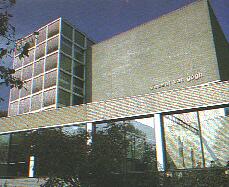 most
various collection of the man’s work—200 paintings and 500 drawings—and
his own collection of engravings and Japanese prints. There is also a fine
assemblage of work by contemporaries, such as Paul Gauguin, Claude Monet and
Henri de Toulouse-Lautrec. most
various collection of the man’s work—200 paintings and 500 drawings—and
his own collection of engravings and Japanese prints. There is also a fine
assemblage of work by contemporaries, such as Paul Gauguin, Claude Monet and
Henri de Toulouse-Lautrec.
One thing is for sure: the moulting had become indispensable: the building,
designed by architect Gerrit Rietveld in 1973 was conceived to receive about
60,000 visitors a year. Well, in 1997 1,000,000 people visited the museum!! The
inevitable consequence was a complete renovation and extension. This happened in
19987 until mid 1999.
“Everything was renovated only the walls and the roof remained”, if we have
to believe the director, John Leighton. And not even that: certain walls have
been destroyed to open the galleries as wide as possible. The result that it has
now a formidable impression of space and luminosity. Well separated one of each
other, on a white or light blue background, the works of 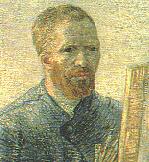 Van
Gogh are shown into relief of great majesty. The visitor is able now to linger
and dream in front of the paintings, which was unthinkable in the old museum. No
more jostling and hassling, that’s the past, finito!! Van
Gogh are shown into relief of great majesty. The visitor is able now to linger
and dream in front of the paintings, which was unthinkable in the old museum. No
more jostling and hassling, that’s the past, finito!!
The visit is even more striking and thrilling than before. On the first floor,
the chronological order of presentation of the artist simply called here
“Vincent”, allows the visitor to follow step by step the evolution of his
style and genius, from the rural scenes of his birth country Holland until the
landscapes and still lives painted in France.
If you happen to go and look at the third floor, the paintings of Van Gogh are
judiciously placed next to works of his contemporary artists to show how Van
Gogh got inspired by them and how he inspired them. Through the delicious
subtlety of the picture hooking, you assist at the unexpected encounter of women
painted by Manet and Van Gogh, at a symphony of pink shades on Monet landscapes,
Van Gogh and Schuffenecker. A regal!!
The new museum is resolutely “high-tech”! On the second floor there is now
an Internet space where the public can consult the web site of the new museum
and learn more about Vincent by reading his mail to his brother Theo and
consulting reference books and bibliography about the artist. In the basement,
the auditorium has been equipped
by the latest audio-visual material to receive conferences, lectures, movies and
theatre plays. And what was very important: the air control system has been
completely updated. It is obvious that the Van Gogh museum has the ambition to
become THE museum of the 21th century, completing its neighbours the Rijksmuseum
(16th to 18th century) and Stedelijk museum (20th
and soon 21th century). They all signed an agreement of lending their works one
to the other.
But let me describe the museum lay out and architecture. New ambitions, new
means.
Conceived by the Japanese Kisho Kurokawa, the new wing of the museum is a sort
of metallic grey vessel hidden almost completely hidden (3/4) in a pit. At the
bottom of this pit a thin water pellicle flows away, sparkling in the sun. On
the northern façade, the prints study profiles like a drawer half way pulled
out of a commode.
The Dutch, never stingy of tender nicknames, baptized this titan, granite and
aluminium construction already as “ the mould” or the “biscuit box”….
Nevertheless, the symbiosis wanted by Kurokawa with the old building is a
success and the lighting is exceptional. Not surprising if you know who George
Berne is: the architect who signed the Louvre and Picasso museum lightings.
This new wing is only dedicated to receive temporary exhibitions (2,300 square
meters), which is double than before. Thus, the museum can expose 80 % of the
collection in the old, renovated building. The result is that nothing more
sleeps in the reserves for our greatest pleasure and happiness.
Bibliography
Holland,
by Adam Hopkins (Faber and Faber, 1988), Penguin Guide to Amsterdam (ed.Vincent
Westzaan, Penguin 1990), Dwalen door Amsterdam en reizen door de Benelux, ( ed.
Lekturama 1984), “Amsterdam:The life of a city” by Geoffrey Cotterell (Saxon
house 1974), “Van Gogh in Amsterdam”, by G. Van de Walle (Lannoo, Brussel
1998)
|