|
back
to Grasse contents
Arriving in Grasse
|
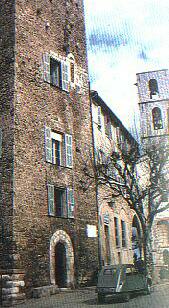 For a visit to the city you
leave your car at the parking on the place du Cours, also buried under plants
and flowers. Just behind the For a visit to the city you
leave your car at the parking on the place du Cours, also buried under plants
and flowers. Just behind the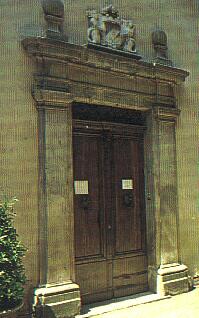 garage lies the musee Fragonard that is just worth
a brief visit. Built like a 17th century villa which was the
property of a merchant in perfumed gloves during the French revolution, and a
nephew of Jean-Honoré de Fragonard, painter born in Grasse in 1732. From
February 1790 to March 1791 Fragonard lived in this house. Fragonard painted,
just like Watteau and Boucher, the elegant erotic fantasies of the wealthy,
their subtle love affairs in green dream parks, their pink girls in high swings,
shortly said an ideal that Watteau had already represented by his famous
“Embarquement pour Cythere”. When Fragonard arrived in Grasse he brought
with him his 4 most beautiful works he ever made. These works were an order of
the king’s maitresse Madame du Barry who quite surprisingly refused them. He
sold them very cheaply to his cousin in Grasse. In 1898 they disappeared to the
United States where they showed up at the estate of garage lies the musee Fragonard that is just worth
a brief visit. Built like a 17th century villa which was the
property of a merchant in perfumed gloves during the French revolution, and a
nephew of Jean-Honoré de Fragonard, painter born in Grasse in 1732. From
February 1790 to March 1791 Fragonard lived in this house. Fragonard painted,
just like Watteau and Boucher, the elegant erotic fantasies of the wealthy,
their subtle love affairs in green dream parks, their pink girls in high swings,
shortly said an ideal that Watteau had already represented by his famous
“Embarquement pour Cythere”. When Fragonard arrived in Grasse he brought
with him his 4 most beautiful works he ever made. These works were an order of
the king’s maitresse Madame du Barry who quite surprisingly refused them. He
sold them very cheaply to his cousin in Grasse. In 1898 they disappeared to the
United States where they showed up at the estate of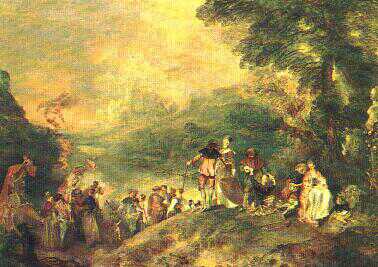 J.Pierpont Morgan. When he
died the legendary art dealer Duveen sold them, for the (at that time)
astronomical amount of 1,425,000 USD to Henri Clay Frick. They are today the
highlight of the Frick collection in New York. In the Grasse museum we can only
see copies. Loitering around in the house you can also discover drawings,
sketches and prints from the master and his family in a superb setting. J.Pierpont Morgan. When he
died the legendary art dealer Duveen sold them, for the (at that time)
astronomical amount of 1,425,000 USD to Henri Clay Frick. They are today the
highlight of the Frick collection in New York. In the Grasse museum we can only
see copies. Loitering around in the house you can also discover drawings,
sketches and prints from the master and his family in a superb setting.
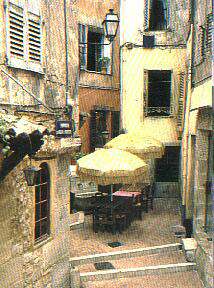 After all this Grasse is open for the walkers and should be reminded that there
is a cathedral to visit, the 12th century Notre-Dame du Puy on the
place du Petit Puy, heavily restored in the 17th century. Typical
roman provencal style. Inside a few interesting works like a rare religious
painting by Fragonard and three works by the young Rubens. There is a triptych
attributed to Louis Brea.
After all this Grasse is open for the walkers and should be reminded that there
is a cathedral to visit, the 12th century Notre-Dame du Puy on the
place du Petit Puy, heavily restored in the 17th century. Typical
roman provencal style. Inside a few interesting works like a rare religious
painting by Fragonard and three works by the young Rubens. There is a triptych
attributed to Louis Brea.
You
want to shop? Here are a few ideas given by the GDR: (quote)
"buy perfumes, soaps, and other baubles in the different markets of the city:
every morning (except on Mondays) a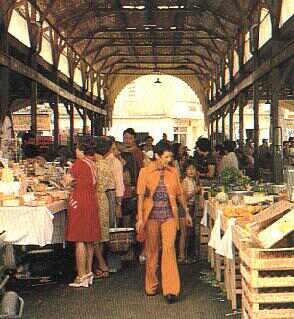 flower market on the place aux Aires
together with a Provencal market famous for his " fruits confits" and
spices. flower market on the place aux Aires
together with a Provencal market famous for his " fruits confits" and
spices.
A very retro bakery-patisserie at 7, rue Marcel-Journet for lunch at noon
and in the same street: Grasse
Bonbon, famous for his " fruits confits", particularly violets.
Finally in the rue Mougins-Roquefort, the "oilery" Autran,
manufacture-negociant, who knows how to select the good products of the region:
olive oil of Speracedes, soaps, etc....). He will explain you kindly the
different steps of manufacturing olive oil. "
(unquote)
Notice that the genuine perfume plants are out in the country and not
open to visits.
Bibliography
John
Pemble, "the Mediterranean Passion, Victorians and Edwardians in the
South", (Oxford University Press 1988), Mary Blume, "Cote d'Azur,
Stephen Liegeard, Guide du Routard 1998-99, Patrick Howarth, “When the Riviera
was ours” (Century, London 1977, Le Parfum en France, by G.Karioutis (ed.
Lamard 1996). “Fragonard a Grasse”, by J.Delannoé (ed.Edisud 1995)
|
back
to Cote d'Azur main page
House
of Fragonard-Visit of city
|