|
Back
to Cote d'Azur main page
Maison
Renoir
|
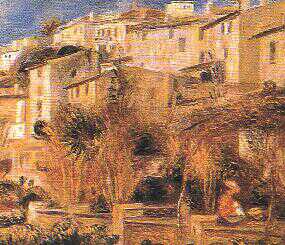 Arriving in Cagnes along the coastal road we realize that
exhaustion of soil and chaos increase the more we approach and soon we are
surrounded by tormenting noises and forms insulting Arriving in Cagnes along the coastal road we realize that
exhaustion of soil and chaos increase the more we approach and soon we are
surrounded by tormenting noises and forms insulting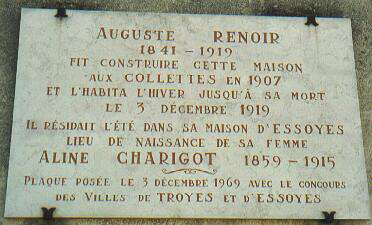 our vision that we didn’t
have in the back country. our vision that we didn’t
have in the back country.
Cagnes is divided in three distinctive parts: the modern uninteresting seaside
resort called Cros de Cagnes, , a modern town with its shopping streets, public
park and weekly market and the town of" Haut-de -Cagnes", the old city, the most picturesque,
perched on a hill. Stay away from "Cagnes-Centre", business minded,
absolutely banal, and especially "Cros-de -Cagnes", alongside the sea,
crossed by the N 98 lining up restaurants,
pizzerias, creperies (pancake snacks) and other tourist traps.
Let’s concentrate first, before climbing up to old town, on the Musee Renoir in CAGNES-SUR-MER, certainly
worth a visit. To get to it, don't worry: it is clearly marked everywhere.
Auguste Renoir (1841-1919) suffered the last years of his
life seriously from serious rheumatism. Despite the fact that the painter of
soft-pink young girls skins preferred to work in Normandy, Brittany or
Montmartre, his doctor advised him to care for his health in the warm south. In
February and March 1903 Renoir was in Cagnes where he settled down in the Maison
de la Poste (now City Hall). From then on he was every summer in Paris and
returned to Cagnes in the winter. In 1907 he bought the “Domaine des
Collettes”, principally for the olive trees who where doomed to destruction.
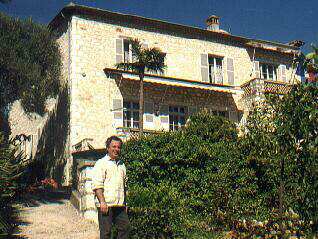
First he took care of the olive trees then he built a house on the property that
was finished in 1908. The house you see today is not entirely the original. The
city of Cagnes bought the estate in 1960 and reconstructed everything exactly as
it was before.
The painter merchant Ambroise Vollard reminds in one of his
memories that unexpected ladies from the chique hotels in Nice and Cannes
visited regularly and unexpectedly the old master then already a world star, got
out of their Dion-Bouton under the olive trees to bore him to dead with their
croaking. It was not directly happiness in les Collettes. Vollard says that the
master often murmured," I feel like living in a monastery". He couldn’t find quick enough an excuse to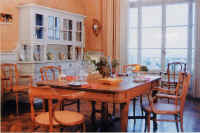 leave and seek refuge in the mountains
or at the seaside. leave and seek refuge in the mountains
or at the seaside.
 On the ground level, the drawing room, dining room and
guest-rooms. Consider the house
less a museum than a souvenir. The atelier is left like the day it was when he
died. With the famous wheelchair and the brushes that were attached to his
fingers because he suffered heavily from chronic poly arthritis.. There are 10
original paintings by Renoir in this museum, including a large sketch for
"Les Grandes Baigneuses", drawings, busts and other work. On the ground level, the drawing room, dining room and
guest-rooms. Consider the house
less a museum than a souvenir. The atelier is left like the day it was when he
died. With the famous wheelchair and the brushes that were attached to his
fingers because he suffered heavily from chronic poly arthritis.. There are 10
original paintings by Renoir in this museum, including a large sketch for
"Les Grandes Baigneuses", drawings, busts and other work.
At the first floor, a moving reconstituted atelier with Renoir's room, and
that of his two sons. Jean filmed there in 1959 almost all his rushes for the
movie “Le Dejeuner sur l’Herbe” and he wrote later from California (in his
novel “My life and my films”) where he lived at that time:” Later I often
thought back with nostalgia when we lived peacefully in Les Collettes under the
big olive trees, and the delicious odour of burning wood accompanying our
work”.
Anyway besides painting Renoir started to sculpt, inspired
by the ravishing light effects. The technique of sculpting was also less painful
for him. A pupil of Maillol assisted him. The terrace, a little gloomy gives the
whole house a sad effect but the most impressive is the olive garden: a modest
resting spot in the hell of Cagnes.
Stroll around in the magnificent
olive grove that surrounds the house, spread out across the hillside with superb
views on the old village of Hauts-de -Cagnes, the Mediterranean and Cap
d'Antibes. Of course the view has changed dramatically since Renoir's
days.
Bibliography:
John Pemble, "the Mediterranean Passion, Victorians and Edwardians in the
South", (Oxford University Press 1988), Mary Blume, "Cote d'Azur.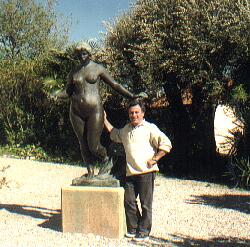 Inventing the French Riviera" (Thames and Hudson, London 1982) Stephen Liegeard,
"La Cote d'Azur (Ed.Serre, Nice 1988), Guide du Routard 1998-99, Patrick
Howarth, “When the Riviera was ours”
Inventing the French Riviera" (Thames and Hudson, London 1982) Stephen Liegeard,
"La Cote d'Azur (Ed.Serre, Nice 1988), Guide du Routard 1998-99, Patrick
Howarth, “When the Riviera was ours” 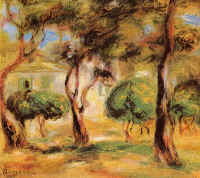 (Century, London 1977), Memories of my
artists, A.Vollard (Presses pockets-199), My life and my films, by J.Renoir
(J’ai Lu, 1984), Musee Renoir (folder at the boxoffice) (Century, London 1977), Memories of my
artists, A.Vollard (Presses pockets-199), My life and my films, by J.Renoir
(J’ai Lu, 1984), Musee Renoir (folder at the boxoffice)
|
Back to Cagnes contents
Hauts
de
Cagnes
|