|
Normandy battle Arromanches artificial port -Site Home - What's New?-Feedback - About Jack-Travel/Art Links |

NORMANDY
Normandy battle - Arromanches and its artificial port
Memorial sites
and beaches main page
D-Day beaches and War Memorial
Pegasus Bridge
Benouville
Ranville
From Ouistreham,
the D 54 follows the shore from the length of the Cote de Nacre, with a well
signposted CIRCUIT DE DEBARQUEMENT indicating everything related to the Landing.
The first three landing beaches lying between Ouistreham and Port-en-Bessin were
given the code names SWORD, JUNO, and GOLD where British and Canadian troops
disembarked.
Today memorials are being added to town centres and new museums opened to honour
a particular troop division or action. And life goes on: some visitors come to
COURSEULLES-SUR-MER to see a Sherman tank dragged out of the sea in 1971to
decorate its waterfront, others enjoy the best oysters of Normandy J.
Near the village of St. Come a windy viewpoint overlooks the port of
ARROMANCHES-LES-BAINS. 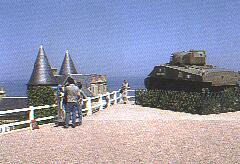
It is a common mistake to imagine this little bath station as a landing beach of
WWII. Nevertheless it is in a certain way.
Arromanches became one of the MAIN SHRINES OF HISTORY OF THE BATTLE OF NORMANDY
thanks to the unimaginable floating and ingenious artificial port built here for
helping the Allied. The Mulberry harbour and considered as the most
incredible technical prowess of WWII.
"Those who possess the ports, possess Europe" was one of the German's
beliefs. But malicious and clever as they were, Churchill and Lord Mountbatten,
had found the repartee: if one cannot conquer the coast harbours, too well
guarded, why not bring one of your own??
So "The Mulberry", vast floating prefabricated port, was built in 1943
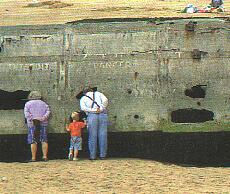
in England, highest top-secret level! The project was aware of the stakes: 115
giant reinforced concrete lockers, weighing each 7000 tons, which will serve as
wave-breakers along a distance of 5 miles.
 |
|
Washed up Mulberry caisson |
22 metallic platforms
supported by props hooked on the bottom of the sea will figure the landing
piers. Immense roads on cable-buoys, connected to the beaches by telescopic
elements, will enable the transport of vehicles, materials and troops. And to
make the dispositions complete, 60 boats will voluntarily be scuttled off
Arromanches, 146 caissons (hollow rectangular concrete boxes) to form a semi
circular harbour wall to keep the harbour safe from the surge.
The Musée du Débarquement in Arromanches (tel
0231223431) has photographs and admiralty films of “Port
Winston” in action, complete with barrage balloons, battleships and tanks
rolling ashore. Thrilling! Dozens of display-windows with objects of
those times, some are very rare. Most interesting are the very well made
small-scale models of the artificial port. A diorama of 7 minutes exposes very
clearly the first Landing manoeuvres. Open every day, except in January.
Another interesting site to visit is the CIRCULAR MOVIE-THEATER (tel
0231223030) on the slopes of Arromanches, identical to the one at Futuroscope in
Poitiers. Open 7 days a week. A film lasting 15 minutes, called "Le Prix de
la Liberte", reunites yesterday's and today's images to give the spectator
the impression to revive the most formidable military adventure of the 20th
century.
Heading now for BAYEUX, visit the BATTERIE
OF LONGUES-SUR-MER. Four concrete casemates and their commanding post are still
on display. Impressive.
Back to Normandy main page and cities
Arromanches artificial port
Omaha beach
Pointe du Hoc
Utah Beach