|
Pegasus bridge Benouville-Site Home - What's New?-Feedback - About Jack-Travel/Art Links |

NORMANDY
Normandy - The Pegasus bridge at Benouville-Ranville battery and cemetery
Memorial sites
and beaches main page
D-Day beaches and War Memorial
Pegasus Bridge
Benouville
Ranville
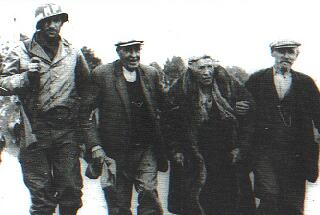 Caen-Benouville,
a short trip today, a hell on June 1944.
Caen-Benouville,
a short trip today, a hell on June 1944.
Take the road direction Cabourg and in a few minutes you are in BENOUVILLE.
A charming little city at the shores of the Orne river. Its most famous
landmark, the PEGASUS BRIDGE, with its metallic structure was unfortunately
dismantled, to the great furor of the local population but also a great
deception for the many surviving British red berets that risked their lives to
defend that bridge. Some even say: was it worth all that sacrifice? And I cannot
blame them…
The PEGASUS BRIDGE was indeed the symbol of courage and tenacity of the British
army. The objective, at the eastern end of the beaches, was an early objective
in the campaign to establish an eastern foothold on French soil and is a natural
starting point for a tour of the D-day beaches.
June 6th, 1944, just after midnight gliders and paratroopers of the
British 6th Airborne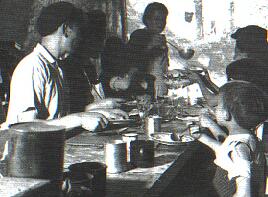 division (insignia was flying horse= Pegasus) landed in the nearby fields and
quickly secured the bridge. The café Gondrée, at its western end was the first
French house to be liberated, and is today an affectionate port-of-call for
returning veterans. But after the
taking of the bridge it was transformed into a hospital. The owner has its way
to celebrate the event. He claimed having buried to hide 3,000 bottles of
Champaign from the Germans and offered them to the troops. Today,
a mythic spot, with numerous souvenirs all over the walls!
division (insignia was flying horse= Pegasus) landed in the nearby fields and
quickly secured the bridge. The café Gondrée, at its western end was the first
French house to be liberated, and is today an affectionate port-of-call for
returning veterans. But after the
taking of the bridge it was transformed into a hospital. The owner has its way
to celebrate the event. He claimed having buried to hide 3,000 bottles of
Champaign from the Germans and offered them to the troops. Today,
a mythic spot, with numerous souvenirs all over the walls!
The conquest of this site which entered History under the name Pegasus Bridge
was under the command of major John Howard, immortalized in the "Longest
Day".
One of the many anecdotes of this taking of the bridge was the arrival of
the green berets and their bag-piper, Lord Lovat, the Scot who commanded the
little troop, and greeted major Howard with a:"Sorry Sir, I am 2 minutes
late."
The MUSEE PEGASUS BRIDGE or
MUSEE DES TROUPES AEROPORTEES BRITTANIQUES ET CANADIENNES is 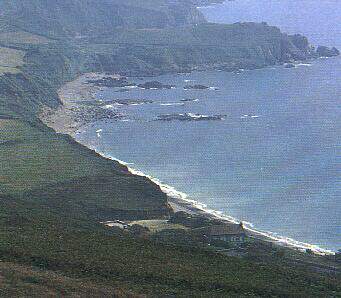 located rue du
Commandant Kieffer tel 0231446254. Open every day from April to mid-October.
Closed in low season. Entrance fee. It recalls the events of that night with
maps, photos and diverse souvenirs: uniforms, arms and the famous bagpipe
everybody who saw the "Longest Day" will remember!
located rue du
Commandant Kieffer tel 0231446254. Open every day from April to mid-October.
Closed in low season. Entrance fee. It recalls the events of that night with
maps, photos and diverse souvenirs: uniforms, arms and the famous bagpipe
everybody who saw the "Longest Day" will remember!
On the east side of the Orne river there are two more sights you should visit (D
514) In the village of RANVILLE the British and Commonwealth war cemetery
contains 2536 dead, including that of Lt. Den Brotheridge, the first allied
soldier killed in invasion. Neat lawns, rows of white headstones and a parish
church built in Norman style from soft-toned Caen stone paint a very English
scene.
If one of the contemplative pleasures of touring the D-day beaches is to compare
the different
styles with which nations choose to honour their dead, another is to try to
imagine the ferocious dramas that took place around what are now dull and
twisted lumps of concrete. Just beyond Sallenelles, a village still living in
1940, are the remnants of the MERVILLE BATTERY: tel 0231242357, open from April
1 to Sept 30 every day. On a 16 hectares site protected by barbed wire, mines
and anti-tank ditches, this was a heavily armed brick, one of the most
impressive in the Atlantic wall of the Atlantic Wall. Capturing it proved a
costly affair—70 men were lost to capture this artillery piece of four
enormous canons protecting Ouistreham and the environing villages. Today the
battery resembles a mid-20th century tumulus: cows and horses graze
nonchalantly beside its casements, while one of the 4 casemates (protected by 2
meters of reinforced concrete) is transformed into a small museum, which
struggles to be an “aide-memoire”.
Bibliography
A holiday history of France,
by Ronald Hamilton (London-Hogarth press), Region Normandie, ses merveilles, ses
cicatrices, by Louis Letellier (ed. Cloison, Rouen 1995), Holt’s battle field
guides, Normandy Overlord by Holt, Tonie and Valmai (Sandwich, Kent), La France
des petits chemins: Normandie, by J. de la Valléé (ed. Cité presse, Paris
1998), Six armies in Normandy, by John Keegan, (paperback ed. Pimlico),
Juno-Sword, plages de feu et de sang by, Lt. J.Kieffer (ed.Barbet-Rouen 1975)
Back to Normandy main page and cities
Ouistreham
Omaha beach
Pointe du Hoc
Utah Beach