|
Bayeux war memorials-Site Home - What's New?-Feedback - About Jack-Travel/Art Links |

NORMANDY
Normandy - Bayeux - War memorials
Memorial sites
and beaches main page
D-Day beaches and War Memorial
Pegasus Bridge
Benouville
Ranville
We arrive to BAYEUX coming from the D 516 from
Arromanches. 
Bayeux, fortunate city. Maybe the only bigger city having that didn't
suffer heavily from war destructions like St.Lo and Caen, very popular with
visitors but which somehow maintained its sanity. Through the eye of a needle…thanks
to the surprise effect of the Allied troops who liberated Bayeux on 7 June 1944
as first French city. Therefore the city kept an agreeable nucleus of historic
buildings located to the south.
But this section, dedicated to the landing sites and memorials will be only
about the memorials in Bayeux. For the tourist visiting part, which is important
and interesting, check the” Normandy tourist” section and Bayeux in this
particular subject.
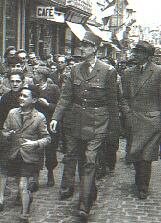 First memorial is the
MUSEE MEMORIAL DU GENERAL DE GAULLE 10, rue Bourbesneur, tel 0231924555. Open
only from March 15 to Nov 15.
First memorial is the
MUSEE MEMORIAL DU GENERAL DE GAULLE 10, rue Bourbesneur, tel 0231924555. Open
only from March 15 to Nov 15.
The museum celebrates the life of the French political leader, who was
welcomed into the city on 14 June 1944. A column in a tree lined park, place
General de Gaulle, celebrates the victorious speech he made that day.
MUSEE MEMORIAL DE LA BATAILLE DE NORMANDIE is on the boulevard
Fabian-Ware tel 0231929341 fax 02318511. If you are interested in weapons, this
is the place! The largest collection of its kind in France. It provides mainly a
thorough account of the war with the aid of maps, photos, newspaper front pages
and the announced weapons and equipment meant to be used to destroy: glass mines
(causing horrible injuries), "mustard pots", bouncing bombs, wooden
mines (undetectable), handle-grenades, fumigant traps....
Less ambitious as the one in Caen, this museum, located in a vast modern
building presents nevertheless a complete and thrilling panorama of the military
operations of 1944. At the ceiling, one of the puppets parachuted by the
Americans to fool the enemy! Interesting is to read the propaganda published at
that time (completely under the control of the nazis), relating the multiple and
horrible massacres perpetrated by the Allies among the French population. The
kind of: "40.000 French killed in Caen!"
It’s introductory film compilation, using newsreels of the day, is one of the
best of its kind to be found anywhere.
A little further along the same boulevard but on the other side of the road,
facing the museum is THE BRITISH CEMETERY. Under sober and simple white pickets, 4.700 British soldiers including from Canada, South Africa
and Australia, rest in peace. They gave their lives to liberate France. A minute
of silence please. You measure here the enormous part taken by Great-Britain in
these combats.
To see in the near neighbourhood of Bayeux:
----------------------------------------------------------------------
LE MUSEE DES EPAVES SOUS-MARINES DU DEBARQUEMENT (Museum of the submarine
wrecks of D-Day) at Commes, route de Bayeux tel 0231211706. Open from June to
end September.
Hundreds of vestiges patiently pulled out of the water: plane debris,
sunken tanks, war ship debris, personal belongings, diverse rams scattered
around on the beaches...are gathered in a large shed. It's crazy what you can find under water!
Bibliography
A holiday history of France, by Ronald Hamilton (London-Hogarth press), Region Normandie, ses merveilles, ses cicatrices, by Louis Letellier (ed. Cloison, Rouen 1995), Holt’s battle field guides, Normandy Overlord by Holt, (Tonie and Valmai ,Sandwich, Kent), La France des petits chemins: Normandie, by J. de la Valléé (ed. Cité presse, Paris 1998), Six armies in Normandy, by John Keegan, (paperback ed. Pimlico), Routard 1999 (ed. Hachette), Bayeux la miraculée, by Paul Letellier (presses univ. Paris 1987)
Back to Normandy main page and cities
Bayeux War Memorials
Omaha beach
Pointe du Hoc
Utah Beach