
|
Site Home - What's New?-Feedback - About Jack-Travel/Art Links |
|
|
Paris-20th arr-Belleville, old popular heart of Paris (1) |
|
For a BELLEVILLE walk, it is best to start from the metro station "Telegraphe"(line 11). If you follow the rue du Télégraphe a few steps, you will see two plaques on the wall of the cemetery of Belleville, at no.49. This is another high point of Paris, 125,508 meters above sea level. Claude Chappe built here his first telegraph pole in 1794, which would give optical signals between Paris and Lille. At the first crossing, take the rue Borrego at the right and you arrive at the rue de la Duée. Look at the right side of the street, a few steps go downstairs and lead to the very narrow Passage de la Duée. The alley is so small and narrow-not more that 80 cm in some passages-that you have only two options if you see somebody coming your way. Or scotch yourself and your back to the wall and flatten your belly, or turn back.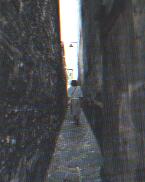 Continue your stroll over the rue de Pixerecourt, left down until rue de Menilmontant. You take it, continue until the rue de l'Ermitage by passing the rue des Pyrenées. Make a right at the rue de l'Ermitage and via the rue de la Mare and the rue des Couronnes (see my previous walk in Menilmontant) we are at the Parc de Belleville. This steep downhill park of 47,000 sq.m. was opened to the public in 1988 and is a creation of François Debulois. The architect imagined a twisting maze circuit, zigzagging between the bushes, bamboos, tile trees and cytisas. It's here that you can admire the biggest cascade fountain of Paris (100 metres long). Unfortunately it doesn't work anymore and is completely dry. The Orangerie it is open every day from 13.30 to 17.00. I must admit that the park is quite a success, an ingenious walk and a haven of peace where you see often groups of Chinese exercise their famous morning gymnastics. Continue your stroll over the rue de Pixerecourt, left down until rue de Menilmontant. You take it, continue until the rue de l'Ermitage by passing the rue des Pyrenées. Make a right at the rue de l'Ermitage and via the rue de la Mare and the rue des Couronnes (see my previous walk in Menilmontant) we are at the Parc de Belleville. This steep downhill park of 47,000 sq.m. was opened to the public in 1988 and is a creation of François Debulois. The architect imagined a twisting maze circuit, zigzagging between the bushes, bamboos, tile trees and cytisas. It's here that you can admire the biggest cascade fountain of Paris (100 metres long). Unfortunately it doesn't work anymore and is completely dry. The Orangerie it is open every day from 13.30 to 17.00. I must admit that the park is quite a success, an ingenious walk and a haven of peace where you see often groups of Chinese exercise their famous morning gymnastics.Left of the park, if you can find the "Passage de Plantin, take it, and admire the small, squashed houses one storey and pointed facades, villas with luxurious green gardens. You arrive on the rue de Transvaal where, right on no.16, an iron wrought gate blocks the entrance of the VILLA CASTEL. If you are a little handy, no problem to open the gate and enter in a world, which existence (in your mind) should have disappeared a long time ago.  Like in many village streets houses are leaning one on another, flowers and bushes grow all around. It's in this dead end alley that François Truffaut shot many scenes of his movie "Jules et Jim". And make a stop at the antique shop (under the roof) where you will be able o pick up some old times, maybe without great value but charged with memories of the past. Like in many village streets houses are leaning one on another, flowers and bushes grow all around. It's in this dead end alley that François Truffaut shot many scenes of his movie "Jules et Jim". And make a stop at the antique shop (under the roof) where you will be able o pick up some old times, maybe without great value but charged with memories of the past.Re-enter the park and exit via the rue Ramponneau and turn right rue Denoyez, a small street still presenting one-floor houses of about two centuries, old guingettes. You emerge now on the rue Belleville..between two splendid cafés, with ancient zinc counters, hearty, convivial and always packed. You want to lose your tourist feeling? Have a drink inside! Once night falls, the heart of the rue des Envierges starts to beat to the rhythms of the hand organ of "Riton la Manivelle" or at the melodies of the accordions of Minelle and Gavroche who anime the dancing dinner-party of the old Belleville. And until the end of the night, you will be lured and attracted by a crowd that dances, shouts, sings balances at the sounds of a farandole and when all whirls around you. About the rue Belleville there is some more to tell and more anecdotes that might interest some off beaten path travellers. That will be for my next article. More about all other Paris arrondissements on my web site Bibliography Dictionnaire historique de la ville de Paris, by Jacques Hillairet (ed.Minuit)-Le Guide du Promeneur, Parigramme (guides par arrondissement)-Le Pieton de Paris, by Leon Lafargue (Ed.Gallimard), De Lutèce à Paris, by Philippe Velay (ed.CNRS) |
||