Certain take the place of
industrial sites, others respond to the secret wish of inspired landscape
architects. Large or small; here are six Parisian spaces green of mystery.
Almost unknown to the grand public. We will visit successively the Parc de Bercy,
the Parc André Citroen, the Parc Georges Brassens, the Jardin Shakespeare, la
Serre des cactus d'Auteuil and le Jardin de l'Arsenal.
 1.PARC
DE BERCY:
Opened in 1995, signed by the
landscape architects Yann Le 1.PARC
DE BERCY:
Opened in 1995, signed by the
landscape architects Yann Le 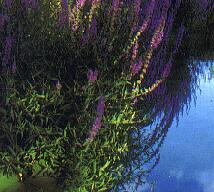 Caisne and Philippe Raguin, the parc de Bercy has
still some remains of vineyards like the ancient pavements that
crisscross the domain. The garden leads to the “Maison du Lac”, that used to
house the tax service on wines and other alcohols. First it looks like a large
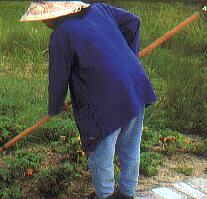
prairie, the, after the iron fence, you discover the kitchen-garden, the
orchard, the rose garden, the labyrinth, the odour garden and the bulbs
surrounding the “Maison du jardinage” where you can learn gardener tricks
and read gardening books. The footbridge
over the rue Joseph Kessel leads to a romantic garden: Corsica pines, Lebanese
cedars, birch-trees and weeping-willows grow there among a theatre of greenery,
a belvedere and a Jardin du Philosophe. Caisne and Philippe Raguin, the parc de Bercy has
still some remains of vineyards like the ancient pavements that
crisscross the domain. The garden leads to the “Maison du Lac”, that used to
house the tax service on wines and other alcohols. First it looks like a large
prairie, the, after the iron fence, you discover the kitchen-garden, the
orchard, the rose garden, the labyrinth, the odour garden and the bulbs
surrounding the “Maison du jardinage” where you can learn gardener tricks
and read gardening books. The footbridge
over the rue Joseph Kessel leads to a romantic garden: Corsica pines, Lebanese
cedars, birch-trees and weeping-willows grow there among a theatre of greenery,
a belvedere and a Jardin du Philosophe.
The access is through the rue Paul-Belmondo, Joseph Kessel, de l’Ambroisie and
François Truffaut in the 12th arrondissement. Open every day at
9.00. Closing half an hour before sunset.
2.THE PARC ANDRE CITROEN: the
most futurist park of Paris is located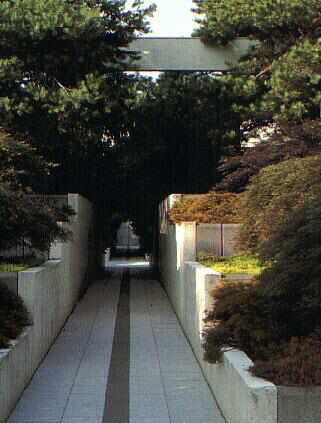
 on
the site of the ancient Citroen plant by the landscape architects Alain Provost
and Gilles Clement. Water has a very important place here (proximity of the
Seine river obliges!). As soon as the sunny days come out, children dabble about
in the basins, called here “lisières”, and have fun under the waterspouts.
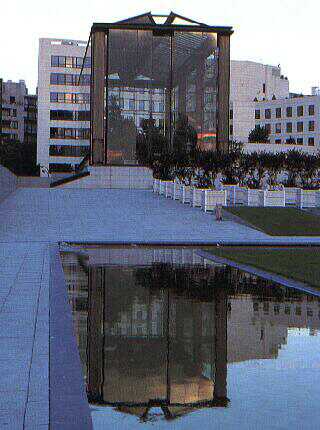
In front of two impressive glass cases, bordered by Magnolias pruned in a
column, a vast lawn, where you are permitted to run on, opens on the river. on
the site of the ancient Citroen plant by the landscape architects Alain Provost
and Gilles Clement. Water has a very important place here (proximity of the
Seine river obliges!). As soon as the sunny days come out, children dabble about
in the basins, called here “lisières”, and have fun under the waterspouts.
In front of two impressive glass cases, bordered by Magnolias pruned in a
column, a vast lawn, where you are permitted to run on, opens on the river.
On one side you discover the “Jardin des Metamorphoses” geometrically
organized, on the other side, “Le Jardin en Mouvement”, looks like fallow
land, but imagined by Gilles Clement: rose bushes, corn –poppies, bamboos,
balsamines, digitals, thorns and other weed grow freely. In its proloungement
come the “Jardins sériels”, more intimate, with each one in a dominant
colour: red, orange, green, blue, gilded and blue and silvery.
You
can access through the quai André Citroen and the rues de la Montagne de
l’Esperou, de la Montagne de la Fage, Saint-Charles et Leblanc, Paris 15th.
Open every day at 9.00. Closing
half an hour before sunset.
3. Parc Georges Brassens:
The belfry of the ancient
slaughterhouse 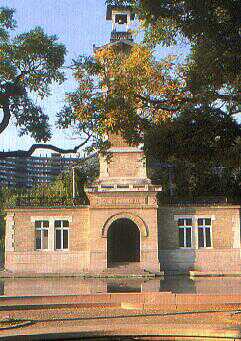 auction
hall, a veritable witness of history, dominates the main entrance of this garden
and park Georges Brassens and reflects in the large central basin. In this
hidden corner of the 15th arrondissement, a large vineyard auction
hall, a veritable witness of history, dominates the main entrance of this garden
and park Georges Brassens and reflects in the large central basin. In this
hidden corner of the 15th arrondissement, a large vineyard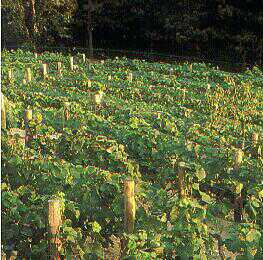 and vegetable gardens preceded the meat trade. Like a beautiful vineyard of
Pinot Noir testifies, vintaged every year by the children of the area. It gives
a “cuvee” named “clos-des-morillons”. You must ford a river to
accentuate that sensation of evasion usual to the open landscapes and discover
some beehives. Nearer the main entrance, in a maze of paths, you will find the
odoriferous, aromatic and medical plants: it’s “le jardin des senteurs”,
imagined by Alexandre Ghiulamila, Jean-Michel Milliex and Daniel Collin.
and vegetable gardens preceded the meat trade. Like a beautiful vineyard of
Pinot Noir testifies, vintaged every year by the children of the area. It gives
a “cuvee” named “clos-des-morillons”. You must ford a river to
accentuate that sensation of evasion usual to the open landscapes and discover
some beehives. Nearer the main entrance, in a maze of paths, you will find the
odoriferous, aromatic and medical plants: it’s “le jardin des senteurs”,
imagined by Alexandre Ghiulamila, Jean-Michel Milliex and Daniel Collin.
Main entrance through the rue des Morillons, but also by the rue Brancion and
Perichaux, Paris 15th.
Open every day at 9.00. Closing
half an hour before sunset.
4.Jardin Shakespeare:
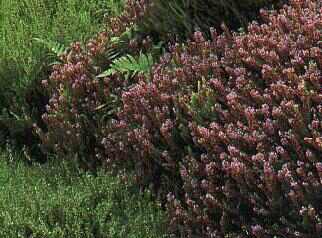 In
a hidden corner of the Pré-Catalan, in the heart of the Bois de Boulogne,
it’s a greenery theatre, created in 1953 by the head conservator of Paris
gardens and parks, Robert Joffret, on the spot of an ancient quarry whose stones
were used to pave the forest alleys. The vegetal ambience of In
a hidden corner of the Pré-Catalan, in the heart of the Bois de Boulogne,
it’s a greenery theatre, created in 1953 by the head conservator of Paris
gardens and parks, Robert Joffret, on the spot of an ancient quarry whose stones
were used to pave the forest alleys. The vegetal ambience of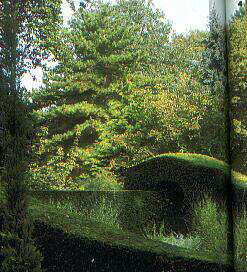 Shakespeare’s plays are reconstituted in a succession of small thematic
gardens: the Scottish moor of “Macbeth”, the melancholic basin where
Hamlet’s fiancée drowns, the untamed garden of “The Storm”. The stage is
under the cypresses, the loges under the rockery.
Shakespeare’s plays are reconstituted in a succession of small thematic
gardens: the Scottish moor of “Macbeth”, the melancholic basin where
Hamlet’s fiancée drowns, the untamed garden of “The Storm”. The stage is
under the cypresses, the loges under the rockery.
Access by the Pré-Catalan, Paris 16th. Open every day from 14.30 to
16.00 except when a play is scheduled. For info phone 0140199533
 5.
Serre des cactus d'Auteuil 5.
Serre des cactus d'Auteuil
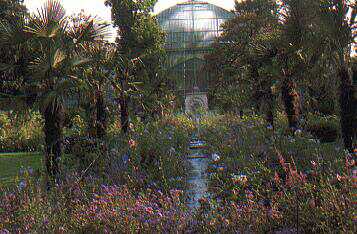
More discreet than the neighboring
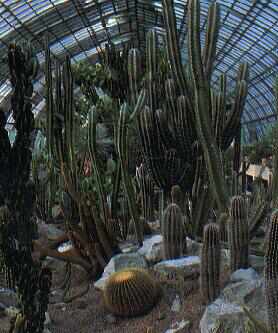
palmarium, but maybe more unexpected, this glass case houses “succulent”
plants growing in dry surroundings and have the aptitude to capture and keep
water. Most of the cacti were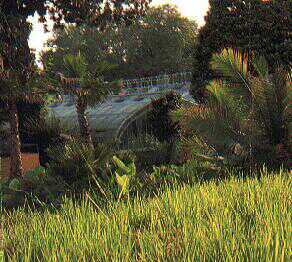 bought
by the city of Paris in 1995, but collectors come regularly to enrich the
diversity of the presented varieties. Amidst the agaves, the Euphorbia
candelabrum touches already the roof of the glass house (when it is pruned, it
gives a allergic gas and its sap irritates the skin of the gardeners). bought
by the city of Paris in 1995, but collectors come regularly to enrich the
diversity of the presented varieties. Amidst the agaves, the Euphorbia
candelabrum touches already the roof of the glass house (when it is pruned, it
gives a allergic gas and its sap irritates the skin of the gardeners).
The
Ferocactus stainesii, with its red leaves, is not more sympathetic. And the
Euphorbia hislopii, it hides a ferocious game under its splendid leaves.
Fascinating!!
Access
through the avenue de la Porte d’Auteuil 3, and 1, avenue Gordon Bennett Paris
16th.
Open in the afternoon on demand
and Sunday from 16.00 to 18.00.
6.Jardin de l'Arsenal
 A
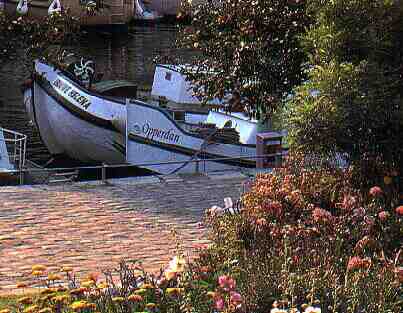
stone throw from the Opera Bastille, the décor is well set: this alley with
flat maple-trees, alder-trees, apple trees is the most romantic of all gardens.
Pergolas of rose bushes, walls covered with clematis and honeysuckle rise out of
the terraces of coloured flowers. All this in front of the pleasure boats of the
bassin de l’Arsenal, dug in 1806. When the last rays of the setting sun kindle
the alley, it’s a delicious walk. Designed by Philippe Mathieux and Serge
Eyzat is at its best in June, when the roses exhale their smell. A
stone throw from the Opera Bastille, the décor is well set: this alley with
flat maple-trees, alder-trees, apple trees is the most romantic of all gardens.
Pergolas of rose bushes, walls covered with clematis and honeysuckle rise out of
the terraces of coloured flowers. All this in front of the pleasure boats of the
bassin de l’Arsenal, dug in 1806. When the last rays of the setting sun kindle
the alley, it’s a delicious walk. Designed by Philippe Mathieux and Serge
Eyzat is at its best in June, when the roses exhale their smell.
Entrance through the boulevard de
la Bastille. Paris 12. Open every day from 7.30 to 23.00.
back
to Jack travel
|
