|
MENILMONTANT! A symbol in the 18th and 19th with its "guingettes" (village taverns) on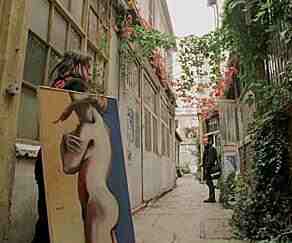 hillsides planted with vineyards that lasted for a long time. The quality of the wine may have been mediocre, but it was sooo cheap! Menilmontant, being considered at that time as lying outside Paris, had no taxes to pay. But an end came to all this in 1860 when the village was incorporated to Paris. It stayed a Parisian landmark, this village in the eastern part of the city, centre of nightlife for the "simple" man. The origin of the name "Menilmontant" has nothing to do with the light slope of the street. It comes from ""mesnil mautenz" which means "bad weather hillsides planted with vineyards that lasted for a long time. The quality of the wine may have been mediocre, but it was sooo cheap! Menilmontant, being considered at that time as lying outside Paris, had no taxes to pay. But an end came to all this in 1860 when the village was incorporated to Paris. It stayed a Parisian landmark, this village in the eastern part of the city, centre of nightlife for the "simple" man. The origin of the name "Menilmontant" has nothing to do with the light slope of the street. It comes from ""mesnil mautenz" which means "bad weather
Edith Piaf, tiny woman in stature, but immense in voice and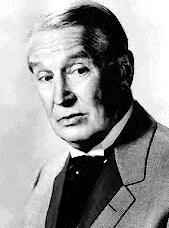 talent, nicknamed "the singing sparrow", was born in this quarter. I her time she was still able to play with the ducks and goose running freely on the streets, and sang for a few "sous" her songs on inner courtyards. In the cabarets of Menilmontant, Maurice Chevalier and Charles Trenet had their first successes. But all this is the past and all what remains are quarters that refuse to die. talent, nicknamed "the singing sparrow", was born in this quarter. I her time she was still able to play with the ducks and goose running freely on the streets, and sang for a few "sous" her songs on inner courtyards. In the cabarets of Menilmontant, Maurice Chevalier and Charles Trenet had their first successes. But all this is the past and all what remains are quarters that refuse to die.
 |
|
Charles Trenet |
If you loiter from Menilmontant to Belleville, you will feel attracted between two worlds. Social housing projects but in the small street you can still feel the former atmosphere, much more friendlier that the Parisian one.
Walk along the boulevard de Menilmontant (starting at the metro Pére Lachaise), along some cafés moreless picturesque, like the one at no.72, old Persian zinc, plaque "Destin" where it is written: "Ici, on boit".
At a certain moment turn right in the rue de Menilmontant. This is the nowadays typical multi-cultural streets, with its Arab butchers, Jewish delicatessen, traditional bakeries and stores like "Momo is the cheapest". Low houses alter witch concrete buildings. On one of them you can see a fresco on a blind wall announcing solidarity of the "petit gars de Menilmontant".
Make a left to discover the parvis of the church "Notre Dame de la Croix." It's here that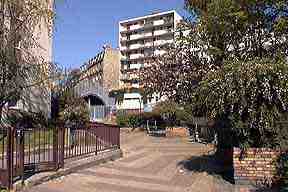 Monseigneur Darbois, archbishop of Paris was trailed and condemned to death sentence by the revolutionaries of the Commune on May the 6th 1871. He was shot on May 24. The square is called "place Maurice Chevalier". Take the street behind the church, the rue de la Mare, erratic and capricious, an old classic urban site with a funny bridge passing over a railway. The place is deserted, strange, silent and mysterious. Pass the bridge and you'll walk again on a paved soil. Continue the rue de la Mare, passing an old plant with superb iron architectural pillars and glass cases, abandoned today. The street climbs and ends at the intersection of the rue des Cascades, always bordered by some old typical Menilmontant houses. All these names like "cascade" reflect an ancient reality: water used to flow abundantly here. Sources provided water to Paris. The rue des Cascades leads to the rue des Savies, on bumpy pavements of a narrow street calling up memories of long bygone days. In 1951, Simone Signoret, was the star in the classic movie "Casque d'Or", the life of Amélie Melie, bewitching Paris for 20 years. Three small houses on no. 64-68 still remind that time. Monseigneur Darbois, archbishop of Paris was trailed and condemned to death sentence by the revolutionaries of the Commune on May the 6th 1871. He was shot on May 24. The square is called "place Maurice Chevalier". Take the street behind the church, the rue de la Mare, erratic and capricious, an old classic urban site with a funny bridge passing over a railway. The place is deserted, strange, silent and mysterious. Pass the bridge and you'll walk again on a paved soil. Continue the rue de la Mare, passing an old plant with superb iron architectural pillars and glass cases, abandoned today. The street climbs and ends at the intersection of the rue des Cascades, always bordered by some old typical Menilmontant houses. All these names like "cascade" reflect an ancient reality: water used to flow abundantly here. Sources provided water to Paris. The rue des Cascades leads to the rue des Savies, on bumpy pavements of a narrow street calling up memories of long bygone days. In 1951, Simone Signoret, was the star in the classic movie "Casque d'Or", the life of Amélie Melie, bewitching Paris for 20 years. Three small houses on no. 64-68 still remind that time.
Descend now left by the rue des Couronnes. No.45 is the location of a disappeared cabaret "Pistolet" where the famous bandit Cartouche was arrested on the 230th of October 1721, died on the place de Gréve after a swift trial. He was 28 years old.
If you take now the rue de Transvaal, you will be taken to a belvedere where you have the most beautiful view on Paris (IMHO). It's the culminant point of Paris, 8 meters higher than Montmartre. Take a deep breath!
Bibliography
Dictionnaire historique de la viulle de Paris, by Jacques Hillairet (ed.Minuit)-Le Guide du Promeneur, Parigramme (guides par arrondissement)-Le Pieton de Paris, by Leon Lafargue (Ed.Gallimard), De Lutèce à Paris, by Philippe Velay (ed.CNRS)
|
