|
During the Second Empire, the village of Charonne, far from the noise and agitation of the capital, was an unspoiled small village like Jean Jacques Rousseau described it in "Confessions" and in "Les Rêveries d'un promeneur solitaire". The names: rue des Haies, la rue des Prairies, la rue des Maraîchers, la rue du Clos.... still testify that the village was dedicated to the vegetable and fruit culture. The neighbouring villages Belleville and Ménilmontant, much more dedicated to craftsmanship and industry, were not so popular among the wealthy Parisians, who looked up Charonne, to build summerhouses and second residences. With its annexion, the last prairies disappeared, but with a little imagination, the walker can still imagine that he is in a small village almost intact, except the huge high rise modern crap, that i will talk later about.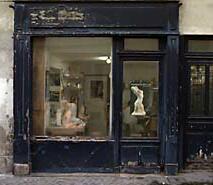
The conservation of the old village of Charonne in the Paris area, constitutes a virtue of the survival of an urban structure composed of small half-craft, half-industrial workshops together with workers' allotments, the witness of a 19th century rural society. This historic heritage is nowadays recognised not only as a cultural asset of great educational importance but as an environment on a human scale, capable of meeting the needs of contemporary life and fostering both social balance and personal development.
That's why the survival of such areas in Paris is vital and important. It's not only on the Charonne quarter but also on many others that survive in Paris, that I have the boldness to draw your attention upon.
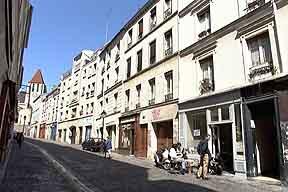 They usually start with a cluster of small, perhaps winding, streets, placed at an angle to surrounding major thoroughfares might signal an older 'village' that had since been surrounded by the city as a whole. Some of these 'villages' are visually more interesting than their, often, modern surroundings - and these are also usually areas in constant danger of being 'disappeared' by progress, by demands for housing or office space. But luckily, after a period of self destruction, citizens and some of their organizations begun to campaign to preserve vital parts of old Paris; and it is a case of 'better late than never,' and in general, it has been 'late' rather than 'sooner.' They usually start with a cluster of small, perhaps winding, streets, placed at an angle to surrounding major thoroughfares might signal an older 'village' that had since been surrounded by the city as a whole. Some of these 'villages' are visually more interesting than their, often, modern surroundings - and these are also usually areas in constant danger of being 'disappeared' by progress, by demands for housing or office space. But luckily, after a period of self destruction, citizens and some of their organizations begun to campaign to preserve vital parts of old Paris; and it is a case of 'better late than never,' and in general, it has been 'late' rather than 'sooner.'
The tour starts on a (I hope), sunny day at Porte de Montreuil and enters soon the 'village' of Saint Blaise, or Charonne, as it is more commonly known.
Descend the rue Saint Blaise, recently "fixed up" and repaved with stone blocks from doorway to doorway, traffic access is restricted and so is parking. The street is lined with very cute old houses, but sometimes replaced by huge towers erected in the '60, disfiguring the quarter. It seems that the 'fix' has not been a big success, from a landlord's viewpoint. The considerable number of restaurants that existed years ago (I was 18, what a long time ago :-)) are still here and even have the same names. Notice at 85, rue de Bagnolet, the villa Godin and the villa Lesseps at no.87. Most of the older buildings are of few floors and many of the shops have not been fixed up, but do contain young people, who are doing things with computers. I do not know what they are
 doing, but they are not dressed like accountants. Other shops contain local crèches that seem to have been left out of the planning of the nearby public housing; they these are not renovated either. doing, but they are not dressed like accountants. Other shops contain local crèches that seem to have been left out of the planning of the nearby public housing; they these are not renovated either.
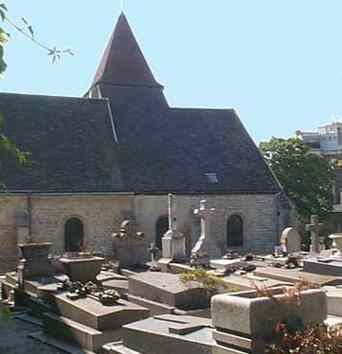
At the top, on the rue de Bagnolet, there is the 12th century Saint-Germain-de-Charonne church, rebuilt in the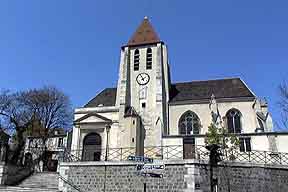 15th century, with its impressive clock-tower (13th century), overhanging a majestic flight of stairs. Newt to the church is one of the most curious Paris cemeteries. Tomb of the French nazi collaborator and virulent anti-Semite, Robert Brasillach, shot by a squadron after the liberation, the son of André Malraux and others. 15th century, with its impressive clock-tower (13th century), overhanging a majestic flight of stairs. Newt to the church is one of the most curious Paris cemeteries. Tomb of the French nazi collaborator and virulent anti-Semite, Robert Brasillach, shot by a squadron after the liberation, the son of André Malraux and others.
The rue Vitruve is the limit of the village: here, the architect, to overcome the contradiction of the monumental new homes and the countryside aspect of the area (that he wanted to keep), he fractioned some buildings into several smaller ones, separated by patios, closed by walls where the plants make it look natural. But unfortunately, the facades look worn out.
Next post about another Paris village: Menilmontant.
Bibliography
Les Rêveries d'un promeneur solitaire, by J.J.Rousseau- Vie et histoire du 20th arr: Belleville, Charonne, histoire, anecdotes, curiosités, monuments, musées, jardins, promenades, by Simon Lacordaire- Charonne: the good old days, by Nick Mika-Dorpen in Parijs, by Jan Hoekstra(ed.Lannoo)
|
