|
For the lovers of pret-à-porter, not expensive and easy to wear, there is no place more mythic as the "SENTIER" in Paris. Fashion is created here, in the numerous ateliers and work shops climbing up to the highest floors, working day and night, cutting, folding, sewing, stitching to keep ahead of the next fashion trend. It's a factory plant in the heart of the 2nd arrondissement, but also a welcome area for loitering, plenty of surprises and curiosities, cultivating the art of surprise and back-scent. more mythic as the "SENTIER" in Paris. Fashion is created here, in the numerous ateliers and work shops climbing up to the highest floors, working day and night, cutting, folding, sewing, stitching to keep ahead of the next fashion trend. It's a factory plant in the heart of the 2nd arrondissement, but also a welcome area for loitering, plenty of surprises and curiosities, cultivating the art of surprise and back-scent.
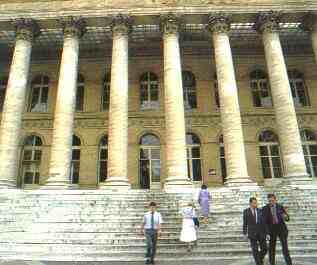 One of France's leading papers (centre right wing) the "Figaro" will be the starting point of this tour passing the BOURSE, Paris stock exchange and the SENTIER. The Figaro is located next to ageless old buildings (up to the rue Reaumur), some being the finest example of metallic architecture of the beginning of the 20th century. One of France's leading papers (centre right wing) the "Figaro" will be the starting point of this tour passing the BOURSE, Paris stock exchange and the SENTIER. The Figaro is located next to ageless old buildings (up to the rue Reaumur), some being the finest example of metallic architecture of the beginning of the 20th century.
Turning left to the Palais Brogniart, you will pass along the Grecian columns of the BOURSE. Don't you imagine something is going on inside! It's completely empty, all is done via PC and other modern technologies. You can always enter to see the diapos, films and other about all this worked in older times and now. And if you are on a vacation where you don't want to even hear the name "finance", avoid the building and walk along the small rue Brogniart, leading to rue Notre Dame des Victoires and stumble upon the "café du Croissant", the spot where Jean Jaures was murdered, 31st of July 1914. One of the greatest political figures of modern French history. The pure and hard Socialist of the beginning.
You come now to the rue Poissonnière, which used to be the only way for the fish carriers to reach Paris, coming from the Pas de Calais. When the street changes name and becomes the rue des Petits Carreaux and finally you reach rue D'ABOUKIR, which you follow to the left. You are now PLACE DU CAIRE where the very ill reputed, medieval "COUR DES MIRACLES", was situated. By the day, the handicapped, blind and deaf went out to beg on the streets. By night they returned shed their wooden legs and eye patches, met all sorts of other companions like cut throats, thieves, murders, bandits and embarked on riotous orgies, so well described in Victor Hugo's "Hunchback of Notre Dame", a book I advise you strongly to read and read again. Never a man described medieval Paris so well and lively. Don't fear anything today, it became an area packed with low-costing cloth shops, selling everything from Gaudy underwear to handmade carriers to reach Paris, coming from the Pas de Calais. When the street changes name and becomes the rue des Petits Carreaux and finally you reach rue D'ABOUKIR, which you follow to the left. You are now PLACE DU CAIRE where the very ill reputed, medieval "COUR DES MIRACLES", was situated. By the day, the handicapped, blind and deaf went out to beg on the streets. By night they returned shed their wooden legs and eye patches, met all sorts of other companions like cut throats, thieves, murders, bandits and embarked on riotous orgies, so well described in Victor Hugo's "Hunchback of Notre Dame", a book I advise you strongly to read and read again. Never a man described medieval Paris so well and lively. Don't fear anything today, it became an area packed with low-costing cloth shops, selling everything from Gaudy underwear to handmade
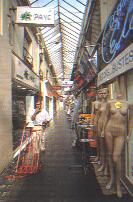 suits. Many street porters wait under the acacias for someone who will hire their strong muscles to drag heavy tissues, fabrics or dress cartons. Here, confection is not a hollow word. But the place du Caire has other features I have to mention. suits. Many street porters wait under the acacias for someone who will hire their strong muscles to drag heavy tissues, fabrics or dress cartons. Here, confection is not a hollow word. But the place du Caire has other features I have to mention.
Rich in mementoes of Napoleon's Egyptian campaign, including hieroglyphics and sphinxes.
Designed in 1798, with the statue "L'Homme au bras levé", by Olivier Brice. You can enter the passage du Caire, ornated by two statues of goddess Hathor, lintels with hieroglyphs , friezes with Egyptian motives. The passage is absolutely not charming, more a work passage for the local confectionaries. But some display window can manage you incredible surprises. I saw one a dress with the whole Sixtine chapel printed on it! Speaking of a dress impossible to sell and certainly to wear!!! Very old fashioned hat models and more impossible window display props.
|

