|
Last part of this extraordinary stroll (no.7 in Arthur's Gillette Ile Saint Louis discovery) along the Ile Saint Louis splendid homes and their historical, gossip and anecdotal interests.
At no.1 quai de Bourbon stands one of the oldest cabarets in 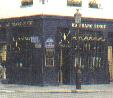 Paris, the 17th century "FRANC PINOT", meaning a trustworthy pineau, being a kind of Burgundian grape, illustrated by the iron wrought grillwork here. But its caves were used for complotting against the government and the police closed the place in 1716 after the discovery of inflammatory pamphlets. The café was later run by a certain Cecile Renault, who was accused to having conspired against Robespierre in order to murder him. She was guillotined at the age of 20 (just a kid!)and to show the good people of Paris this was a serious matter, her parents were guillotined too-for good measure! Can you believe that? Arthur doubts it and says it is an invented anecdote to blacken the French Revolution. It's a horrifying story, however. Paris, the 17th century "FRANC PINOT", meaning a trustworthy pineau, being a kind of Burgundian grape, illustrated by the iron wrought grillwork here. But its caves were used for complotting against the government and the police closed the place in 1716 after the discovery of inflammatory pamphlets. The café was later run by a certain Cecile Renault, who was accused to having conspired against Robespierre in order to murder him. She was guillotined at the age of 20 (just a kid!)and to show the good people of Paris this was a serious matter, her parents were guillotined too-for good measure! Can you believe that? Arthur doubts it and says it is an invented anecdote to blacken the French Revolution. It's a horrifying story, however.
Let's move to a very curious house at no.15, quai de Bourbon. No, the lopsided features on its façade are not a joke, but the result of continuing settling of the building. Don't forget that the island was originally barley above the river level. The first architect had to begin by building a wall around it, and filling the created gap with rubble, several meters deep. This rubble is still settling today and Islanders now and again find that a door or window that juts opened easily yesterday is stuck fast shut today. Illustrious inhabitants were painter Emile Bernard, a friend of Van Gogh, Cezanne and Gauguin. A plaque states that he was the father of symbolism.
To close this series let's move to the corner of quai de Bourbon and rue Le Regrattier. Look at the building and you'll see a decapitated statue juts above an engraving in the stone saying: (in old French spelling): Femme Sans Teste" (woman without a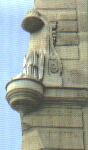 head) Well, whatever tourist guide or book may tell you, the inscription has nothing to do with the decapitated statue. It is in fact St. Nicolas, the saint patron of sailors, very dear to Nicholas Jassaud who bought this corner plot in 1661 and had a statue carved, reminding also the rowing boats that ferried people to and from the island. It was beheaded by the anti-religious Couffinhal, we met already at 5 and 6 rue Le Regrattier (the one who sent Lavoisier to the gallows). head) Well, whatever tourist guide or book may tell you, the inscription has nothing to do with the decapitated statue. It is in fact St. Nicolas, the saint patron of sailors, very dear to Nicholas Jassaud who bought this corner plot in 1661 and had a statue carved, reminding also the rowing boats that ferried people to and from the island. It was beheaded by the anti-religious Couffinhal, we met already at 5 and 6 rue Le Regrattier (the one who sent Lavoisier to the gallows).
What about the headless woman?? The consensus is that she was a shop sign in the street, showing the decapitated bust of a woman. Follow this sexistic reasoning: where a woman has no head, she has no tongue, and where a woman has no tongue "everything"-i.e. the shopkeeper's wares-is fine. But the story has a suite: the Headless Woman recovered a woman's head, juts visible here. Maybe not entirely, since her face is not visible from the street.
When is a headless woman not headless, or at least partly headless? You may wish to meditate on this theory problem as you walk along the quay Bourbon to our starting point, by the Centaur's house for a last captain's view look at central Paris.
I'll wager you'll be back here, one of the loveliest spots in the city.
If you want the illustrated brochure of all strolls mail to
Armedv@aol.com
|
