|
On the rue des Morillons, far flung south west of Paris, a beautiful park was created in 1982 (metro Convention). It is built on the spot where there used to be slaughterhouses but is now a paradise for children, with play-houses, rock piles, rivers and
mini-lakes.The parc GEORGES BRASSENS.
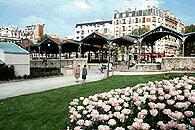 Twenty species of roses flourish in the ROSERAIE and the JARDIN DES ODEURS is a must for amateurs of aromatic plants and spices. In fact it is designed for the blind. You can sniff blind folded the fragrance of the foliage and if you know some Braille, signs will give you relevant information on herbs and shrubs. There are 700 grape plants, transformed into wine (Clos de Morillons) every year by the bistrotier Jacques Melac. On top of that, every Saturday and Sunday it houses a giant book market. And for the little children, a puppet theatre every Sunday afternoon… Twenty species of roses flourish in the ROSERAIE and the JARDIN DES ODEURS is a must for amateurs of aromatic plants and spices. In fact it is designed for the blind. You can sniff blind folded the fragrance of the foliage and if you know some Braille, signs will give you relevant information on herbs and shrubs. There are 700 grape plants, transformed into wine (Clos de Morillons) every year by the bistrotier Jacques Melac. On top of that, every Saturday and Sunday it houses a giant book market. And for the little children, a puppet theatre every Sunday afternoon…
|
|
|
La Ruche |
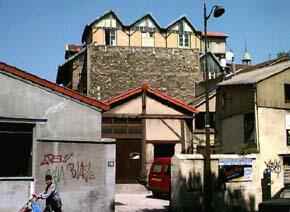
Passage Dantzig no.52, metro Convention houses LA RUCHE, where very famous and less
famous artists lived in the years 1900. Two floors, a pagoda roof and caryatides at the entrance. Used as "Pavillon des Vins " during the World Fair of 1900, it sheltered from 1902 on, Soutine, Chagall, Zadkine, Fenand Leger. The Ruche became as famous as the bateau Lavoir at Montmartre before it. A sort of oasis in the heart of Paris. Modigliani, Brancusi frequented the place and it is said that Chagall certainly painted over 30 works and that Trotsky used to sleep some nights in the pavilion.
In 1970 La Ruche almost disappeared under the demolition hammer. Luckily the real estate sharks lost the case and it is now a living space and an atelier for about 80 sculptors and painters. That's why you can only visit the garden.
Boulevard de Vaugirard, in a back house at no.34 you can visit the MUSEE DE LA POSTE. For those who are interested. Especially stamp collectors should visit the place. Fifteen rooms lead you through history of "la poste (mail)" along the centuries. Letters, stamps, airmail and telegraphy. It includes a section of special wartime services. One of the rooms is specially dedicated to the famous woman writer Marquise de Sevigné.
 |
|
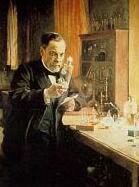
Pasteur by Edelfelt |
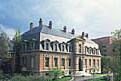 And let's finish the visit of this arrondissement, with a brief reminder that the Institut Pasteur, in the rue du Docteur Roux, one of the finest medical institutes of the world, has also a MUSEE PASTEUR. It's the house where the famous chemist and bacteriologist lived from 1888 until his death in 1895. It is kept in such a way that you have the feeling he still lives there. And let's finish the visit of this arrondissement, with a brief reminder that the Institut Pasteur, in the rue du Docteur Roux, one of the finest medical institutes of the world, has also a MUSEE PASTEUR. It's the house where the famous chemist and bacteriologist lived from 1888 until his death in 1895. It is kept in such a way that you have the feeling he still lives there.
Bibliography
--Vie et histoire des arrondissements de Paris, ed.Hervas (1985-1988--Nouvelle Histoire de Paris, ed.Hachette-Paris, 2000 d'histoire, by J.Favier, ed.Fayard 1997--Remembrance of Things Past, by Marcel Proust ( New York, Random House, 198),-- Dictionnaire Historique des rues de Paris, by Jacques Hillairet (2 vol. Paris, Editions de Minuit, 1961) Exploring Paris, Fiona Dunlop, Fodor's Travel Publications, Inc., New York.- The TimeOut Paris Guide (2nd Edition), (Penguin Books USA Inc., New York) Louis Pasteur, by Patrice Debré , (translation the Johns Hopkins University Press 1998)
|
