|
The parc Monceau was already treated in a short article in the 8th arrondissement. The area around with the nice hotels particuliers is in the 17th. That's why I will start over again as if the park was in the 17th.
To transfer to my short article in the 8th, click here. 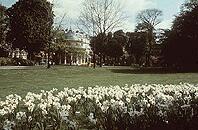
In December 1787, the Duke of Chartres, future Philippe Egalite, bought a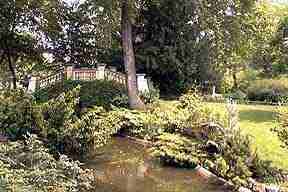 parcel of land a little more than one hectare which was the starting point of the future Monceau Park. He then increased the surface area by twelve hectares to create a place for festivals and recreation...Vistas and rivers appeared as well as surprising buildings such as an Egyptian pyramid and an oval pool " naumachie" that one finds still today. After the revolution it became a public park in what is now a wealthy quarter of the city. The designer used Rousseau's words from La Nouvelle Héloïse in explaining the aim: 'to bring together all ages and all parts of the world in a single garden'. Many ages and parts of the world are represented by follies: a Roman ruin, an Egyptian pyramid, a minaret, a Dutch windmill, a ruined fort and other structures inspired by China, the Middle Ages and prehistory. Parc Monceau is a descendent of Stowe and an ancestor of the modern Theme Park. The park changed owners following the Revolution and then the Restoration, to become, in 1860, the property of the city of Paris preserving half of its surface of the time. Inaugurated the 13th of August 1861 by Napoléon III, the park had an immediate success. parcel of land a little more than one hectare which was the starting point of the future Monceau Park. He then increased the surface area by twelve hectares to create a place for festivals and recreation...Vistas and rivers appeared as well as surprising buildings such as an Egyptian pyramid and an oval pool " naumachie" that one finds still today. After the revolution it became a public park in what is now a wealthy quarter of the city. The designer used Rousseau's words from La Nouvelle Héloïse in explaining the aim: 'to bring together all ages and all parts of the world in a single garden'. Many ages and parts of the world are represented by follies: a Roman ruin, an Egyptian pyramid, a minaret, a Dutch windmill, a ruined fort and other structures inspired by China, the Middle Ages and prehistory. Parc Monceau is a descendent of Stowe and an ancestor of the modern Theme Park. The park changed owners following the Revolution and then the Restoration, to become, in 1860, the property of the city of Paris preserving half of its surface of the time. Inaugurated the 13th of August 1861 by Napoléon III, the park had an immediate success.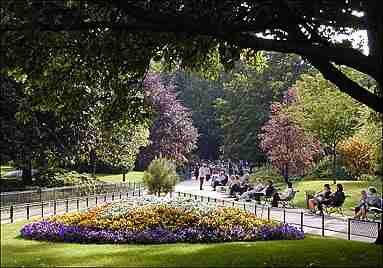 First of all because of its beauty but also because half of the " folly " was sold by Haussman to the bankers Pereire, who built many hotels particuliers around the park. First of all because of its beauty but also because half of the " folly " was sold by Haussman to the bankers Pereire, who built many hotels particuliers around the park.
These building had to follow very strict rules decreed by Haussman, like a 15 m green area in front of the house and a grille separating the edifices from the public. It's the sublime Davioud who designed all grilles in accordance to the new wealth of the area. They are magnificent. I was impressed by
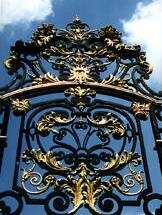 the imposing and gilded grille at the entry of the parc Monceau, and the three others like it at the other entries. They must have cost a fortune but what is it for a park originally named 'La Folie de Chartres."?? The ensemble of the park has been recomposed with refinement, creating the illusion of a harmonious nature. Rocks, waterfalls, a small bridge over a brook, a pond, tortuous paths…La Rotonde, called Pavillon de Chartres, was restored by Davioud as a guard pavilion. Other typical, decorative elements have been conserved like the " Naumachie", a colonnade recuperated from the unachieved tomb of Henri II in Saint-Denis. The park Monceau has also the largest tree of the capital: an Orient plane tree of 7m circumference. the imposing and gilded grille at the entry of the parc Monceau, and the three others like it at the other entries. They must have cost a fortune but what is it for a park originally named 'La Folie de Chartres."?? The ensemble of the park has been recomposed with refinement, creating the illusion of a harmonious nature. Rocks, waterfalls, a small bridge over a brook, a pond, tortuous paths…La Rotonde, called Pavillon de Chartres, was restored by Davioud as a guard pavilion. Other typical, decorative elements have been conserved like the " Naumachie", a colonnade recuperated from the unachieved tomb of Henri II in Saint-Denis. The park Monceau has also the largest tree of the capital: an Orient plane tree of 7m circumference.
The proximity to two museums,the space, which it offers, its long alleys, its statues, its playgrounds...make this park a place visited and appreciated by all.
You all got it now: the Parc de Monceau is not in the poorest quarter of Paris. There are few nannies with their charges all over the place almost every day. I guess the time is off too. I have seen them here in summer, sitting under the stifling greenery, waiting for a breeze - with all the grass, so green and well-cared for, inviting reclinements - but forbidden, verboten, keep off!
Bibliography
Nouvelle Histoire de Paris, ed.Hachette--Le Pieton de Paris, by L.P.Fargue, ed.Gallimard 1997--Dictionnaire historique des rues de Paris, by J.Hillairet, ed.Minuit)--Paris, 2000 d'histoire, by J.Favier, ed.Fayard 1997 --Paris 19eme siecle, l'immeuble et la rue, by F.Loyer, ed.Hazan, 1994- Paris inconnu, quartiers tranquilles, by B.Beyern (own folder)- Je me souviens du 17e arrondissement, by Catherine Vialle
|