|
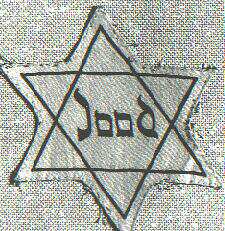 The Jodenbuurt that I have
been describing along all me previous essays was destroyed, quite literally,
between 1941 and 1943. German troops attacked Holland on the night of May 9,
1940, a Thursday. Moses Mandelbaum recalls it very clearly. He had been at a
late movie and bicycled home around midnight when he heard much distant rumbling
of Dutch anti-aircraft guns. That was nothing unusual: for months Holland had
demonstrated its neutrality by taking shots at any unidentified planes coming
over. But the following morning his mother came in his room at about six o’
clock and said:”We’re at war.” Moses lay in his bed and shivered and shook
for a while, but then calmed down, and such sheer terror would only afflict him
later during the Jews chasing. The Jodenbuurt that I have
been describing along all me previous essays was destroyed, quite literally,
between 1941 and 1943. German troops attacked Holland on the night of May 9,
1940, a Thursday. Moses Mandelbaum recalls it very clearly. He had been at a
late movie and bicycled home around midnight when he heard much distant rumbling
of Dutch anti-aircraft guns. That was nothing unusual: for months Holland had
demonstrated its neutrality by taking shots at any unidentified planes coming
over. But the following morning his mother came in his room at about six o’
clock and said:”We’re at war.” Moses lay in his bed and shivered and shook
for a while, but then calmed down, and such sheer terror would only afflict him
later during the Jews chasing.
Out on the streets people were already forming long queues at grocery stores and
shoe shops. After all these centuries of peace, they knew almost instinctively
what deprivations war could bring. The Dutch thought all there would be a static
front line of trenches somewhere east of the Zuiderzee, but this wasn’t 1914.
Four days later the sky over Amsterdam was black with the smoke of the oil
reservoirs burning, and the day afterwards the German columns marched through
the city. Dutch army had surrendered but no armistice was concluded—and there
was no surrender by the Dutch government, which, in exile, stayed in war with
Germany.
 |
|
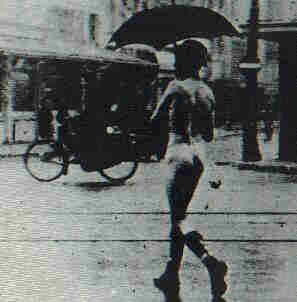
1940, defiant Amsterdammer, clad
only in a hat, socks and shoes stalks in a one-man demonstration against
the rationing of clothes imposed by the nazis. |
In the autumn of 1940 the
Germans promulgated the first of their anti-Jewish measures, dismissing all
Jewish civil servants from their posts. In February 1941, disturbances broke out
between Jewish workers and German and Dutch nazis. On February 22, the Germans
began retaliatory raids on Jonas Daniel Meyerplein (see my essay Amsterdam
visits 2—Rembrandt house-Waterlooplein). They rounded up at random 425 Jewish
men under age of 35. These men were destined for deportation to the death camps
but no one in Holland knew that yet.
I once saw in the Amsterdam Historical Museum off Kalverstraat a photograph I
believe was taken on February 22, 1941. Almost certainly an amateur, since it
was not very sharp. But it showed the crust of old snow in the square: the
winter of 1940-1941 was bitter cold, unending. German soldiers in helmet were
standing around. 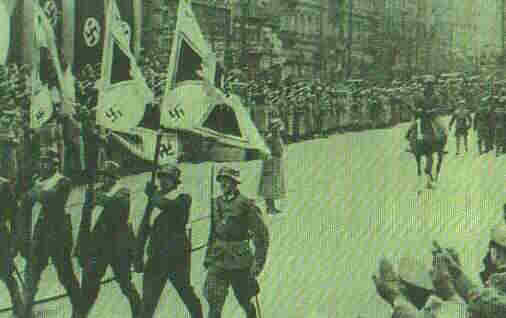 The
central figure of the picture was a Jew approaching the camera, who was
evidently herded somewhere else. He wore a long blackish overcoat, a white
shirt, and a black bow tie. A waiter, a musician? We will never know, since none
of the Jews arrested that day survived. A few steps behind the man walks a
German, in the government issued cap and belted overcoat the Dutch became to
know so well. A pistol in his belt indicated he was a sergeant or an adjudant.
The man in the long black coat seemed neither scared nor indifferent but there
was an odd, hasty expression on his face. He was going through an experience
utterly unknown in Holland and looked as he was taking stock of it. By contrast,
the officer was smiling at the camera with the relaxed air of a holiday-maker
having his snap-shot taken. He was no SS zealot, just an average member of the
German army, thousands of whom came back to visit Holland after the war was over
to show their wives where they had been stationed. The
central figure of the picture was a Jew approaching the camera, who was
evidently herded somewhere else. He wore a long blackish overcoat, a white
shirt, and a black bow tie. A waiter, a musician? We will never know, since none
of the Jews arrested that day survived. A few steps behind the man walks a
German, in the government issued cap and belted overcoat the Dutch became to
know so well. A pistol in his belt indicated he was a sergeant or an adjudant.
The man in the long black coat seemed neither scared nor indifferent but there
was an odd, hasty expression on his face. He was going through an experience
utterly unknown in Holland and looked as he was taking stock of it. By contrast,
the officer was smiling at the camera with the relaxed air of a holiday-maker
having his snap-shot taken. He was no SS zealot, just an average member of the
German army, thousands of whom came back to visit Holland after the war was over
to show their wives where they had been stationed.
That photograph documents in my opinion the destruction of Amsterdam Jewry in
one glance. For me it has the elements of a nightmare. I realize that now,
thinking about it. Hatred serves no purpose, nor is it even acceptable. Still, I
well understand an Amsterdam bookstore owner who still has, so many years later,
a sign in his window stating, “We don’t speak German.”
|