|
The “Jodenbuurt” (Jewish
neighbourhood) has no dilemma today of having lost its form of survival, since
it no longer exists. But until its extinction during WWII, the Jodenbuurt, like
the Jordaan, greatly contributed to the city’s language, humour, culture and
character. In this neighbourhood, Jewish immigrants of all periods traditionally
settled. The poorest of the residents used to live around the Waterlooplein and
farther east, in a section called the Plantage (Plantation), the houses were
larger, the streets wider, and the people more well-to-do. As in the Jordaan, a
strong sense of community existed in the Jodenbuurt, but it was based on
religion and custom rather than working-class solidarity.
It was not a ghetto or a “separate world”. Religious prejudice has always
been quite foreign to the mentality of Amsterdam and so there has never been a
need to cloak it under circumlocutions or for Amsterdam’s Jews either to seek
to avoid identification. The question simply does not arise. For instance, one
of the great Amsterdammers of the 19th century was a man named Samuel
Sarphati. The Amsterdam schools teach that he was a promoter of public housing,
an organizer of municipal services such as garbage collecting, and the builder
of a bread factory that provided better and cheaper bread for the city (he also
built the Amstel hotel). Sarphati is seen by Dutch (and not Jewish) history as a
great philanthropist. Nobody ever knew he was Jewish—until the Germans
authorities changed the name Sarphati street into “Muiderschans”.
I read in an old magazine that in 1975 an editor of an Amsterdam weekly angrily
fought against the (well meant) initiative to ban the Amsterdam word
“voddenjood” (rag-and-bones Jew), and change it into “voddenman”
(rag-and-bones man). In Amsterdam, he wrote, a man collecting rags and bones was
traditionally a Jew, and not interested in hiding that fact either. The editor
was a Jew himself.
I’m not just touching on what is admittedly a complex phenomenon. It should
not be thought that I want to paint the Amsterdammers as too good to be true,
and I do not want to imply that Anti-Semitism was entirely unknown in Amsterdam.
When the 1930’s brought an influx of new Jewish refugees from Germany, there
was a lot of unpleasant comment. However, the hostility of Amsterdammers was
really aimed at the German, not the Jewish, character of the newcomers. They had
what is called a “bei-uns” (in our country) complex. Indeed, the real nature
of nazism had not yet been quite recognized by its first victims, and the
immigrants spoke how, bei-uns, things were done more efficiently than in
Holland.
 |
|
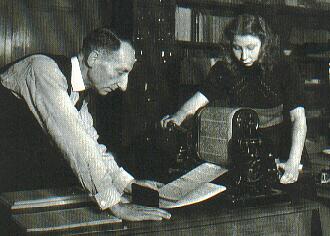
Latest Resistance news rolls |
But these were petty
irritations, wiped away forever by a massacre that utterly appalled all
Amsterdammers. After the German invasion in 1940 and the imposition of nazi
racial policies, the first reaction of the Gentile population was: “They
can’t do that to our Jews!” My uncle Arnold, 80 years old today, living in
Amsterdam, told me that he heard that from a lot of Amsterdammers in those days.
And many Dutch Jews failed to hide or escape because they, too, felt that the
Germans would not dare differentiate between them and their fellow
Amsterdammers. The ensuing horrors were made all the more tragic by the fact
that they took place in a city that for centuries had been known for the
protective welcome it extended to people of different faiths.
Next, the history of Jews in Amsterdam through the centuries.
Bibliography
Herbert I. Bloom, "The Economic Activities of the Jews of Amsterdam in the 17th and 18th" (Kennikat Press, New-York 1969), Geoffrey Cotterell, "Amsterdam, the life of a city" (Saxon House 1974), Walter B.Maas, "The Netherlands at War 1940-45 (Abelard-Schuman, New-York 1970), Werner Warmbrunn, "The Dutch under German Occupation" (Oxford University Press 1963)
|