|
The life in the Jodenbuurt
was extinguished by late 1943, when the last inhabitants were arrested. For the
rest of Amsterdam, the final blow came in the winter of 1944-45, when 20,000
people died of famine, and tulip bulbs were considered as a luxury—to eat that
is. The cold too, took a terrible toll. In September 1944, the Dutch railway
workers had gone on strike and river traffic had been halted in reprisal by the
Germans. As a result, from that time until May 1945, Amsterdam was without gas,
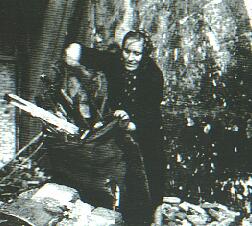
electricity or coal. Perfectly respectable citizens entered the empty houses of
the Jewish quarter to take away wood for burning: first chairs, doors and
doorposts, then floor and beams. The plundered houses collapsed and for years
after the war the derelict Jodenbuurt was a scar on Amsterdam’s face.
Moses Mandelbaum re-entered Amsterdam in May 1945--a week after the
liberation—riding on a truck of the Allied 21st Army Group. He had
a load of whole-wheat bread in the back, picked up the way north in Zeeland
province. At a stop, one of the other truck drivers took a loaf of bread and
handled it to a boy standing in the street.
 |
|
Winter of desolation |
Within a few seconds,
a crowd had assembled, an old man with an umbrella was grappling with the boy
over possession of the bread. That was hunger!………….
Piles of garbage covered the streets. Wooden blocks from between the tram tracks
had vanished, burned for fuel. And the harbour facilities had been reduced to a
pile of twisted steel. Moses mother was very thin but not starving and had still
some potatoes left from a bagful she had obtained from a farmer in April, in
trade for winter clothes. Soon the café terraces were packed, although all you
could order was a kind of sweet, purple concoction. Sipping that purple
artificiality, Amsterdammers sat and held their breath, and slowly began to
believe it was all over.
It took a long time for any recovery to come to the blighted area of the
Jodenbuurt, but in 1953 the city took the first steps towards some kind of
rehabilitation. A few blocks were rebuilt instead of being razed, and
Amsterdammers of which some Jewish stated to move back into those haunted
streets. And although Amsterdam’s post-war population figure of a mere 13,000
Jews—survivors, returnees and new-born---had risen to a registered population
of about 15,000, there can be no doubt that the Jodenbuurt, with all its special
qualities, was gone forever.
Moses showed me the only—for him—adequate commemoration of that loss on
central avenue of the Plantage, where the Hollandse Schouwburg (Dutch theatre)
formerly stood. This imposing building was the home of many long-running plays,
particularly those of the turn-of-the-century Jewish dramatist Herman
Heijermans, whose pithy dialogue and anti-romantism won him enthusiastic
audiences year after year. Being in the centre of the Jodenbuurt, the theatre
was chosen by the nazis as collection point for the arrested Jews. After the war
it was unthinkable to use this hall of miseries once more for a theatre. In 1958
the city acquired it and tore the building down, preserving as a symbolic
memorial only the façade and fragments of the four walls. Within the stone, a
stark stone column rises under an open sky, and beside it grows an olive tree
and an oleander from Israel. On a whitewashed section of the shell appear the
words: “My soul melteth for heaviness; strengthen thou me according to thy
word. Psalm 119:28”.
Moses Mandelbaum was right. This quiet, open quadrangle is the most eloquent war
monument I have ever seen…..
|