|
Go along the Spinhuisberg to
the Kloveniersburgwal canal and turn left again. Not far to the east is the
prominent grey tower, with its red and gold clock of the 17th century
ZUIDERKERK, on the opposite side of the canal. On your left is the
giant-warehouse-like façade of the OOSTINDISCHE HUIS (east India House).,
headquarters of the VERENIGDE OOSTINDISCHE COMPAGNIE. Built in 1642, it’s a
plain brick building with green double doors giving access to the storehouses.
This company once was very wealthy and imported spices, silks, tea, coffee and
other riches from Asia.
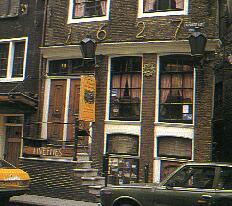 At the corner of
East-India house, turn left along the Oude Hoogstraat to go back into the sleazy
world of the Red Light District. Rejoining the Oudezijds Voorburgwal, cross the
canal and turn right into no.148 which houses the CANNABIS MUSEUM, the only of
its kind in the whole world. At the corner of
East-India house, turn left along the Oude Hoogstraat to go back into the sleazy
world of the Red Light District. Rejoining the Oudezijds Voorburgwal, cross the
canal and turn right into no.148 which houses the CANNABIS MUSEUM, the only of
its kind in the whole world.
Amsterdam has a long time liberal attitude towards soft-drug use. In hundred of
coffee shops, marijuana and hashish are free on sale and in the large cities, a
great number of addicts receive every day their official doses of methadone. The
service office of Amsterdam distributes every year about 750,000 clean syringes
in exchange of used ones. On the contrary of the idea that everybody has about
Netherlands drug politics CULTURE, SALE, AND CONSOMMATION OF ALL FORMS OF DRUGS
ARE STRICTLY FORBIDDEN BY LAW. Possession of less than 30 g (1 oz) is
technically a misdemeanour, but the authorities have long since given up
prosecuting users. In many euphemistically named coffee shops, customers are
quietly offered an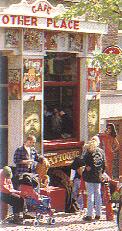 “alternative menu” from which they can choose any of a dozen types of
mind-expanding smoke to enjoy at home or over a cup of coffee on the premises.
As a result of this enlightened policy, cannabis users are less likely to come
into contact with hard drugs. The possessors of hard drugs and of course the
dealer risk very heavy penalties and years of imprisonment. It is a fact that
the city has a much lower rate of hard drug addiction and drug related crime
than many others with tougher regimes. Despite this, in 1995 the newly elected
conservative municipality announced plans to reduce the number of tolerated
coffee shops, blithely ignoring the considerable revenue the tourism industry
gets from thousand of visitors for whom Amsterdam’s main attraction is not its
cultural heritage but its home-grown herbs. It’s interesting that, even in the
age of AIDS, the mayor’s born again Puritanism does not extend to the thriving
commercial sex industry of the Red Light District, arguably as great (or as
little) a threat to the city’s image.
“alternative menu” from which they can choose any of a dozen types of
mind-expanding smoke to enjoy at home or over a cup of coffee on the premises.
As a result of this enlightened policy, cannabis users are less likely to come
into contact with hard drugs. The possessors of hard drugs and of course the
dealer risk very heavy penalties and years of imprisonment. It is a fact that
the city has a much lower rate of hard drug addiction and drug related crime
than many others with tougher regimes. Despite this, in 1995 the newly elected
conservative municipality announced plans to reduce the number of tolerated
coffee shops, blithely ignoring the considerable revenue the tourism industry
gets from thousand of visitors for whom Amsterdam’s main attraction is not its
cultural heritage but its home-grown herbs. It’s interesting that, even in the
age of AIDS, the mayor’s born again Puritanism does not extend to the thriving
commercial sex industry of the Red Light District, arguably as great (or as
little) a threat to the city’s image.
The Cannabis museum exhibition---unashamedly tracing the positive aspects of
marijuana and the cannabis plant through the ages and contrasting its medicinal,
environmental and therapeutic benefits with the lethal side effects of legal
drugs such as tobacco and alcohol—is an eye opener. The high tech equipment
and information purveyed by the Cannabis Connoisseurs Club is startling, too.
Pot growers these days use sophisticated hydroponics, special lighting and
seed-selection techniques to produce high-potency strains—just as the
Netherlands world famous tulip cultivators mix and match to produce ever more
colourful and exotic blooms.
Bibliography
Holland,
by Adam Hopkins (Faber and Faber, 1988), Penguin Guide to Amsterdam (ed.Vincent
Westzaan, Penguin 1990), Guide du Routard 1998 (ed.Hachette), -Dwalen door
Amsterdam en reizen door de Benelux, ( ed. Lekturama 1984), -« Nederland
en haar drugs politiek, een goede zaak ? » by J. Groenendaal
(Cleyssen, Amsterdam 1998)
|