|
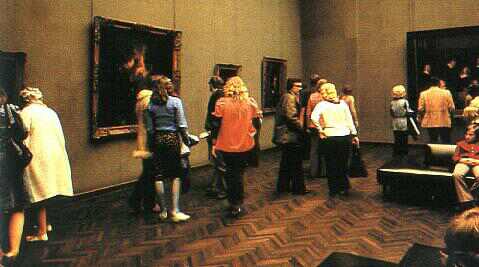
The important starts in room
207 with the introduction of a whole new view on representing society through
painting. Remember, the Golden age creates new fortunes, a very rich
bourgeoisie, fed up with religion and who wants to see laic images. Holland
blooms into a rich cultural, commercial and political nation and society. What
better expression than painting to show it of to the future generations?
In room 209 and 210 you meet one of
the really big names: Frans Hals. The most prominent portrait here is the lively
portrait of Merry Drinker. A left turn in the museum brings you into the
Rembrandt rooms. First a few early
works, and of masters who influenced him, It
continues with some not so interesting rooms with monumental landscapes and
detailed representations of Classical and Biblical mythology. Next rooms 215 and 216 contain the lively portraits of Jan Steen (1626-1679), family
groups, tavern scenes, drunks, fights, dice gamblers in a tavern,( a scandal for
that era!). They are full of charm and contrast vividly with the solemn
portrayals the Dutch bourgeois liked to pose for like for Frans Hals. Wherever
you turn now, you see the full extension of Dutch painting in that period: you
see nature and landscapes (Jan Van Goyen and especially one of my favorite
landscape painters Jakob van Ruysdael), real life persons depicted exactly as
they are. See Frans Hals 'The Merry Drinker" and in room 211 the first
Rembrandt painting with a portrait of his mother. Before heading to THE
masterpiece of the museum; I mean the "Nightwatch " of Rembrandt,
make a detour through rooms
217-221 and see some Vermeer perfect masterpieces "The Milkmaid",
"The Little Street", "Woman reading a letter" and "The
Love Letter". See how striking the light works in Vermeer's paintings.
Vermeer had an incredible feeling for colors, details and knew better than
anyone how to structure its paintings. The almost photographic realism makes
them stand out from its neighbours, whose style seems heavy-handed when you
compare. So, don't compare!
As everybody (?) knows, Vermeer was not the most prolific painter ever. Maybe
about 40 of his works are known over the world.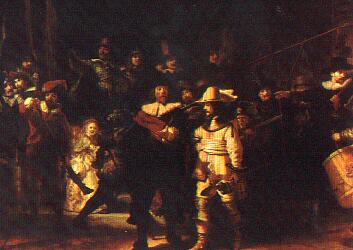
We come now to the Night Watch!! So many is written about this giant painting,
and still you stand speechless. Yes "The Guard Company of Captain Frans
Banning Cocq and Lieutenant Willem van Ruitenburg"( wow, what a long name!)
was restored in 1975, after an act of vandalism. The artist painted here a civic
guard, whose duty it was at that time to keep an eye on Amsterdam at night The
painting is full of vigor and action , showing the guardsmen on patrol rather
than stuffy on parade. These kind of paintings were routine orders by the
militias of that time. Rich men , they had to be since they had to pay
themselves for their rich uniforms and all military attributes.
Let' quote a French guide with a
few remarks in this painting:
The personages seem to be moving, looking elsewhere, to be busy, nobody looks
stiff constipated. The famous " light and shade" technique is at his
highest refinement here.
What people usually don't know is that every personage on the painting had to
pay hard cash to figure on it. Except Rembrandt himself! Yes, he painted
himself, in the background, you hardly notice him.
An original anecdote I read in a leading French guide:
"""Count the number of personages...yes: 18 on the painting!! But
originally there were 34!! It was a matter of squeezing the painting between the
two doors of Town Hall, so 16
persons had to leave eternal glory since the work was shortened in the
18th"""""(end of quotation)
I imagine some bourgeois who had
sleepless nights and whose wives must have been beaten up! Poor guys!
Continue to see other Rembrandt works
in the next rooms.
Bibliography
Holland, by Adam Hopkins
(Faber and Faber, 1988), Penguin Guide to Amsterdam (ed.Vincent Westzaan,
Penguin 1990), Guide du Routard 1998 (ed.Hachette), De Nederlandse Realiteit, by
J.Oostkamp (own folders).-Die Niederlande in Europa Geschichte (Dieter
Verlag-Munchen 1986)-Dwalen door Amsterdam, Reizen door de Benelux, ed. Lekturama 1984)-Rijksmuseum catalogus 1995
|