|
 This walk will start of
course with a visit of the Rijksmuseum, one of the finest in the world with an
immense collection of superb paintings and other works. You can easily spend
whole day here, and the impact of the collection is such that trying to combine
a visit to the Rijksmuseum with a trip to the nearby Van Gogh museum, which will
be the subject of another article, is to find yourself wandering in too much of good a good
thing. This visit of the Van Gogh museum will be part of another walk, that will
be posted at another time. This walk will start of
course with a visit of the Rijksmuseum, one of the finest in the world with an
immense collection of superb paintings and other works. You can easily spend
whole day here, and the impact of the collection is such that trying to combine
a visit to the Rijksmuseum with a trip to the nearby Van Gogh museum, which will
be the subject of another article, is to find yourself wandering in too much of good a good
thing. This visit of the Van Gogh museum will be part of another walk, that will
be posted at another time.
But as I imagine you are not all in a state of staying a whole day in a museum (
headaches are lurking !!) the nearby Vondelpark is a welcome splash of green in
the summer after the immensely man-made scenery of the historic-centre.
Leaving behind the bars and street entertainers of the Leidseplein, cross the
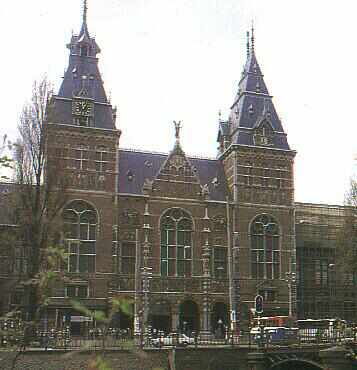
Singelgracht and turn left along Stadhouderskade. The red-brick Romanesque
facade of the museum may not please some of you but that's the typical architecture of the main Amsterdam buildings. Didn't
you notice the resemblance with Central Station? Yes? Well, you got your
architecture grade! It is indeed the same architect who designed the Central
Station and the Rijksmuseum : P.J.H.Cuypers.
It was a very controversial project in its day but now the Amsterdammers
consider it as one of the prides of the city. Funny taste.
A hint for those who, hate queues!! According to a guide I consulted about that
, it seems that there is an entrance at the other side of the museum, in the
Frans Hobbemastraat no.19, very unknown to the public.
The nucleus of the museum's treasury of art is the collection of some 200
paintings amassed by Prince William V (1748-1806) who was drive into exile
in 1798. A new museum to house this all opened in 1885 and has expanded
ever since. Now we can see more than 5000 paintings, a million prints and
drawings and tens of thousand of
sculptures and all sorts of objects. The good idea of the museum managers is to
have organised a rotation of the works, so it could be you visited the museum in
March and will not find the work you're looking for at the same spot in October.
If you want to avoid to have such adventures you can acquire a detailed guide in
the museum other rooms and the information desk in the foyer at the first floor.
The best work of the museum are at the first floor, where every room trace the
pictures of Dutch paintings from the stiff religious art of the early medieval
epoch to the more fluid styles of the Renaissance and the Golden Age. Painters
loosened the grip of formalism that the trend and changed to other subjects than the
exclusively religious ones of earlier centuries.
As soon you are on the first floor, make a left into a maze of exhibition rooms.
The first rooms are dedicated to the primitive Dutch art, all with religious
themes, like the series painted by the Master of Alkmaar "The Seven Works
of Charity". In the next few rooms the Renaissance takes over. Make a
detour in room 7 whose walls are covered with delightful miniature portraits and
landscapes, two perfect ones by Jan Bruegel the Elder.
But the most thrilling is still to come: the Dutch paintings of the Golden Age,
Frans Hals, Rembrandt, Jan Steen.
But this post is already long enough. I will describe the rooms and further
visit in my next post
Bibliography
Holland, by Adam Hopkins
(Faber and Faber, 1988), Penguin Guide to Amsterdam (ed.Vincent Westzaan,
Penguin 1990), Guide du Routard 1998 (ed.Hachette), De Nederlandse Realiteit, by
J.Oostkamp (own folders).-Die Niederlande in Europa Geschichte (Dieter
Verlag-Munchen 1986)-Dwalen door Amsterdam, Reizen door de Benelux, ed. Lekturama 1984)-Rijksmuseum catalogus 1995
|