|
I'm sure this is a tour
that's going to interest a lot of you;-)!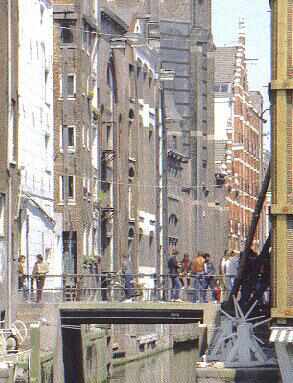
We start at the Oudezijds Achterburgwal. At its upper ends, and spilling over
the other side of the Oudezijds Achterburgwal, are the fleshpots of of the
city's famous Red Light District, with its provocative women and transvestites
beckon passers-by, but also houses some of Amsterdam most prominent churches.
During daytime sex-shops, massage parlours and go-go bars just look sad and
seedy, since everyday life goes on and
the ordinary inhabitants of the area seem oblivious to all this sleaze. But at night, the glow of shining neons and sparkling
light give the whole scene a somewhat spurious air of glamour and excitement.
Let's start at Damrak , crossing the Oudezijds Achterburgwal to visit a few of
historic buildings and then we'll return through Amsterdam's Chinatown.
Leaving the animated Damrak and walking Oude Lange Niezel, you will slowly be
struck by the multitude by suggestively named bars, curtained shop windows and
pink neon light. It indicates you that
you are on the fringe of the Red Light District. Don't forget we are here in a
total democracy and Amsterdam has no inhibitions about any pictorial material
that could be displayed openly in shop windows. They are very explicit! But
let's go visit churches now;-)!
Crossing the bridge from Oude Lange Niezel to Korte Niezel, you have the full
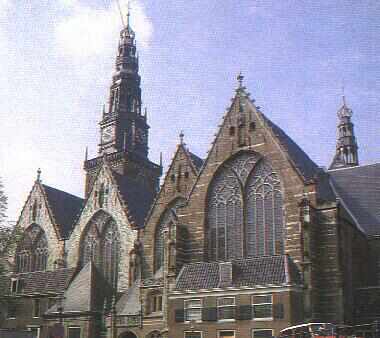
view of two imposing churches. The Sint-Nicolaas kerk with its roof and domes ,
a few hundred meters to the Northeast and
the bell-tower of the Oude Kerk ( 50 m south of the bridge). Stop at the
bridgeand look around.
 |
|
Oude Kerk |
You have a fine view of some
of the handsome 17th and 18th century homes on the other side. Don't you think
the richly decorated gables give each house such an individual air? Check no. 14
Oude Voorburgwal, with its six-stepped gable and red shuttered windows. No. 19
has what is known a "neck gable", with two pretty plunging dolphins in
carved stone. Gable decorations were often inspired by the owner's source of
wealth, and have many maritime themes. (a detail found in "The
Embarrassment of Riches" by Simon Shama--ed. Collins 1987--. It is
scholarly but accessible interpretation of Dutch culture during the Golden Age).
Turning right down Oudezijds Voorburgwal and entering the Old Side, you rapidly
notice a change in the atmosphere 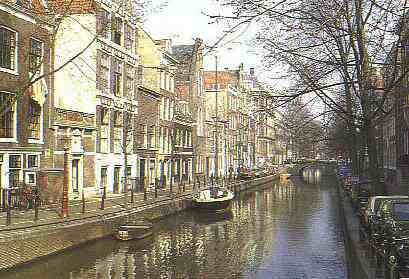 and
in streetlife: nervous tourists try to appear blasé as the are beckoned by
ladies of the night. You encounter people of uncertain gender , clad in gold lamé,
rub-shoulders with shaven-headed men clad had-to-foot in black leather, maybe
heading to the Hanky Panky Tattooing Museum and House of Pain, one of
Amsterdam's kinkier institutions, at
no. 141. Amsterdam tattoo parlours
are world famous for the connoisseurs!. The Museum ids not for the weak of
stomach or tender of heart: it shows how far certain people could go juts to
look different. and
in streetlife: nervous tourists try to appear blasé as the are beckoned by
ladies of the night. You encounter people of uncertain gender , clad in gold lamé,
rub-shoulders with shaven-headed men clad had-to-foot in black leather, maybe
heading to the Hanky Panky Tattooing Museum and House of Pain, one of
Amsterdam's kinkier institutions, at
no. 141. Amsterdam tattoo parlours
are world famous for the connoisseurs!. The Museum ids not for the weak of
stomach or tender of heart: it shows how far certain people could go juts to
look different.
At
no. 187--opposite the Oude Kerk--pause to note the wealthy facade of the House
of Pillars. The lowest are Tuscany style, the next Ionic and the top two
Corinthian.
Bibliography
Holland, by Adam Hopkins
(Faber and Faber, 1988), Penguin Guide to Amsterdam (ed.Vincent Westzaan,
Penguin 1990), Guide du Routard 1998 (ed.Hachette), -Dwalen door Amsterdam en reizen door de Benelux,
(ed. Lekturama 1984)
|