|
Introduction
and
history
Citywalk
and
cathedral
Picasso
museum
|
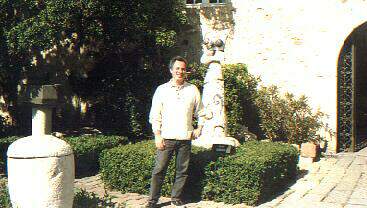 When
the market stalls start to disappear around noon it’s the moment to --after a
simple but agreeable lunch on one of the terraces--go and visit the famous
Picasso Museum in the chateau de Grimaldi. When
the market stalls start to disappear around noon it’s the moment to --after a
simple but agreeable lunch on one of the terraces--go and visit the famous
Picasso Museum in the chateau de Grimaldi.
This chateau used to be the property of the Grimaldi family of Monaco. The
honourable edifice,
like we see it today, is from the 16th century and the tower of the
12th. In 1928 it turned into an archaeological museum thanks to a
certain Dor de la Souchere, a teacher in ancient languages at the Carnot high
school in Cannes. His glorious day will be in 1946 when he was introduced to
Pablo Picasso and his new girl friend Françoise Gilot. Dor proposed Picasso to
organize an atelier at the second floor of the enormous chateau. Picasso visited
 the chateau and discovered that he benefited
from
the chateau and discovered that he benefited
from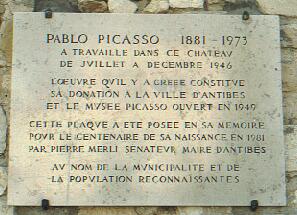 incredible landscape views from a lot of points, like the windows and the
terraces. He took the keys of the chateau that were offered to him and used it
as a grand studio and atelier. He painted solidly for five months incorporating
immediately the light and intense colour of the south in a series of drawings
and paintings. Above
all that Picasso was in a stage of his life where he was very much in love with
Françoise. (see Françoise Gilot book “Life with Picasso). incredible landscape views from a lot of points, like the windows and the
terraces. He took the keys of the chateau that were offered to him and used it
as a grand studio and atelier. He painted solidly for five months incorporating
immediately the light and intense colour of the south in a series of drawings
and paintings. Above
all that Picasso was in a stage of his life where he was very much in love with
Françoise. (see Françoise Gilot book “Life with Picasso).
“With
much pleasure because at
least I know now I work for the people,” said the
painter in
his peace dove-communist period. The largest panel that
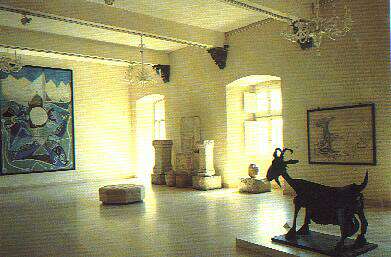 we would paint is ”La
Joie de Vivre”. It's a major work, which symbolises his whole stay in the chateau.
It is crowded by fauns, satyrs and centaurs. A year
later, Picasso’s enthusiasm was still very great and he liked to
paint mythological subjects (Ulysse et les Sirenes, Faunes musiciens), fishermen
provided another source of inspiration like his "Gobeur d'Oursins"
(Man Gulping Sea Urchins), and cubist nudes (" Nus
couches" au lit blanc, au lit bleu and sur fond vert). It was also here that
Picasso painted the "Antipolis Suite", a series depicting highly
stylised, pared-down nudes, often reclining. Dor de le Souchére changes the name of the
chateau into Picasso Museum. The miracle is that Picasso offers what he realized
during his stay to the city of Antibes. 175 paintings, sketches, drawings and
examples of his art of pottery making like the 80 ceramics realized in Vallauris
and other donations. The artist, famous for his avarice and stinginess promised many things he never
kept in his life but this donation was for real. we would paint is ”La
Joie de Vivre”. It's a major work, which symbolises his whole stay in the chateau.
It is crowded by fauns, satyrs and centaurs. A year
later, Picasso’s enthusiasm was still very great and he liked to
paint mythological subjects (Ulysse et les Sirenes, Faunes musiciens), fishermen
provided another source of inspiration like his "Gobeur d'Oursins"
(Man Gulping Sea Urchins), and cubist nudes (" Nus
couches" au lit blanc, au lit bleu and sur fond vert). It was also here that
Picasso painted the "Antipolis Suite", a series depicting highly
stylised, pared-down nudes, often reclining. Dor de le Souchére changes the name of the
chateau into Picasso Museum. The miracle is that Picasso offers what he realized
during his stay to the city of Antibes. 175 paintings, sketches, drawings and
examples of his art of pottery making like the 80 ceramics realized in Vallauris
and other donations. The artist, famous for his avarice and stinginess promised many things he never
kept in his life but this donation was for real.
|
|
|
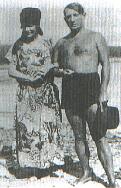
Picasso and Sara Murphy-Antibes 1923 |
 |
|
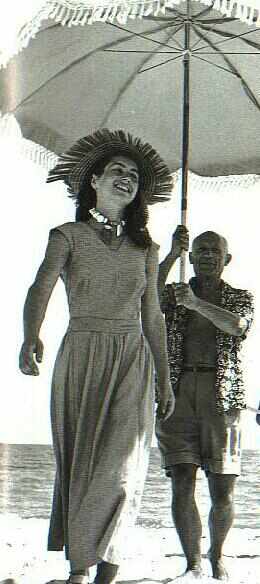
Picasso and Fr.Gilot |
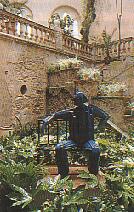
The chateau Grimaldi is in my opinion one of the MUSTS
of the Cote d’Azur. We can discuss about the intrinsical valour of Picasso’s
work after WWII but we must admit that the chateau became one of the most
sympathetic smaller museums of France, not even talking of it’s enchanting
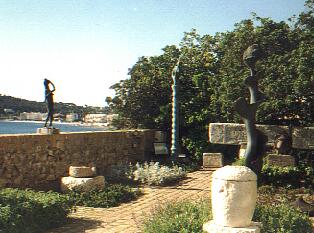
terrace, packed like in a fairy tale with beautiful sculptures and nice odorant
plants and a free magnificent view
on the Mediterranean sea. The sculptures of Germaine
Richier stand out, reminding Giacometti. Also " La deesse de la mer"
by Miro, "Hommage a Picasso" by Arman and "Jupiter and
Encelade" by Patrick and Anne Poirier, made out of 10 tons of white marble
and Roman vestiges. Astonishing !!
 The museum possesses also a quite impressive contemporary art collection outside Picasso, luckily. One of the largest collections of Nicolas de
Stael (who committed suicide in 1955 by jumping out of his
window). An important collection of the modern Nice school of Cesar,
Arman, Spoerri, Klein, but also Leger, Calder, Modigliani, Corneille, Hartung, Max
Ernst, Magnelli. The museum possesses also a quite impressive contemporary art collection outside Picasso, luckily. One of the largest collections of Nicolas de
Stael (who committed suicide in 1955 by jumping out of his
window). An important collection of the modern Nice school of Cesar,
Arman, Spoerri, Klein, but also Leger, Calder, Modigliani, Corneille, Hartung, Max
Ernst, Magnelli.
Bibliography
Mary
Blume, "Cote d'Azur. Inventing the French Riviera" (Thames and Hudson,
London 1982) Stephen Liegeard, "La Cote d'Azur (Ed.Serre, Nice 1988), Guide du
Routard 1998-99, Patrick Howarth, “When the Riviera was ours” (Century,
London 1977, “Greek Settlements on the Medterranean”, essay by J.Moss,
“Antibes la belle “ , by Jean Centurion (ed. Nice publ. 1991), “Picasso
après le guerre”, by.J.Bornet (ed.Litard, Paris 1996), “Life with
Picasso”, by.Fr.Gilot.
|
Back
to Cote d'Azur main page
Back
to Antibes contents
|