|
Introduction
and
history
Citywalk
and
cathedral
Picasso
museum
|
 Leave
Biot and continue on the N 7 towards Antibes. Leave
Biot and continue on the N 7 towards Antibes.
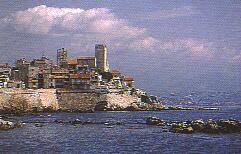
ANTIBES: a superb site, a pity that
modern hotel bunkers spoil the view if you look at Antibes from Cap d’Antibes,
but the old city and its rising medieval city walls and turrets are magnificent.
A yachting town , narrow, winding streets and high houses covered with
ivy, so typically provencal, authentic and an indescribable atmosphere. You can't get tired of
walking on the ramparts or in the old Antibes....
 |
|
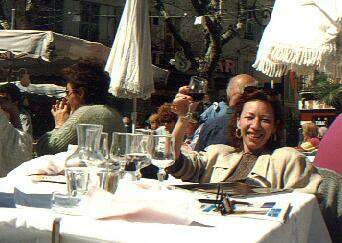
Cheers from Mme Jack!! |
Surprisingly, Antibes in
itself is untouristy. But sitting on a terrace, sipping on your glass of wine or
espresso, you will soon feel the ambience that escapes nobody. Like Graham
Greene; who was a long time resident. He always preferred being there in
winter.
Let’s leave the new city for what it is: a not inelegant side for tourists
that are hungry for sand, sea and sun and of a level that doesn’t leave empty
Cola cans under the pine trees. Let’s park the car a little outside the walls
and let’s concentrate on the old city.
The old Antibes is almost a moving surprise, after the many aesthetic hangovers
that we already had to go through along the Cote. In the centre of Antibes is
the COURS MASSENA, a long stretched square with small shops, bars and terraces
on both sides.
 It
is unbelievable what a hell of a noise those merchants make on a market day and
how it doesn’t bother us at all if we sit and look from a terrace along the
market. The market on the cours Massena is daily
( from 6-12 AM except on Monday) . It
is for me one of the most "sympathique" and authentic markets on the cote. Roofed by an
architecture " a la Baltard" the products of the Provence are
displayed in a dazzling colour festival and smell so good the
Provence ! ! For those who understand French the savoury talking and
gestures of the merchants add to the local character. A small flea market is
organized every Thursday from 6 AM to 6 PM on the neighbouring place Audiberti. It
is unbelievable what a hell of a noise those merchants make on a market day and
how it doesn’t bother us at all if we sit and look from a terrace along the
market. The market on the cours Massena is daily
( from 6-12 AM except on Monday) . It
is for me one of the most "sympathique" and authentic markets on the cote. Roofed by an
architecture " a la Baltard" the products of the Provence are
displayed in a dazzling colour festival and smell so good the
Provence ! ! For those who understand French the savoury talking and
gestures of the merchants add to the local character. A small flea market is
organized every Thursday from 6 AM to 6 PM on the neighbouring place Audiberti.
At the end of the market hall the Cours Massena becomes the Place
Massena and gets wider until the Hotel de Ville appears like coming out of a cartoon. At the
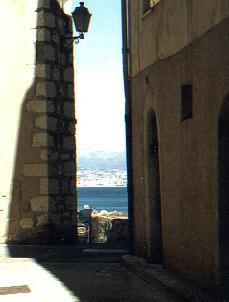
end of the place Massena we see an old gate from where the harbour, blue sea and
high masts go and come. Take your time here, you’ll see the Riviera like it
must have looked a long time ago.
The Greek Antibes has almost the same age as Massilia. Around the 5th
century B.C. its founders called the place Antipolis, which means “the city at
the other side”. What city was that? Nobody
ever found out what was that “other side”. Nice? (Nikaia), the Ligurian
oppidum Biot or the island of Corsica. The Romans, in their turn, built an
important city at Antibes and the ruins of the baths, the aqueduct, the circus
and the theatre stood until 1691 when Vauban used the stones to construct his
massive fortifications.
 |
|
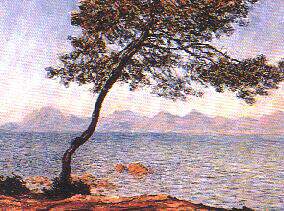
Antibes by Monet |
In 1388 Antibes
became an important border city of the French side when the county of Nice
became the property of the house of Savoie. The In 1536, Spanish mercenaries looted
and burnt Antibes so that François 1er built a wall around the city. Henri IV
ordered Vauban to build fortifications around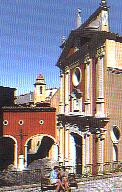 the city see higher). When Napoleon landed in Golf-Juan coming from the isle of Elbe,
Antibes refused to receive him and imprisoned the 40 delegates of Napoleon.
When
the county of Nice returned to France in 1860 the fortifications lots their
utility and in 1898, a great part of the fortifications of Antibes were torn
down to extend the building of new houses, except those who constituted the sea
wall, today the promenade Amiral de Grasse. The funny result is that you can’t see the old city from
the sea, passing with a boat. Which gave birth to this anecdote: on the question (after passing Antibes on a boat):
”How did you find
it?” Alexandre Dumas once answered: “I didn’t find it at all”.
the city see higher). When Napoleon landed in Golf-Juan coming from the isle of Elbe,
Antibes refused to receive him and imprisoned the 40 delegates of Napoleon.
When
the county of Nice returned to France in 1860 the fortifications lots their
utility and in 1898, a great part of the fortifications of Antibes were torn
down to extend the building of new houses, except those who constituted the sea
wall, today the promenade Amiral de Grasse. The funny result is that you can’t see the old city from
the sea, passing with a boat. Which gave birth to this anecdote: on the question (after passing Antibes on a boat):
”How did you find
it?” Alexandre Dumas once answered: “I didn’t find it at all”.
Bibliography:
John
Pemble, "the Mediterranean Passion, Victorians and Edwardians in the
South", (Oxford University Press 1988), Mary Blume, "Cote d'Azur.
Inventing the French Riviera" (Thames and Hudson, London 1982) Stephen Liegeard,
"La Cote d'Azur (Ed.Serre, Nice 1988), Guide du Routard 1998-99, Patrick
Howarth, “When the Riviera was ours” (Century, London 1977, “Greek
Settlements on the Medterranean”, essay by J.Moss, “Antibes la belle “ ,
by Jean Centurion (ed. Nice publ. 1991)
|
Back
to Cote d'Azur main page
Back
to Antibes contents
|