Cannes, all about the city, visits, Croisette promenade and port - the Cote d'Azur Site Home - What's New? -Feedback - About Jack- Travel/Art Links

Cote d'Azur
|
Cannes, all about the city, visits, Croisette promenade and port - the Cote d'Azur Site Home - What's New? -Feedback - About Jack- Travel/Art Links |
|
|
|
Cote d'Azur |
|
Cannes Croisette and port, wealth and status |
|
|
|
Not to forget anyway, most
important, if it is possible, avoid July-August!! What can be more
Winter becomes a favourite
rendez vous place for all kind of foreigners and
artists like the vice-king of India, members
of the Russian aristocracy, the Rothshilds. Never building and architecture has
been more delirious. You see al styles and follies. Luxurious, from the pseudo-gothic manor to the pagoda
style villa or even with a minaret, grottos, marble columns, etc.... Bibliography: Tobias Smollet,
"Travels through France and Italy", (Oxford University Press, Oxford,
New-York in the series World Classics), John Pemble, "the Mediterranean
Passion, Victorians and Edwardians in the South", (Oxford University Press
1988), Mary Blume, "Cote d'Azur. Inventing the French Riviera" (Thames
and Hudson, London 1982), The Twenties, From Notebooks and Diaries of the
Period, by Edmund Wilson (Cannes 1921)-“ Cannes”, by R. Bailey (Pinguin
pocket) |
Some
black
|
|
Cote d'Azur-Cannes- |
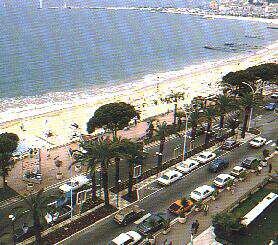 The
most famous avenue of the Cote d'Azur is
undoubtedly the Croisette, with its haughty palms, its stylish palaces,
shops reserved for the billionaires, flower-beds manicured 12 months of the year
by 130 full gardeners and a unique view on the Esterel. The Croisette is also an
agreeable promenade. Most internationally recognised of all seafront promenades,
yet
The
most famous avenue of the Cote d'Azur is
undoubtedly the Croisette, with its haughty palms, its stylish palaces,
shops reserved for the billionaires, flower-beds manicured 12 months of the year
by 130 full gardeners and a unique view on the Esterel. The Croisette is also an
agreeable promenade. Most internationally recognised of all seafront promenades,
yet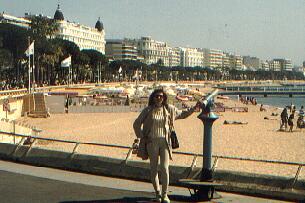 not one advert for fast food or tanning cream has been allowed to sully its
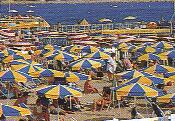
Edwardian elegance. In the summertime the average age of he tourists is rather
young, invading the few, rare public beaches. A lot, lot of foreigners of all
nationalities. Imagine ! 96 daily
papers in 30 different languages are sold in Cannes. It’s true, a new Hilton
stands in place of the old Palais
not one advert for fast food or tanning cream has been allowed to sully its
Edwardian elegance. In the summertime the average age of he tourists is rather
young, invading the few, rare public beaches. A lot, lot of foreigners of all
nationalities. Imagine ! 96 daily
papers in 30 different languages are sold in Cannes. It’s true, a new Hilton
stands in place of the old Palais 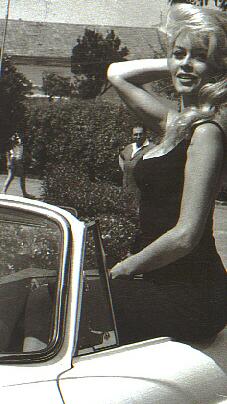 des
Festivals, where Vadim launched Bardot. But the wedding cake façade of the
Carlton Hotel only a few yards away has barely changed over the last 80 years,
complete with its twin
des
Festivals, where Vadim launched Bardot. But the wedding cake façade of the
Carlton Hotel only a few yards away has barely changed over the last 80 years,
complete with its twin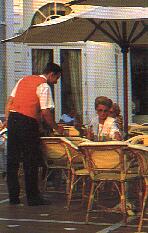 pepper-pot cupolas modelled on the breasts of “La Belle Otero” a famous
courtesan of that period. It symbolises Cannes as much as Big Ben does London,
its name for comfort and grace. In the wintertime, Cannes is rather frequented
by wealthy representatives of the third age, walking distinguished dogs and
wearing heavy pearl necklaces, seeking for sweet living in a mild climate.
pepper-pot cupolas modelled on the breasts of “La Belle Otero” a famous
courtesan of that period. It symbolises Cannes as much as Big Ben does London,
its name for comfort and grace. In the wintertime, Cannes is rather frequented
by wealthy representatives of the third age, walking distinguished dogs and
wearing heavy pearl necklaces, seeking for sweet living in a mild climate.
Strolling up the Croisette towards the Palm Beach casino, you will pass
the hotel Carlton, continue until the end of the walk you arrive at the casino
Palm Beach, quite famous for some French movies shot 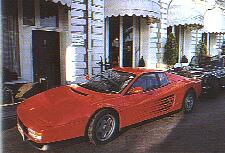 there.
Today, it makes sometimes the sulphurous political financial news.
there.
Today, it makes sometimes the sulphurous political financial news.
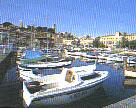
Return to the old harbour to have an idea of the centre of Cannes and old
town. It guards some delightfully down-to-earth secrets. Take for instance the
old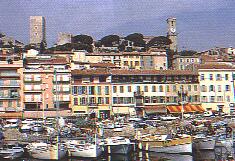 harbour, just in front of the Allees which houses a fishers flotilla with its
fishing boats nets piled up and numerous pleasure-boats bearing evocative names:
Princess Audrey, Love-Love, Sea wind. The colline du Suquet and the charming
quai St.Pierre with his pastel houses seen from here, form a real provencal
backcloth. Just stroll along the moored boats and yachts, if you're a
sailor fan you will be fascinated by superb sailors
harbour, just in front of the Allees which houses a fishers flotilla with its
fishing boats nets piled up and numerous pleasure-boats bearing evocative names:
Princess Audrey, Love-Love, Sea wind. The colline du Suquet and the charming
quai St.Pierre with his pastel houses seen from here, form a real provencal
backcloth. Just stroll along the moored boats and yachts, if you're a
sailor fan you will be fascinated by superb sailors 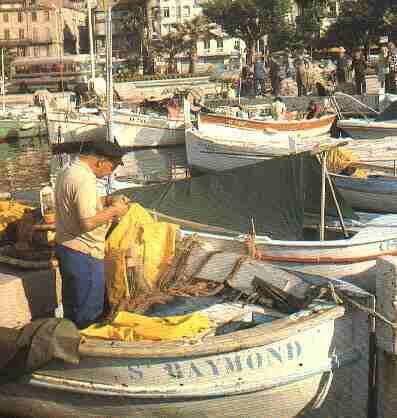 (brass
and varnished mahogany). It's fun to observe the life of people in their big
boats. You want to see the most luxurious ones? Go on the jetee Albert-Edouard,
behind the Palais, an enchanting spectacle in the evening, when the boats are
illuminated, and you can observe scarcely the TV-parlours, master paintings,
leather couches, immense flower bouquets, bar, etc.... The dazzling white hulls,
shining brass and polished teak of greater vessels sharing this little basin
dwarf them, and the fishermen becoming fewer and fewer each year like an
endangered species. These status symbols belong to some of the world’s richest
individuals or corporations. If we only had all that in our own homes !!....Yet
the “manja pei’” (literally “fish eaters”) still chug past them to
bring in their catch in the early dawn. Strange
(brass
and varnished mahogany). It's fun to observe the life of people in their big
boats. You want to see the most luxurious ones? Go on the jetee Albert-Edouard,
behind the Palais, an enchanting spectacle in the evening, when the boats are
illuminated, and you can observe scarcely the TV-parlours, master paintings,
leather couches, immense flower bouquets, bar, etc.... The dazzling white hulls,
shining brass and polished teak of greater vessels sharing this little basin
dwarf them, and the fishermen becoming fewer and fewer each year like an
endangered species. These status symbols belong to some of the world’s richest
individuals or corporations. If we only had all that in our own homes !!....Yet
the “manja pei’” (literally “fish eaters”) still chug past them to
bring in their catch in the early dawn. Strange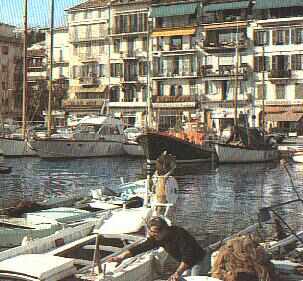 Mediterranean fish with names like “rascasse, rouquier or blavier”, some of
which have poisonous, spiny fins and are best enjoyed in a bouillabaisse on the
quay, flip and flop as they have always done.
Mediterranean fish with names like “rascasse, rouquier or blavier”, some of
which have poisonous, spiny fins and are best enjoyed in a bouillabaisse on the
quay, flip and flop as they have always done.
On the esplanade Pompidou,
nearby, more than 120 foot and handprints of stars, French and foreign, mostly
American.
Just in front of the boats departure pier a big square opens his arms to the
overheated tourist: called les Allees de la Liberte, shaded by old plane-trees,
it is a joy to walk there in the morning during the daily flower market. But
that’s for next article.
Bibliography
Mary Blume, "Cote d'Azur. Inventing the French Riviera" (Thames and Hudson, London 1982), The Twenties, From Notebooks and Diaries of the Period, by Edmund Wilson (Cannes 1921)-“ Cannes”, by R. Bailey (Pinguin pocket)-Cannes in moderne tijden”, by Jan van Vlaardingen (Dominicus 1997, Guides du Routard, (ed.Hachette)
 pleasant than lunching on the beach in January, when the sun is not very hot and
the Esterel is clearly visible with a blue sky as decor? The Croisette is empty,
the air is sharp and life is beautiful. Sigh.......
pleasant than lunching on the beach in January, when the sun is not very hot and
the Esterel is clearly visible with a blue sky as decor? The Croisette is empty,
the air is sharp and life is beautiful. Sigh.......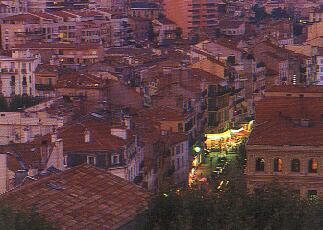
 Like wise the floral arrangements. 40,000 bedding-out plants are planted on the
Croisette and every season others are replanted. Cleaning crews on motorbikes
with high-pressure vacuum pipes are meanwhile supposed to eliminate that other
pavement peril left behind by dogs, not always successfully.
Like wise the floral arrangements. 40,000 bedding-out plants are planted on the
Croisette and every season others are replanted. Cleaning crews on motorbikes
with high-pressure vacuum pipes are meanwhile supposed to eliminate that other
pavement peril left behind by dogs, not always successfully.