|
back
to Cannes contents
How
Cannes was
founded
Cannes
reflections
Croisette
and port
|
 Let’s
finish this series about Cannes with a general perspective of what Let’s
finish this series about Cannes with a general perspective of what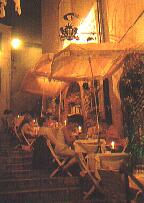 Cannes represents today. It is all about excess-excessive posing, excessive
indulgence and excessive spending. Cannes has never been a real town at all. The
Croisette along the shore with its row of ‘”grande luxe hotels”, was
created largely to please the English taste for the Riviera in a more gracious
age. Even the beaches are false, sand is imported to cover the pebbles and is
duly raked over each morning by minions for the hotel opposite. Each section of
the beach is owned by the nearby hotel and the visitor will pay heavily for
lunch in the restaurant at the back of the beach, or to hire the parasols and
mattresses to have a suntan. Few complain since everyone is on expenses.
Cannes represents today. It is all about excess-excessive posing, excessive
indulgence and excessive spending. Cannes has never been a real town at all. The
Croisette along the shore with its row of ‘”grande luxe hotels”, was
created largely to please the English taste for the Riviera in a more gracious
age. Even the beaches are false, sand is imported to cover the pebbles and is
duly raked over each morning by minions for the hotel opposite. Each section of
the beach is owned by the nearby hotel and the visitor will pay heavily for
lunch in the restaurant at the back of the beach, or to hire the parasols and
mattresses to have a suntan. Few complain since everyone is on expenses.
Imagine
that even the harbour, which looks so authentic, has a suspect air about it.
No-one ever sees a “bona-fide”
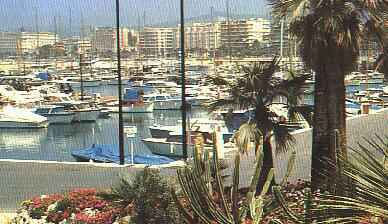 fishing vessel land its catch there. Not
surprising when you know that every year, every kind of non-fishing boat from
small pleasure-cruisers jam the place to the sort of yacht that Clint Eastwood
must be seen in. The harbour becomes a forest of masts and silver rigging. No
fishing but posing in Armani and Chanel, designed scuba gear by their owners. fishing vessel land its catch there. Not
surprising when you know that every year, every kind of non-fishing boat from
small pleasure-cruisers jam the place to the sort of yacht that Clint Eastwood
must be seen in. The harbour becomes a forest of masts and silver rigging. No
fishing but posing in Armani and Chanel, designed scuba gear by their owners.
The debarred critics like me can always take refuge in the Rue d’Antibes, the
main shopping street, running parallel to the Croisette. Apart of the inordinate
number of expensive lingerie shops. But that’s no consolation.
So let’s finish with some more sites to visit eventually. The RUSSIAN ORTHODOX
CHURCH ST.MICHEL THE ANGEL on 30, boulevard Alexandre III. The growing Russian
enclave in Cannes and the come back of empress Maria Alexandrovna in the city,
urged the Russians to build a larger church at the end of the 19th
century with a richly decorated interior and a few admirable icons. Part of the
royal family is buried in the crypt.
LA CROIX DES GARDES is a 164 m high hilltop where you can benefit of a
magnificent view on the Lerins islands until the Esterel mountain range.
We must admit anyway that Cannes thanks mainly its prestige to the 19th
century villas, in fact small castles, located in La Croix des Gardes, east of
the city in an area called “La Californie. “ Those villas built for the
large aristocratic and wealthy families who passed their holidays with all their
children and servants. The most famous of its inhabitants was Pablo Picasso who
bought a villa in 1955 after the death of his wife Olga. Most of these houses
are still private and not open for visit. But it is agreeable to make a walk
through these quarters, like the Chateau Scott at the avenue Maréchal Juin, a
sort of pastiche of a medieval English castle. The villa Rothschild, now a
public library, is one of the most beautiful houses of the 19th
century. The garden with her fake rocks and grottos are still intact.
Bibliography:
John Pemble, "the
Mediterranean Passion, Victorians and Edwardians in the South", (Oxford
University Press 1988), Mary Blume, "Cote d'Azur. Inventing the French
Riviera" (Thames and Hudson, London 1982), The Twenties, From Notebooks and
Diaries of the Period, by Edmund Wilson (Cannes 1921)-“ Cannes”, by R.
Bailey (Pinguin pocket)-“ Eine Cannes Spaziergang”, by Th.Wolfers (ed.
Spinne 1995)-Geschiedenis van het Festival” by Piet de Rooy (Alkm.1998)
|
back
to Cote d'Azur main page
Some
black
ideas and
the lively
rue Meynadier
Film
Festival
Cannes
today
|