|
Bayeux cathedral and commonwealth cemetery Site Home - What's New?-Feedback - About Jack-Travel/Art Links |

NORMANDY
Bayeux - Cathedral and Commonwealth cemetery
Bayeux and its tapestry-Generalities
 To
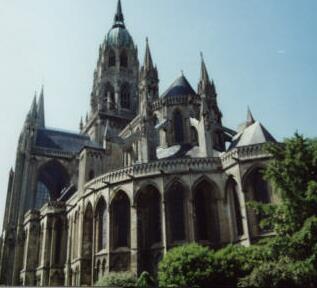
the northwest of the seminary rises the CATHEDRALE NOTRE DAME, certainly one of
the most beautiful in France, built in the 11th century. Citizens
consider it as an almighty beacon for the city. We owe it mainly to Odo,
archbishop of Bayeux and brother in law of William the Conqueror (who will be
present at the inauguration after which he imprisoned Odo, a future rival). Only
the crypts and the parts of its west towers will survive from that era. It was
inaccessible during hundreds of years but reopened. Choir
was rebuilt a century later and the chapels added in the 14th. The
bulk of the stonework is in magnificent Gothic, though the central tower was
added in the 15th and capped with a 19th century dome,
highly disapproved by the critics.
To
the northwest of the seminary rises the CATHEDRALE NOTRE DAME, certainly one of
the most beautiful in France, built in the 11th century. Citizens
consider it as an almighty beacon for the city. We owe it mainly to Odo,
archbishop of Bayeux and brother in law of William the Conqueror (who will be
present at the inauguration after which he imprisoned Odo, a future rival). Only
the crypts and the parts of its west towers will survive from that era. It was
inaccessible during hundreds of years but reopened. Choir
was rebuilt a century later and the chapels added in the 14th. The
bulk of the stonework is in magnificent Gothic, though the central tower was
added in the 15th and capped with a 19th century dome,
highly disapproved by the critics.
Beautiful façade with its 5 sculpted portals. The work of successive centuries
is clearly visible in the interior with its very vast proportions of the nave
(102 meters long!). The typical Roman style decorated arches of the nave are
surmounted by a 13th century clerestory and vaulting—though they is
inevitable first caught by the sculpted pulpit, installed in 1787. Renaissance
stalls rich master-altar of the of the 18th and in one of the side
chapels you can see 13th century stained glass windows. Numerous
chapels on both sides. Very luminous choir and 13th century paintings
on the ceiling. Everywhere you look, you see rich furniture. The crypt is decorated with delightful Gothic frescoes of angels playing
musical instruments.
The MUSEE BARON GERARD is our next target. An ancient Episcopal palace
displaying rich collections of different Bayeux families, the most important
being of baron Gerard. It’s a cool, dark and soothingly crowd-free palace,
with a collection of fine art, porcelain, furniture and lace for which a special
room is dedicated. On the first
floor a display of paintings by Boucher, Champaigne, Boudin, David, Corot,
etc…. It’s between the 17th
and 19th century that Bayeux became a centre of lace making (10,000
in the area in 1860). See on the south side of the cathedral the “MUSEE DE LA
DENTELLE” currently teaching the craft to 25 students. This school is housed
in the same building as the MUSEE D’ART RELIGIEUX with religious objects out
of the cathedral. Old manuscripts, sacerdotal clothes, gilded objects. One room
recreates the scene in which the 15 years old Ste Therese asks the bishop of
Bayeux for permission to enter a convent.
The war memorials BATAILLE DE NORMANDIE and the MEMORIAL GENERAL DE GAULLE have
already been described in my essays “Landing sites memorials 2"
|
|
|
Bayeux war cemetery |

A little further along the
same boulevard but on the other side of the road, facing the museum is THE
BRITISH CEMETERY, the largest WWII BTITISH AND COMMONWEALTH WAR CEMETERY in
France, containing Commonwealth 4648 graves, including soldiers from South
Africa, Canada and Australia buried under sober and simple white pickets. There are 181 Canadians here; among them 21 members of the
R.C.A.F. Polish graves are also to be found - men of the 1st
Polish Armoured Division. Scattered throughout the cemetery are the
graves of "CANLOAN"
officers, young Canadians lent to the British Army. It is a serene place. The
Stone of Remembrance is a depository, throughout the summer months, for wreaths
and floral tributes left by veterans organizations of many lands. Let them rest
in peace and lets’ observe a minute of silence, please. They gave their lives
to liberate France.. You measure here the enormous part taken by Great Britain
and the British Commonwealth in these combats. Without the help of our British
friends, the departure and defeat of the nazis wouldn’t have been so easy.
Bibliography
A holiday history of France, by Ronald Hamilton (London-Hogarth press), Region Normandie, ses merveilles, ses cicatrices, by Louis Letellier (ed. Cloison, Rouen 1995), Identity of France, by Fernand Braudel (London, Fontana Press, “Our Bravest and Our Best: The Stories of Canada's Victoria Cross Winners” by Bishop, Arthur, (Toronto: McGraw-Hill Ryerson Ltd., 1995), “Courage Remembered: The Story Behind the Construction and Maintenance of the Commonwealth's Military Cemeteries and Memorials of the Wars of 1914-1918 and 1939-1945”.( Gibson, Edwin and G. Kingsley Ward. (Toronto: McClelland & Stewart, 1989.)
Cathedral and Commonwealth Cemetery