|
Bayeux tapestry and its generalities Site Home - What's New?-Feedback - About Jack-Travel/Art Links |

NORMANDY
Bayeux and its tapestry-Generalities
Bayeux and its tapestry-Generalities
|
|
|
William 1st Norman king |
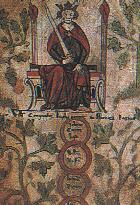
Bayeux was very fortunate to be the first liberated city of France on Jun 7 1944, without having suffered major damages and destructions. Call it a spoiled city since this is a rarity in the Normandy of the landing days. The old city is exactly the same as it was before WWII. It’s the capital of the BESSIN region and has to deal each year with hoards of tourists coming especially to visit the famous tapestry. But that's for later. Notice that Bayeux managed also to get preserved from too much modernity, no high rise, and no industry.
If there
weren’t automobiles in the streets one could feel itself in the 19th
century. A final word before I begin with history: there are other sites to see
in Bayeux outside the tapestry, like it’s magnificent cathedral, the old town
with its ancient houses and admirable hotels particuliers.
One of the first towns to be colonised by the Vikings. Its highlight period was
under the Norman dukes like Odon, half brother of William the Conqueror who
invaded good old Albion in 1066. It stayed under English rule during the Hundred
Years War and becomes French again in 1450. The British came again but
in……1944 to liberate the city from oppression!!
Bayeux has an agreeable nucleus of historic buildings running through the pedestrianised
street Rue Saint-Jean. The famous TAPESTRY, you can call the largest and biggest
comic strip in the world, is displayed in the CENTRE GUILLAUME LE CONQUERANT,
occupying a former seminary built in 1693.
Magnificent example of roman art, this embroidered tapestry of 70 meters long
and 450 cm high is not exactly a tapestry since it is not woven but more an
embroidery. The Bayeux Tapestry has preserved the history of the Norman Conquest
of England, and the saga of Harold of Wessex and Duke William of Normandy for
over 900 years. Usually attributed to William's wife Matilda, the Bayeux
Tapestry in fact was more likely commissioned by William's half-brother, Bishop
Odon of Bayeux (also Earl of Kent), who ordered it from an English atelier in
Canterbury (scholars see it like that since the style of the figures sewn in
colored wools leads) for display in the Bayeux Cathedral, which was consecrated
just eleven years after Hasting. It shows us many scenes of the battle of
Hastings (1066) and thus the conquest of Great Britain by 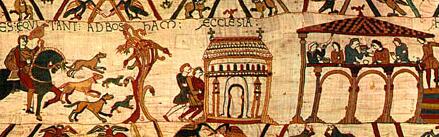 William
the Conqueror. The Bayeux Tapestry was first mentioned in a 1476 inventory of
the Bayeux Cathedral.
William
the Conqueror. The Bayeux Tapestry was first mentioned in a 1476 inventory of
the Bayeux Cathedral.
In 1792, French revolutionaries used this historical tapestry as a wagon cover
until a local lawyer rescued it. Scholars believe two missing panels at the end
may have portrayed William on the throne of England.
Today, the tapestry resides like a “Garboesque” recluse, in a dimly lit,
bulletproof glassed gallery. A guided commentary is available on headphones,
though it is advisable to spend a preliminary hour or so in the Centre’s upper
floors, where a cinema and exhibitions set out the background to the tapestry.
Next essay a few anecdotes about the tapestry.
Bibliography
A holiday history of France, by Ronald Hamilton (London-Hogarth press), Region Normandie, ses merveilles, ses cicatrices, by Louis Letellier (ed. Cloison, Rouen 1995), Identity of France, by Fernand Braudel (London, Fontana Press), Odo’s Hanging, by Peter Benson (Hodder and Stoughton, London), The Bayeux Tapestry, by David M. Wilson (Thames and Hudson, London).