|
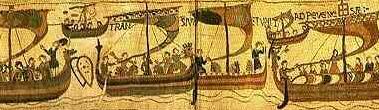 The Bayeux Tapestry was first mentioned in a 1476 inventory of the
Bayeux Cathedral.In 1792, French revolutionaries used this historical tapestry as a wagon cover until a local lawyer rescued it. The Bayeux Tapestry was first mentioned in a 1476 inventory of the
Bayeux Cathedral.In 1792, French revolutionaries used this historical tapestry as a wagon cover until a local lawyer rescued it.
Let's describe the facts as they are narrated on the tapestry: I will use as reference a translation of an ancient description of William of
Poitiers (see his bio just next to this paragraph), where I will use
some of these delicious Ancient English words and sentences that I can not invent myself. (being Belgian). Hundreds of historians did it in
the past, I think Jack will be allowed to use some to try to recreate
the ambience of the story described on the tapestry.
William of Poitiers was born in Normandy in about 1030. His sister was abbess of a monastery at Préaux. About 1040 he went to make his
studies at Poitiers (whence his surname). After leading the life of a
knight and taking part in several battles, he took orders, and became chaplain to Duke William the Conqueror. Later he became a priest and
was eventually appointed as the Archdeacon of Lisieux. It was at this time that he resolved to write about William, Duke of Normandy.
When William became king of England in 1066 he invited William of Poitiers to become his personal chaplain. William's book, The Deeds of
William, Duke of the Normans, was published in about 1073. Although William of Poitiers was in Lisieux during 1066, his book provides the
most detailed description that we have of the Battle of Hastings.
Uncertainty haunts the English throne, King Edward has to choose an heir for the throne. According to Norman chroniclers, he promises the
kingdom to his cousin, Duke William of Normandy, who was a bastard but had Norman blood. Now the king beckons to his side Harold
Godwinson, his brother-in-law, to go and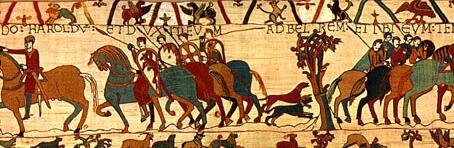 fetch the Duke Harold who leads him the
way to the port of Bosham, where he prays for a safe voyage. fetch the Duke Harold who leads him the
way to the port of Bosham, where he prays for a safe voyage.
"Master, your ship awaits," gestures a servant, as Harold Godwinson quaffs a
beaker of wine. But what perils of the sea lie ahead? Tempestuous Channel winds blow
Harold ashore near St. Valéry, where he falls into the hands of Count Guy, a vassal of Duke William.
An eavesdropper hiding behind a column may have carried the news of Harold's capture to William.
Armed with lances, two messengers come from the duke to command Harold's release.
In a flashback scene, the powerful Lord of Normandy, enthroned at Rouen, learns of Harold's capture by Count Guy. The duke and his
English friend lead a company of knights to relieve Dol Castle, besieged by Count Conan of Brittany near the monastery of Mont St.
Michel (you recognize the Mont on the tapestry). Slippery Conan is run to ground at the castle of Dinan. When spears
and missiles prove ineffective, the Normans resort to fire. Torches of pinewood and resin set the
fortifications burning.
A despairing Conan surrenders the fortress keys to William on the tip of his lance. Having already rescued him from Count Guy, William by
this act forges yet another link in the chain of obligations that binds the Englishman to him.
At Bayeux as the tapestry maintains, the enthroned duke calls his barons together and
swear on hallowed relics, bones of saints, to aid William in securing the English
throne.
In London the aged and bearded King Edward welcomes Harold to the
palace of Westminster.
Before his death, the wise ruler entrusted the throne to Harold himself. Harold listens to the king's last words at the foot of the bed and
breaking his oath to William, he accepts the crown. That's a mean trick and treason to his word to William!!!!
Suddenly, over all England a sign in the skies was seen. It was the star 'comet' which some call the star with hair, "Halley's comet". A
courtier hastens to tell Harold of the omen. Sinister, ghostly ships
in the tapestry border hint at coming disaster. Enraged at such perfidy, William resolves to invade England and take
the throne.The Conqueror's fighting force numbers some 7,500 men and 450 boats and in darkness, the fleet slips across the
Channel (he did better than the Germans during WWII). Finally the horizon becomes England and horses leap ashore.
With the news that the Anglo-Saxons draw near, the duke dons full battle armour; a squire brings his Spanish charger - a present from
King Alfonso of Aragon. An anxious night gives way to a chill dawn as the army moves out.
Uttering prayers for victory, veteran Norman knights mount their sturdy warhorses and ride to destiny at sunrise on an immortal
day: October 14, 1066. Leading his army William meets the knight Vital, who brings news of the enemy's position.
The English - also about 7,000 strong - occupy the hill of Senlacnear Hastings.The Normans thread marshy land and climb a brambly slope.
One-hundred-yards from the enemy line, the Norman archers let loose a
barrage of shafts that clatters against the shield wall like a hailstorm. Wielding battle-axes and hurling spears and stones, the
English give measure for measure. "They bravely withstood and successfully repulsed those. ... at close quarters," wrote William of
Poitiers.
Trapped on a hillock in the valley, the over-anxious Anglo-Saxon militiamen fight to the last man
against encircling invaders. Galloping past, Bishop Odo rallies the Norman cavalry with his swinging mace. In the melee William's horse is
thrice cut from under him.The shield wall begins to crumble, exposing Harold to mortal danger. Rushing in, a mounted Norman knight hews down
the doomed monarch with one mighty blow from his broadsword.Their stalwart leader dead, their army shattered, the English have
little heart left for battle.
"They... began to fly as swiftly as they could," wrote William of Poitiers.
Behind them, "The blood-stained battleground was covered with the flower of the youth and nobility of England. "The sun set on the field- and on Anglo-Saxon England".
(Scholars believe two missing panels at the end may have portrayed William on the throne of England.)
Bibliography
"The Deeds of William, Duke of the Normans",by William of Normandy,
"William the Conqueror", by Robert Green, "1066, The Year of the Conquest", by David Howarth "Reconstructing medieval pictorial narrative: Louis Joubert's
tapestry restoration project"( Art Journal Weigert, Laura; 06-01-1995)
|
