|
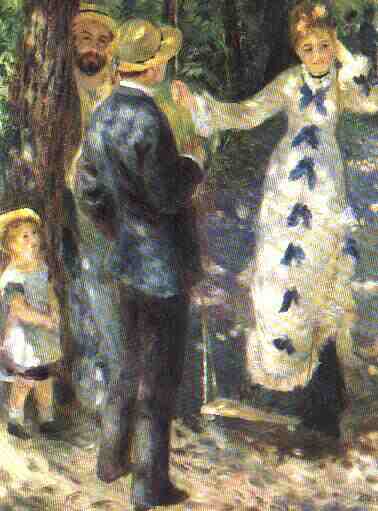 It’s on a balcony of an
apartment located on 198 rue de Rivoli that MONET painted his “Vue des
Tuileries” at the same time that RENOIR immortalized, without knowing it, the
“Moulin de la Galette”. It’s on a balcony of an
apartment located on 198 rue de Rivoli that MONET painted his “Vue des
Tuileries” at the same time that RENOIR immortalized, without knowing it, the
“Moulin de la Galette”.
Every article of this series is an invitation for a journey out of this time,
the opportunity to discover, by confronting the paintings and the descriptions
of different locations, the reality of past times.
Bistros are still plenty in tie rue de l’Isly in the 8th arr, where
MONET had an atelier at no.8 after the French-Prussian war of 1870. “Just next
to the gare Saint-Lazare” he wrote to his friend CAMILLE PISSARO in 1871 after
their return from London where they had fled.
A few houses further in the same street, the always-drudging Camille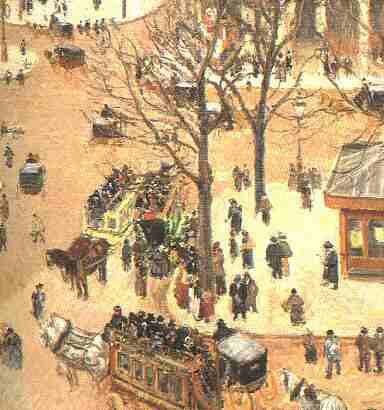 PISSARRO
rented in 1893 room 404 in hotel Garnier, with a view on the place du Havre at
the beginning of the rue d’Amsterdam. He painted the busy crossroad during
rain and obtained “Effets de pluie” you can see at the Chicago Art Institute
now. Five years later he painted the double deck buses tracked by horses on the
place du Theatre Francais from the window of the Grand Hotel du Louvre, right
across the Comedie Francaise. The bus stop is still there and in the hall there
is still a reproduction of the famous canvas that moved to Los Angeles. Kirk
Douglas stood, in honour of the LA Olympics in 1984 in the same window to tell
the story of the poor Camille Pissarro, because the exhibition
“L’impressionisme et le paysage Francais” was shown there for the first
time. PISSARRO
rented in 1893 room 404 in hotel Garnier, with a view on the place du Havre at
the beginning of the rue d’Amsterdam. He painted the busy crossroad during
rain and obtained “Effets de pluie” you can see at the Chicago Art Institute
now. Five years later he painted the double deck buses tracked by horses on the
place du Theatre Francais from the window of the Grand Hotel du Louvre, right
across the Comedie Francaise. The bus stop is still there and in the hall there
is still a reproduction of the famous canvas that moved to Los Angeles. Kirk
Douglas stood, in honour of the LA Olympics in 1984 in the same window to tell
the story of the poor Camille Pissarro, because the exhibition
“L’impressionisme et le paysage Francais” was shown there for the first
time.
 Camille PISSARRO didn’t sell much, even very little, during his lifetime. He
was so poor tat he even hadn’t money for the horse tram. He walked with his
paintings under his arm and looked all around town to find some work.
Camille PISSARRO didn’t sell much, even very little, during his lifetime. He
was so poor tat he even hadn’t money for the horse tram. He walked with his
paintings under his arm and looked all around town to find some work.
The gare Saint-Lazare was newly built and became the centre of the offices and
department stores in Paris. For painters the gare Saint-Lazare was the escape
point for outside town, a new portal of the city, representing at the same time
“a cathedral of the new humanity” like Theophile Gauthier formulated it.
It’s from this station that trains went to Saint-Germaine-en-Laye, Argenteuil,
Chatou or Bougival where the painters could still find unspoiled nature and put
them in their own impressions on canvas. The trains still run today, but only
for the daily workers and employees living out of town.
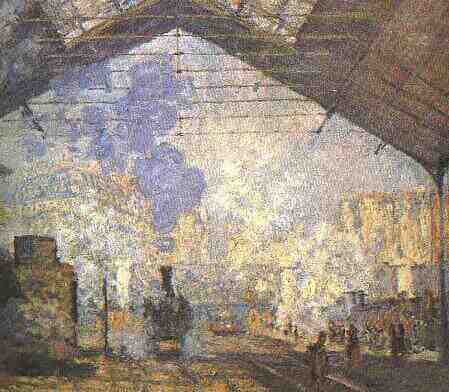
CLAUDE MONET painted in 1877 a series of 7 paintings in the gare Saint-Lazare,
after having official permission to put his easel on a platform. A few of them
are exposed in the Musee d’Orsay or in the musee Marmottan. In fact, compared
to today, it didn’t change much. The largest Paris suburb station is a station
as it should be. With a gigantic “salle des pas perdus” where millions of
lost footsteps still sound hollow in the quiet hours. A glass roof in a metallic
structure from Gustave Eiffel, gives the light.
Bibliography
The crisis of Impressionism
1878-1882, by Ann Harbor (university of Michigan)--Visions of City and Country:
prints and photographs of 19th century France (Worcester Art museum and
New-york, American federation of Arts), Camille Pissarro in Paris: a study of
his development by R.Coe (Gazette des Beaux-Arts 1954)
|
