 |
|
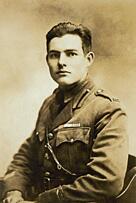
Young Hemingway |
If two foreign artists
have identified themselves totally with Paris it is undeniable that we must name
Ernest Hemingway and Gertrude Stein.
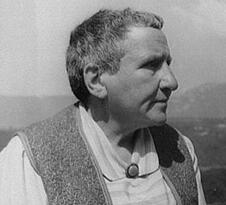
The American author and art pope Gertrude Stein (1874-1946) is such a figure
that colours a period and city. 1903 was the year she settled down in the rue de
Fleurus, a stone throw from the jardins du Luxembourg. All what Paris had of
important and famous artists elected her home as the centre of all meetings.
Picasso portrayed her (Metropolitan Museum, New York), Matisse, Juan Gris and a
lot more visited her more often than normal. I'm not sure you ever read her best
known book "The Autobiography of Alice B. Toklas" titled after the
name of her life companion, from whom it is said, she wrote the book and mean
tongues that they formed a "gossiping couple".
 |
|
Gertrude Stein |
When he first met her,
Ernest Hemingway was full of respectful admiration for the woman who lived in
Paris much longer than he did, and who decided what was politically and
artistically correct. In the chapter "Miss Stein instructs" of his
book "A Moveable Feast" he describes her as follow: (I quote)
""My wife and I had called on miss Stein, and she and the friend who
lived with her had been very cordial and friendly and we loved the big studio
with the great paintings. It was like one of the best rooms in the finest museum
except there as a big fireplace and it was warm and comfortable and they gave
you good things to eat and tea and naturally distilled liqueurs made from purple
plums, yellow plums or wild raspberries [......]
They seemed to like us too [......] When they came to our flat they seemed to
like us even more, but perhaps that was because the place was so small and we
were much closer together. Miss Stein sat on the bed that was on the floor and
asked to see the stories I had written and she said that she liked them except
one called "Up in Michigan".
"It's good", she said," that's not the question at all. But it is
inaccrochable. That means it is like a picture that a painter paints and then he
cannot hang it when he has a show and nobody will buy it because they cannot
hang it either". (unquote)
 Hemingway got
a little off balance and replied with a sharp tone: Hemingway got
a little off balance and replied with a sharp tone:
(quote): "But what if it is not dirty but it is only that you are trying to
use words that people can actually use? Those are the only words that can make
the story come true and that you must use them? You have to use them."
"But you don't get the point at all", she said, "you mustn't
write anything that is "inaccrochable". There is no point in it. It's
wrong and it's silly.(unquote)
Now, Hemingway, who was quite a touchy character, didn't like that at all and
the revenge came soon afterwards when he tells how "that fat oil-dumpling,
contemptuous vain person, Gertrude Stein, stumbled over her philosophy of
"the lost generation". To be honest, he didn't describe her like that,
but colleagues put them in his mouth, and he never denied. The expression
"lost generation" is said that she picked it up in a garage where she
tried to have her Ford fixed. The mechanic having failed, his boss snapped
angrily "You are a lost generation!".
She also named the future Nobel price winner like that, as well as all those in
Paris, who became very important to American literature.
As you probably guess, it never clicked anymore between Ernest and
Gertrude.
Bibliography
A moveable feast, by Ernest Heminway (Charles Scribner's Sons, New York), La vie
quotidienne à Montparnasse à la Grande Epoque, 1905-1930 (Hachette,
Paris).
|
Paris
main page
|
